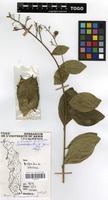
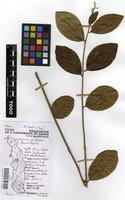
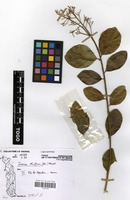
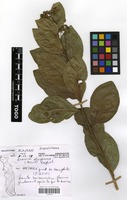
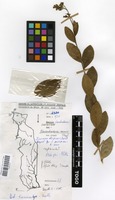
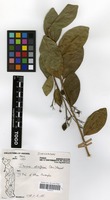
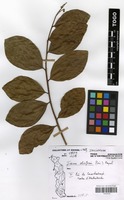
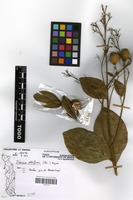
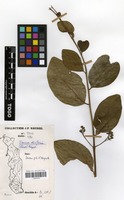
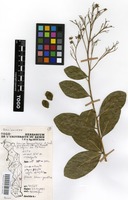
An erect woody herb or scandent shrub to 1 m tall of a number of stems arising from a large subterranean tuber with long roots; of roadsides and waste places in the savanna scrub; from Senegal to S Nigeria, and in the Central African Republic and Sudan.The plant is a weed of cultivation, and is common around villages and on old farmland, especially in yam-fields. It is vigorous and rapidly invades newly cleared and cultivated land (2, 9). Eradication is fraught with difficulty because of its large, or very large, tuber, which may reach 30–50 cm diameter (9) or 25 kg in weight (5), set 30 cm or so deep in the soil, and its long creeping roots (24). The Asante name, abubu ntσpe: breaks hoes, reflects this situation (7).The leaves are toxic to sheep and cause death. It is recorded that pasturalists bringing their sheep into the Casamance area (Tambacoumba), where the plant is common, used to muzzle them to prevent them grazing it (6, 16). The plant is one of the grand panaceas in the Casamance pharmacopoeia, the leaf, always prescribed alone, being used for numerous diverse treatments. Leafy twigs in decoction are used for internal haemorrhages and in baths and washes, for cough and all chest affections, and for feverish states. For the last-named, the patient should sleep the night on a bed of newly-cut leaves (18, 19, 21). A decoction of twigs and roots is given to adults in Senegal for general debility of an undiagnosed origin (20), and a leaf-decoction by draught for snake-bite (17). Tenda in SE Senegal apply heated leaves topically to points of pain, particularly in elephantiasis, as an analgesic (8). Leaf-sap is used in The Gambia for eye infections (10).The leaf is used in The Gambia as a container for carrying cashew nuts (10). Tenda use them to blacken pottery (8).The leaf enters into Tenda ritual in a burial ceremony: a head-pad is placed under the head of the dead person (8).The enormous tuber is fleshy and on the whole is poisonous. With suitable treatment it has in the past served as a famine-food (1, 4, 5, 9, 10, 12, 13, 21). It needs to be cut up and placed in running water for several days to remove bitterness and to facilitate maceration. When dried it is pounded and the fibres strained out, then boiled down to a paste. The product is mainly starch and is said to be palatable (7, 13–15). If consumed without detoxification colic and dysentery will result (10), and if eaten in quantity death will follow within a few days. As a common weed of many savanna areas, it could be exploited where crop-failure is likely (15). Selection for ameliorated strains should be considered.The root is put to various medicinal uses. In Casamance a decoction is given by draught for dermatitis, headache, chest-complaints, kidney-troubles, etc. It is considered tonic and is given for senescence, debility, internal pain, etc., and to children with rickets, as also for use against dental caries (17, 20, 21). A root-macerate is given by draught or in baths for general fatigue. Tenda administer the tip ends of roots as an abortifacient (8), while Asante in western Ghana take it for impotence (14).The poisonous principle of the tuber is a bitter; alkaloid is also present (3), and a gum-resin at 0 .9–2 .8% concentration (15).The fruit when ripe is red with a thin sweet gelatinous pulp which is edible (7–10, 15, 19, 22). In Senegal the fruit is eaten by chimpanzees (23).The kernel is eaten in time of dearth after pounding and drying to yield a flour (15, 17). Normally it is deemed poisonous and is soaked for a week with daily changes of water, dried in the sun for 2 days and then ground to flour. Tenda prepare the latter with millet or beans (enap) to produce a palatable food said to be ‘good enough for guests’ (8, 22).The flowers are sweet-scented and are visited by bees and flies (11). There is no report on the quality of bee honey from this source.