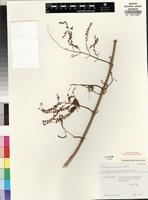
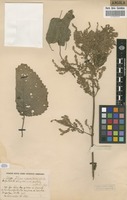
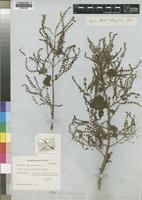
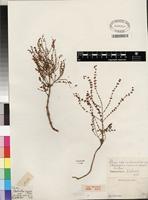
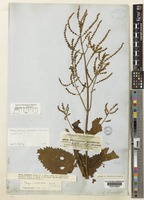
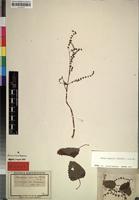
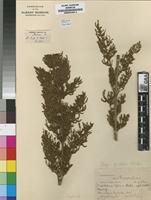
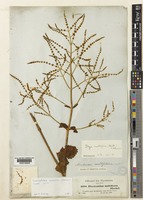
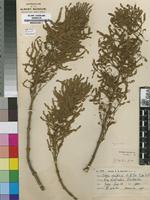
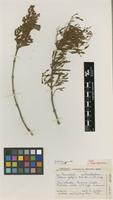
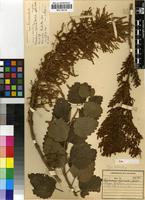
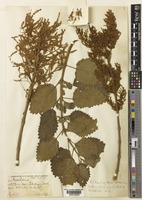
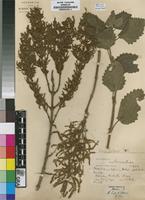
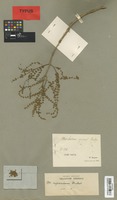
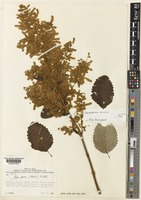
a stout herb 2 1/2–5 ft. high; stems obtusely 4-angled, branching above, puberulous, at least on the upper part; leaves with a pubescent petiole 1/2–3 1/2 in. long and blade 1 1/4–6 in. long, 1–5 in. broad, broadly ovate, notched (or some on the panicle entire and rounded) at the base, acute or subacute at the apex, coarsely and obtusely toothed, with the lower margin of the teeth denticulate, not rugose and the tertiary veins not at all prominent beneath, pubescent on both sides, with the hairs longer than the thickness of the veins on which they stand and not hiding the surface between them; panicle 6–15 in. long, 4–8 in. in diam.; male spikes 1–3 in. long, 1/4– 1/3 in. in diam., lax, with the flower-whorls 1/8– 1/4 in. apart; bracts about 1 lin. long, 1 1/4–1 1/3 lin. broad, very broadly triangular-ovate, subacute, concave, minutely pubescent, ciliate; pedicels 1/4 lin. long; calyx 1/2 lin. long, cup-like, 3-lobed to the middle, puberulous; dorsal lobe elliptic or suborbicular, obtuse; lateral lobes elliptic-oblong, acutely bifid at the apex; corolla unequally 5- (or occasionally 4-) lobed, minutely and thinly pubescent outside, white or pale-lilac; tube about 1 lin. long, 3/4 lin. in diam. at the oblique mouth, with a tuft of hairs near the base inside; lower lobe larger than the others, 3/4–1 lin. long, oblong, obtuse; stamens 4, about 3/4 lin. long, subequal, exserted; ovary 4-lobed, abortive; style shortly bifid at the apex; female spikes 1/2–1 in. long, 1/6 in. in diam., with flower-whorls somewhat crowded or 1/2–1 lin. apart; bracts 1/2– 2/3 lin. long, otherwise as in the male; pedicels as in the male; corolla very like that of the male but smaller, 2/3– 3/4 lin. long; stamens none; ovary perfecting seeds; styles much exserted; stigmas linear, spreading. null