

Compilation
Hypoxis stricta
1 Images see all
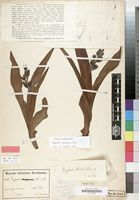
Name
Identification
Hypoxis stricta Nel [family HYPOXIDACEAE ] Verified by Not on sheet., Hypoxis galpinii Baker [family HYPOXIDACEAE ] (stored under name); Verified by Not on sheet.,
Related name
- Hypoxis galpinii
- Hypoxis stricta
Flora
Entry for Hypoxis galpinii Baker [family HYPOXIDACEAE]
Herbarium
Royal Botanic Gardens, Kew (K)
Collection
Flora Zambesiaca
Resource Type
Reference Sources
Entry From
FZ, Vol 12, Part 3, page 1, (2001) Author: I. Nordal & C. Zimudzi
Names
Hypoxis galpinii Baker [family HYPOXIDACEAE], in F.C. 6: 188 (1896) as \"galpini\". —Nel in Bot. Jahrb. Syst. 51: 320 (1914). —Zimudzi in Kirkia 16: 16 (1997). Type from South Africa (Transvaal).
Hypoxis stricta Nel [family HYPOXIDACEAE], in Bot. Jahrb. Syst. 51: 321 (1914). Type from South Africa (KwaZulu-Natal).
Hypoxis costata [family HYPOXIDACEAE], sensu Norlindh in Norlindh & Weimarck in Bot. Not. 1937: 164 (1937) quoad specim. 3088, 3564.
Hypoxis pungwensis Norlindh [family HYPOXIDACEAE], in Norlindh & Weimarck in Bot. Not. 1937: 164, fig. 1 (1937). Type: Zimbabwe, Nyanga, Pungwe R., 18.xii.1930, Fries, Norlindh & Weimarck 3819 (BM; BR; LD, holotype).
Information
Robust perennial herb to 50(60) cm tall. Rhizome stout, vertical 4–8 × 3.5–5 cm, ovoid-turbinate to cylindrical, equatorially ringed by stout contractile roots. Leaves 7–11, ternate, drying dark purple, erect, ± flat eventually conduplicate, with funnel-shaped basal sheaths which envelop the sheaths of successive inner leaves to form a pseudostem; outermost leaves reduced to sheaths with lamina ± absent, 4–9 × 1–3 cm; inner leaves 15–30 × 1–5 cm, lanceolate, increasing to 60(75) cm long, with the lamina prominently finely many-ribbed, glabrous on both surfaces with the margins and midrib beneath (and sometimes the main veins) ciliate to hispid-pubescent; the hairs 3–9(12)-armed (stellate) with 1 or 2 arms strongly developed ± acicular and up to c. 5 mm long; leaf sheaths and sometimes the base of the lamina ± sparsely strigose-hispid; pseudostem 5–15 × 1–2 cm, cylindrical to obconical-cylindrical. Inflorescences 2–6, usually appearing with the young leaves. Scapes 25–40 cm long, ± flattened in cross-section and 1.5–3 mm wide, strigose-villose in the upper part, glabrous in the lower part except for the hispid margins; the hairs unequally 3–9-armed (stellate) as in the leaf indumentum, or sometimes 2-armed, appressed to ± spreading. Flowers 4–10, in a spiciform arrangement 4–10 cm long, subsessile, sometimes shortly pedicellate; bracts 10–30 × 1–3 mm, linear-lanceolate to narrowly triangular, pubescent on the abaxial midrib; pedicels ascending, 0–6(10) mm long, the upper flowers usually sessile. Outer tepals 14–16 × 5–6 mm, lanceolate, coriaceous, strigose-sericeous abaxially, with margins ± involute; inner tepals 14–16 × 8–10 mm, membranous, broadly elliptic, glabrous or strigose on the midrib; the indumentum hairs stellate with one arm strongly developed. Filaments 2–3 mm long; thecae c. 6 mm long. Style c. 2 mm long; stigma 1.5–2.5 mm long. Capsule 6–9 mm long and 4.5–5.5 mm in diameter, cylindric-turbinate. Seeds black and glossy, 1.2–1.4 × 1.6–2 mm, ovoid; testa smooth or covered in closely-spaced papillae, the papillae minute varying from incipient dome-shaped undulations to sharply conical points, the cuticle smooth.
Habitat
Montane grasslands
Altitude range
1500–1700 m.
1700
1500
Distribution
Zimbabwe E Mutasa Distr., Stapleford Estates, close to Main Offices, fl. & fr. 19.i.1989, Zimudzi 92 (SRGH); Nyanga Distr., Pungwe R., 18.xii.1930, Fries, Norlindh & Weimarck 3819 (BM; LD); above the Pungwe Falls, c. 1850 m, fl. 16.xii.1930, Fries, Norlindh & Weimarck 3730 (LD).
Distribution (external)
South Africa (Transvaal, KwaZulu-Natal)