

Compilation
Hypoxis orbiculata
1 Images see all
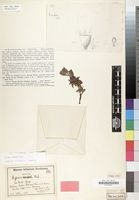
Name
Identification
Hypoxis orbiculata Nel [family HYPOXIDACEAE ] Verified by Not on sheet., Hypoxis villosa L. [family HYPOXIDACEAE ] (stored under name); Verified by Not on sheet.,
Related name
- Hypoxis orbiculata
- Hypoxis villosa
Flora
Entry for Hypoxis polystachya Welw. ex Baker [family HYPOXIDACEAE]
Herbarium
Royal Botanic Gardens, Kew (K)
Collection
Flora Zambesiaca
Resource Type
Reference Sources
Entry From
FZ, Vol 12, Part 3, page 1, (2001) Author: I. Nordal & C. Zimudzi
Names
Hypoxis orbiculata Nel [family HYPOXIDACEAE], in Bot. Jahrb. Syst. 51: 313 (1914). Syntypes: Zambia, Ndola Distr., between Kabwe (Broken Hill) Zinc Mine and Bwana Mkubwa (Bwana M’cuba) Copper Mine, x.1906, C.E.F. Allen 380 (K); and Dem. Rep. Congo.
Hypoxis multiflora Nel [family HYPOXIDACEAE], in Bot. Jahrb. Syst. 51: 317 (1914). Type from Uganda.
Hypoxis pedicellata Nel [family HYPOXIDACEAE], in Bot. Jahrb. Syst. 51: 315 (1914). Syntypes: Zambia, Mbala Distr., Sisya (Msisi) Forest, Fries 1261, 1261a (UPS); and Dem. Rep. Congo.
Hypoxis katangensis Nel [family HYPOXIDACEAE], in Bot. Jahrb. Syst. 51: 312 (1914). Syntypes from Zambia, between L. Bangweulu and Tanzania, near Kalungu R., Oct. 1911, Fries 1148 (UPS); and Dem. Rep. Congo.
Hypoxis obtusa [family HYPOXIDACEAE], auct. non Burch. ex Ker Gawl. (1816).
Hypoxis villosa complex [family HYPOXIDACEAE], sensu Zimudzi in Kirkia 16: 17 (1997) pro parte.
Hypoxis polystachya Welw. ex Baker [family HYPOXIDACEAE], in Trans. Linn. Soc. London, Bot. 1: 266 (1878). —Rendle in Hiern, Cat. Afr. Pl. Welw. 2: 31 (1899). Type from Angola.
Information
Robust perennial herb to 75 cm tall. Rhizome vertical, 3–5 × 4–6 cm, subglobose or hemispheric with a flat base, or up to c. 8 cm long and ± cylindrical, with numerous stout contractile roots about the middle. Leaves (3)5–9(12), ± rigidly erect, becoming lax, usually conduplicate with narrowly funnel-shaped sheaths broadly membranous-hyaline on the margins; lamina increasing to c. 75 cm long, 0.5–2 cm wide (width measured when folded blades are spread apart and flattened), linear, gradually tapering to a narrowly acute apex, strongly many-ribbed with ribs ± spaced, thinly loosely pilose to densely spreading pilose-pubescent, more sparsely so on the adaxial (inner) surface, the hairs finely 2–8-armed (stellate), sometimes appressed silvery-strigose on young growth; outermost leaves reduced to membranous sheaths with or without small blades, the entire outer surface ± densely sericeous-lanate to glabrescent; pseudostem 4–20 cm long and up to 12 mm in diameter. Inflorescences 1–5(8), usually appearing with the leaves. Scapes up to c. 37(45) cm long, overtopped by the mature leaves, strongly flattened in cross-section, 2–5 mm wide, width reducing in steps as pedicels diverge, whitish sericeous to spreading pubescent particularly towards the apex and on the margins towards the base; bracts 7–40 mm long, subulate to linear-lanceolate; pedicels erect-ascending, the lower ones 5–25 mm long, the upper decreasing in length. Flowers 3–14(25) in a raceme-like ± cylindrical arrangement 3–13 cm long. Outer tepals 10–18 × 4–5 mm, lanceolate with ± involute margins, silvery strigose-sericeous abaxially, often drying greenish; inner tepals 10–12 × 5–8 mm, broadly elliptic, glabrous except for the abaxial midrib, the hairs unequally 3–6-armed (stellate) usually with one arm strongly developed. Filaments 1.3–1.6 mm long; thecae 3–4.5(5.7) mm long. Style 0.5–1(2.3) mm long; stigma 1–2(3.5) mm long. Capsule 4–8 × 3–6 mm, turbinate, 16- to 20-seeded. Seeds black and glossy, 1.2–1.7 mm in diameter, globose; testa papillose, the papilla minute varying from incipient dome-shaped undulations to sharply conical points, the cuticle smooth and shiny.
Habitat
Montane grassland, plateau and dambo grassland, and in high rainfall miombo and deciduous woodland, often in sandy soils and on Kalahari Sand, usually after annual fires
Altitude range
900–2150 m.
2150
900
Distribution
Zambia B road to Kaoma (Mankoya), fl. & fr. 1.x.1957, West 3488 (K; SRGH).Malawi N Mzimba Distr., Viphya, fl. & fr. 20.x.1952, Jackson 986 (K).Mozambique T Angónia Distr., arredores de Dómuè, proximo da aldeia N’tchide, fl. & fr. 20.xi.1980, Macuácua 1271 (K; LISC).Zambia N Mbala Distr., Ndundu, c. 1740 m, fl. 22.x.1966, Richards 21544 (K).Zambia W Kitwe, fl. & fr. 13.xii.1955, Fanshawe 2650 (BR; K; NDO).Zambia E Nyika Plateau, c. 9 km southwest of Government Rest House, c. 2150 m, fl. & fr. 25.x.1958, Robson & Angus 341 (K; LISC).Malawi C Dedza Distr., Chongoni Forest Reserve, fl. & fr. 23.xi.1967, Salubeni 587 (K; MAL; SRGH).Malawi S Blantyre Distr., top of Nyambadwe Hill, fl. 16.xi.1969, Moriarty 205 (K).
Distribution (external)
Kenya
Tanzania
Notes
The specimen Fries 1725, referred to H. canaliculata Baker in Fries, Wiss. Ergebn. Schwed. Rhod.-Kongo-Exped.: 233 (1914) and by Nel in Bot. Jahrb. Syst. 51: 324 (1914), is too young to be determined with certainty. In the absence of mature leaves and inflorescences, the characters such as the white sericeous indumentum, and pseudostem formed from sheathing leaf-bases, and the collecting locality “Abercorn”, place it for the time being near H. polystachya. H. canaliculata is an Angolan taxon (known only from the type, Welwitsch 4057) the like of which has not been seen in the FZ area. The white sericeous indumentum, consisting of (1)2-armed or sometimes 3–6-armed (stellate) hairs, of Fries 1725, is similar to that in H. polystachya and H. canaliculata. H. polystachya and H. canaliculata are however, readily distinguished from each other on leaf characters and habit – H. canaliculatahas very distinctively rolled, almost tubular, leaves up to 20 cm long, and c. 1 mm wide even when mature, and scape up to c. 10 cm long. As yet no specimens have been collected from the Mbala area that match H. canaliculata.