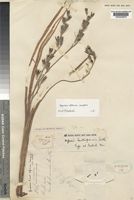
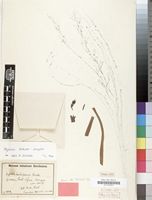
Hypoxis laikipiensisRendle [family HYPOXIDACEAE ] Verified by Not on sheet., Hypoxis obtusa-complexHolt & Staubo ? [family HYPOXIDACEAE ] (stored under name); Verified by Not on sheet.,
Related name
Hypoxis laikipiensis
Hypoxis villosa
Hypoxis obtusa-complex
Hypoxis obtusa
Flora
Entry for HYPOXIS laikipiensis Rendle [family HYPOXIDACEAE]
Herbarium
Royal Botanic Gardens, Kew (K)
Collection
Flora of Tropical Africa
Resource Type
Reference Sources
Entry From
Flora of Tropical Africa, Vol 7, page 376, (1898) Author: (By J. G. Baker.)
Names
HYPOXIS laikipiensisRendle [family HYPOXIDACEAE], in Journ. Linn. Soc. xxx. 407.
Information
Tuber perennial. Leaves about 6 to a tuber, linear, acuminate, reaching a length of above 2 ft., scarcely 1/2 in. broad; upper surface sparsely, lower and edges densely hairy. Peduncles 5 to a tuber, flattened, reaching 1 1/2 ft. long. Raceme lax, 10-flowered, about 5 in. long; bracts linear-subulate, hairy, lower as long as the flowers; pedicels 1/2– 3/4 in. long. Perianth-segments yellow, 6–7 lin. long; outer hairy outside. Stamens half as long as the perianth; anthers more than twice as long as the filaments. Ovary turbinate, densely hairy, 1/6– 1/4 in. long.
Distribution
German East Africa Mozamb. Dist. Karagwe, 4000–5000 ft., Scott-Elliot, 8206!British East Africa Nile Land Lykipia; on steppes cut up by deep ravines, West of Alngaria, Gregory!