JSTOR Global Plants Home
  • Home
  • Browse
  • About
  • Access
  • Account
    • Saved Items
    • Profile
  • Log in

Global Plants

Skip to Main Content
  • JSTOR Global Plants Home
  • Global Plants

    • Browse
    • About
    • Access
    • Account
      • Saved Items
      • Profile
Log in
  • Browse
  • About
  • Access
  • Account
    • Saved Items
    • Profile
Advanced Search

Compilation
Hypolytrum congense

6 Images see all

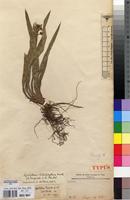
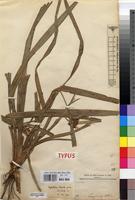
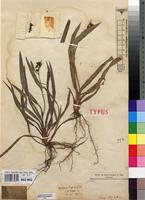
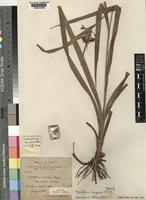
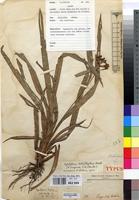
Syntype of Hypolytrum congense C.B.Clarke [family CYPERACEAE]
Hypolytrum heterophyllum Boeck. [family CYPERACEAE]
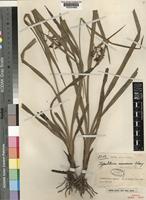
Syntype of Hypolytrum congense C.B.Clarke [family CYPERACEAE]
Hypolytrum heterophyllum Boeck. [family CYPERACEAE]
Previous
Next

Name

Identification
Hypolytrum congense C.B.Clarke [family CYPERACEAE ] Verified by Not on sheet, Hypolytrum heterophyllum Boeck. [family CYPERACEAE ] (stored under name); Verified by Nelmes E., 1953
Related name
  • Hypolytrum heterophyllum
  • Hypolytrum nemorum
  • Hypolytrum congense

Flora

Entry for HYPOLYTRUM congense C. B. Clarke [family CYPERACEAE]
Herbarium
Royal Botanic Gardens, Kew (K)
Collection
Flora of Tropical Africa
Resource Type
Reference Sources
Entry From
Flora of Tropical Africa, Vol 8, page 264, (1902) Author: (By C. B. Clarke.)
Names
HYPOLYTRUM congense C. B. Clarke [family CYPERACEAE]
Information
Stolons densely covered by ovate scales. Stems 4–10 in. long, carrying 2 leaves far above the base, smooth, in Dewevre 746 glabrous, in Dewevre 1061 bis hairy. Basal leaves overtopping the stem, 1/2 in. broad, the tip narrow-triangular; stem-leaves similar but smaller, overtopping the inflorescence, not caudate and scarcely acuminate at the tip. Corymb 1/8– 1/5 in. in diam., with 15–25 spikes; rhachis hairy or scabrid; bracts 2 by 2/5 in., narrowly lanceolate, not caudate. Spikes in flower 1/8 in. long, ellipsoid, brown.
Distribution
Congo South Central Dewevre, 746! 1061 bis!

Related Materials

  • Terms and Conditions
  • Privacy Policy
  • Cookie Policy
  • Cookie Settings
  • Accessibility
  • Help
  • Contact Us
  • Facebook
  • Twitter
ITHAKA

JSTOR is part of ITHAKA, a not-for-profit organization helping the academic community use digital technologies to preserve the scholarly record and to advance research and teaching in sustainable ways.

©2000-2026 ITHAKA. All Rights Reserved. JSTOR®, the JSTOR logo, JPASS®, Aluka®, and ITHAKA® are registered trademarks of ITHAKA.

╳