

Compilation
Hypericum lanuriense
1 Images see all
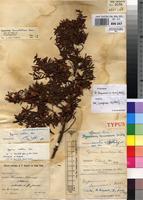
Name
Identification
Hypericum lanuriense De Wild. [family CLUSIACEAE ] Verified by Not on sheet, Hypericum revolutum Vahl [family CLUSIACEAE ] (stored under name); Verified by Bamps P., 1969
Related name
- Hypericum revolutum
- Hypericum lanuriense
Flora
Entry for HYPERICUM lanceolatum Lam. [family GUTTIFERAE]
Herbarium
Royal Botanic Gardens, Kew (K)
Collection
Flora of Tropical East Africa
Resource Type
Reference Sources
Entry From
Flora of Tropical East Africa, page 1, (1953) Author: E. MILNE-REDHEAD
Names
HYPERICUM lanceolatum Lam. [family GUTTIFERAE], Encycl. 4: 145 (1797); F.T.A. 1: 156 (1868); P.O.A. C: 274 (1895): V.E. 3 (2): 497, t.229 (1921); F.W.T.A. 1: 230 (1927); B.J.B.B. 13: 74 (1934); T.S.K. 36 (1936); Gard. E. Afr., ed. 2, 207, t. 3/4 (1939); F.P.N.A. 1: 620 (1948); Fl. Madag. 135: 3 (1951). Type: Réunion [Bourbon], Commerson (LINN-SM, iso.!)
HYPERICUM leucoptychodes Steud. ex A. Rich. [family GUTTIFERAE], Tent. Fl. Abyss. 1: 96 (1847); Good in J.B. 65: 330, t. 582/3–5 (1927); Bredell in Bothalia 3: 580 (1939); Fl. Pl. S. Afr. 20: t. 787 (1940); T.T.C.L. 249 (1949); I.T.U., ed. 2, 157, t .33 (1952).
HYPERICUM lanuriense De Wild. [family GUTTIFERAE], Pl. Bequaert. 5: 403 (1932); Robyns, F.P.N.A. 1: 622 (1948). Type: Belgian Congo, Ruwenzori, Ruanoli Lanuri Valley, Bequaert 4460 (BR, holo.!)
Information
Much branched evergreen glabrous shrub or tree, 1–12 m. high, with scaly bark. Young stems 4-angled, but soon becoming woody and terete. Leaves lanceolate or oblong-lanceolate, ranging from 11 x 2.5 mm. to 37 x 10 mm, acute, narrowed to a clasping base, furnished with pinnate venation and longitudinal interrupted linear, often translucent, glands and inconspicuous translucent (rarely opaque black) marginal glandular dots. Flowers solitary at the ends of the branches. Bracts (if any) leaflike, with black opaque marginal dots. Sepals unequal, ovate, rather concave, obtuse, with black opaque marginal dots. Petals (1.5) 2.5–3.0 cm. long, yellow, without black marginal dots. Stamens in 5 bundles of about 30 each. Styles 5, united in the lower part. Capsule 5-valved.
Range
DISTR. U1–3; K3, 4; T2, 3, 6, 7 mountains of eastern Africa from Ethiopia to Cape Province, the Cameroons and Fernando Po; also in Madagascar, the Comoro Islands and Réunion.
Altitude range
1800–3360 m., descending to 900 m. on the Uluguru Mts.
Distribution
KENYA Trans-Nzoia District Elgon, Nov. 1950 (fl.), Tweedie 876!;KENYA Nakuru District between Thomson’s Falls and Nakuru, 15 Feb. 1934 (fl.), Edwards 2843/16!;KENYA Nyeri District NW. Mt. Kenya, Battiscombe 731!TANGANYIKA Moshi District Kilimanjaro, S. slope between Umbwe and Weru Weru Rivers, 1 Sept. 1932 (fl.), Greenway 3215!;TANGANYIKA Morogoro District Uluguru Mts., Lupanga Peak, 26 Dec. 1931 (fl. and fr.), B. D. Burtt 3468!;TANGANYIKA Mbeya District Poroto Mts., slopes of Wentzel Heckmann Crater, 14 Sept. 1936 (fl.), B. D. Burtt 6224!UGANDA Kigezi District Muhavura—Mgahinga saddle, Sept. 1946 (fl.), Purseglove 2159!UGANDA Ruwenzori, Karangora, 27 Jan. 1935 (fl.), G. Taylor 3254!;UGANDA Mbale District Elgon, Benet, 1936, Eggeling 2460!
Notes
As is to be expected in a widely spread species, H. lanceolatum shows considerable variation and I find myself unable to recognize H. lanuriense De Wild. as a species distinct from it. Whilst the leaves of H. lanceolatum usually are without opaque black marginal dots, these occur occasionally on plants which in all other respects are characteristic of H. lanceolatum, for instance, on Gillett 5142 from Ethiopia, Galla Pass (9° 28′ N., 42° 19′ E.), and H. B. Johnston 1491 from the A.-E. Sudan, Imatong Mts., both from areas where normal H. lanceolatum also occurs. The character, leaves subobtuse, used by Robyns (l.c.) in separating H. lanuriense from H. lanceolatum is scarcely supported by the type specimen. Whilst it is admittedly relatively scarce on Ruwenzori, typical H. lanceolatum does occur on that massif, as can be seen from the specimen here cited and from material recently collected by H. A. Osmaston.