JSTOR Global Plants Home
  • Home
  • Browse
  • About
  • Access
  • Account
    • Saved Items
    • Profile
  • Log in

Global Plants

Skip to Main Content
  • JSTOR Global Plants Home
  • Global Plants

    • Browse
    • About
    • Access
    • Account
      • Saved Items
      • Profile
Log in
  • Browse
  • About
  • Access
  • Account
    • Saved Items
    • Profile
Advanced Search

Compilation
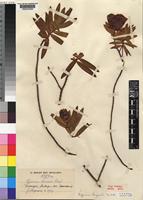
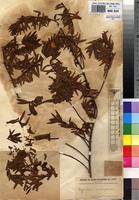
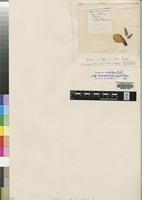
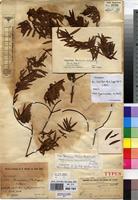
Hypericum keniense

6 Images see all

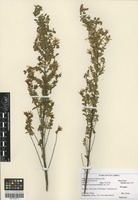
Hypericum bequaerti De Wild. [family GUTTIFERAE]
Type of Hypericum keniense Schweinf. [family GUTTIFERAE]
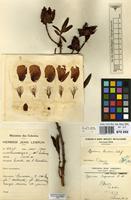
Type of Hypericum ruwenzoriense De Wild. [family CLUSIACEAE]
Filed as Hypericum keniense Schweinf. [family CLUSIACEAE]
Filed as Hypericum bequaertii De Wild. [family CLUSIACEAE]
Previous
Next

Name

Identification
Hypericum keniense Schweinf. [family GUTTIFERAE ] Hypericum revolutum (Schweinf.) N.Robson [family GUTTIFERAE ] (stored under name); Verified by Robson,N.K.B., 1980
Related name
  • Hypericum bequaerti
  • Hypericum revolutum
  • Hypericum ruwenzoriense
  • Hypericum keniense
  • Hypericum bequaertii

Flora

Entry for HYPERICUM keniense Schweinf. [family GUTTIFERAE]
Herbarium
Royal Botanic Gardens, Kew (K)
Collection
Flora of Tropical East Africa
Resource Type
Reference Sources
Entry From
Flora of Tropical East Africa, page 1, (1953) Author: E. MILNE-REDHEAD
Names
HYPERICUM keniense Schweinf. [family GUTTIFERAE], in von Hoehnel, Zum Rudolf-See u. Stephanie-See 868 (1892); P.O.A. C; 274 (1895), pro parte, quoad sp. ex Kenia; V.E. 3 (2): 499 (1921), pro parte, quoad sp. ex Kenia; K.B. 1953: 434 (1953). Type: Mt. Kenya, western slope at 1950 m., von Hoehnel (B, holo. †; BM, fragment!)
HYPERICUM ruwenzoriense De Wild. [family GUTTIFERAE], in Rev. Zool. Bot. Afr. 8, Suppl. Bot. 5 (1920): Staner in B.J.B.B. 13: 71 (1934); F.P.N.A. 1: 623 (1948); T.T.C.L. 250 (1949); I.T.U., ed. 2, 159 (1952). Type: Belgian Congo, Ruwenzori, Butahu Butagu Valley, Bequaert 3705 (BR, holo.!)
Information
Much branched shrub or small tree (0.3) 1–10 m. high. Young stems 4-angled but soon becoming woody and terete. Leaves lanceolate or oblong-lanceolate, ranging from 15 x 5 mm. and 11 x 2.5 mm. to 37 x 8.5 mm., and 60 x 7.5 mm., acute, narrowed to a rather broad clasping base, furnished with 3 or 5 veins running from the base to near the apex, sometimes with one or two indistinct veins connecting them obliquely with the midrib in the apical half, with numerous longitudinal linear not translucent glands. Flowers solitary at the ends of the branches. Sepals ± unequal, ovate, subacute, without black dots. Petals spreading in anthesis (2.4) 2.8–3.3 (3.8) cm. long, 1.4–1.7 (2.2) cm. wide, bright yellow or orange-yellow, without black marginal dots. Stamens in 5 bundles of about 40 each. Styles 5, united in the lower part. Capsule 5-valved.
Range
DISTR. U2, 3; K3, 4; T2 also in the Belgian Congo on Ruwenzori and Mt. Kahusi; not known on the Virunga Mts.
Altitude range
2400–3550 m., reaching 4000 m. (fide Grote) on Kilimanjaro. The altitude, 1950 m., quoted for the type gathering seems unusually low, and needs confirmation.
Distribution
KENYA Elgon, Mar. 1935, Thorold 2747!KENYA Aberdare Mts., Kinangop, 17 July 1948, Hedberg 1629!KENYA Mt. Kenya, Caesar’s Seat, 18 June 1933, C. G. Rogers 675!TANGANYIKA Mbulu District Mt. Hanang, main peak, 8 Feb. 1946, Greenway 7658! and Mt. Loolmalasin, 17 Sept. 1932, B. D. Burtt 4211!;TANGANYIKA Moshi District Kilimanjaro, N. slope above Rongai, 18 Feb. 1933, C. G. Rogers 426!UGANDA Ruwenzori, Kigo, Aug. 1931, Fishlock & Hancock 50! and Bujuku Valley, Aug. 1933, Eggeling 1343! and April 1948 (fl.), Hedberg 624!
Notes
Some specimens of H. keniense (e.g. Uganda, Mbale District, N. Bugishu, Butandiga, A. S. Thomas 488! and Tanganyika, Kilimanjaro, Mashame, Haarer 962! & Moreau 39!) approach H. lanceolatum in appearance and in leaf-venation, and may possibly be of hybrid origin.

Related Materials

  • Terms and Conditions
  • Privacy Policy
  • Cookie Policy
  • Cookie Settings
  • Accessibility
  • Help
  • Contact Us
  • Facebook
  • Twitter
ITHAKA

JSTOR is part of ITHAKA, a not-for-profit organization helping the academic community use digital technologies to preserve the scholarly record and to advance research and teaching in sustainable ways.

©2000-2026 ITHAKA. All Rights Reserved. JSTOR®, the JSTOR logo, JPASS®, Aluka®, and ITHAKA® are registered trademarks of ITHAKA.

╳