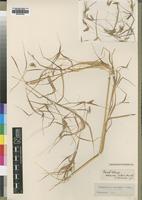
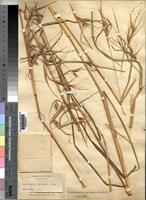
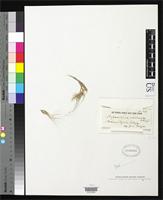
Annual, 8–10 ft. high. Culms robust, up to 2 lin. in diam., simple and about 4-noded below the panicle, terete, glabrous. Leaf-sheaths terete, tight, at length slipping off the culms altogether (lowest), or upwards only and inrolled from the margins, smooth, glabrous; ligules scarious, short, truncate, ciliolate, blades linear from an equally broad or gradually narrowed base, tapering to a long point, up to over 1 ft. by 3 lin., pale green, flaccid, more or less rough on both sides and scabrid along the margins, slender or somewhat stout downwards, whitish below; primary lateral nerves 3–4 on each side, slightly raised. Spatheate panicle narrow, very lax, up to 2 ft. (or more?) long, of over 4 distant mixed or upwards simple tiers; lower tiers few- to 6-rayed with the compound rays up to over 6 in. long and 2–3-noded; simple rays very slender, filiform, 1 to over 2 in. long, frequently strongly arched or recurved; lower spathes resembling the preceding leaves with long blades. Spatheoles narrowly lanceolate, long and finely acuminate, 2 1/2–3 1/2 in. long, up to 1 1/2 lin. wide, scarious, pale tinged with purple, finally inrolled from the margins but never tightly; peduncles filiform, up to 1 in. long, flexuous or recurved and exserted from the spatheole, glabrous. Racemes nodding, subcontiguous or slightly spreading, up to 1 in. long, contracted, greenish, 2–3-awned per pair; raceme-bases rather stout, up to 1 lin. long, dorsally compressed, densely pubescent in the fork, exappendiculate; joints if any, slender, filiform, with obliquely truncate tips shortly silky-ciliate, 1 lin. long; pedicels similar, up to 2 lin. long. Homogamous pairs of spikelets 1 at the base of the upper, 2 at that of the lower raceme, the latter forming a persistent imperfect involucre. Fertile spikelets oblong, 4 lin. long including the callus, pale green, tomentose; callus slender, acute, 1 lin. long, finely grooved on the back, shortly silvery bearded. Glumes equal, firmly chartaceous, minutely truncate; lower rounded on the back, shortly villous almost all over, faintly 9-nerved, very finely grooved along the middle nerve at the base; upper glume 3-nerved, ciliolate on the rounded keel, and reversedly so on the margins. Lower floret reduced to a linear-oblong obtuse ciliate 2-nerved hyaline valve. Upper floret hermaphrodite: valve stipitiform, minutely 2-toothed; awn 2 1/2 to over 3 in. long, column brown, subplumose, hairs white, 1/2– 3/4 lin. long, bristle pale; valvule 0. Anthers 1 1/2 lin. long. Pedicelled spikelets ♂ or neuter, linear-lanceolate to almost linear, 4–5 lin. long, acute, glabrous or minutely pubescent, pale green; lower glume thinly chartaceous, usually aristulate with a bristle (from 1–6 lin. long) arising from between 2 minute teeth, or muticous, intracarinal nerves about 5, faint, keels rigidly and minutely ciliolate or scaberulous; upper glume sublinear, acute, 3- to sub-5-nerved, reversedly ciliate; lower valve if present narrowly linear, hyaline, faintly 3-nerved, ciliate, up to 3 1/2 lin. long, or more or less reduced; upper suppressed; anthers up to 2 lin. long.