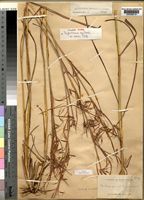
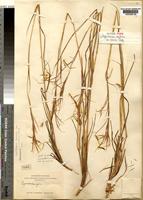
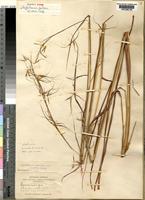
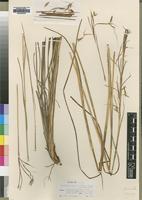
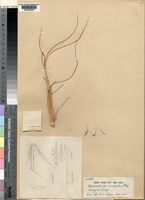
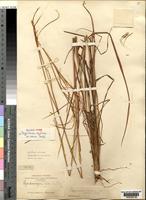
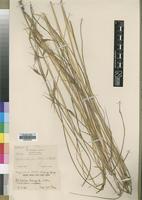
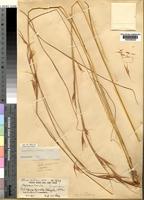
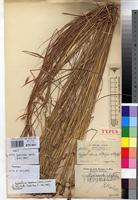
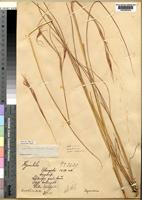
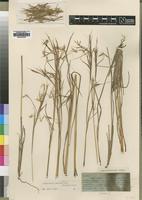
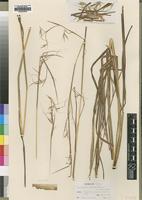
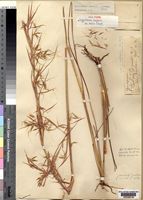
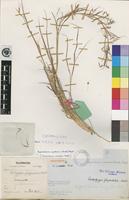
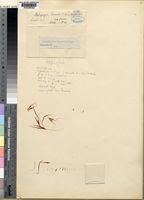
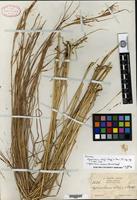
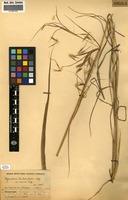
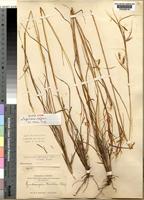
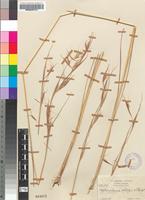
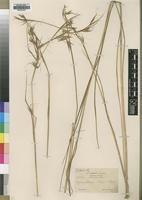
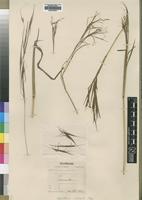
Perennial, densely cæspitose, up to over 3 ft. high with numerous mostly intravaginal innovations, cataphylls of extravaginal innovation-buds glabrous. Culms erect, terete or slightly compressed below, rather slender, simple and about 3–4-noded below the panicle. Leaf-sheaths terete or the lowest and those of the innovations compressed and keeled, very firm, glabrous or hairy, those of the culms produced at the mouth into short triangular auricles; ligules from very short to 1 lin. long, scarious, truncate, adnate to the auricles of the sheath; blades linear from a slightly and often long-attenuated base, long-tapering to a fine point, very firm and rigid or slightly flexuous, up to 1 ft. by 1–1 1/2 lin., flat, pale green or turning reddish, softly hirsute to almost villous on both sides, scabrid along the margins, midrib slender and prominent below, wider and whitish towards the base above, lateral nerves numerous, very slender and close on the upper side, obscure on the lower. Spatheate panicle slender, loose, interrupted, up to 1 1/2 ft. long, of 5–6 distant tiers, 2–4-rayed, mixed downwards or the lowest branch undivided, lowest compound rays up to over 1/2 ft. long, few-noded; simple rays 1–2 in. long, those of each tier subequal; lower subtending leaves like the preceding ones, upper with much reduced blades, spatheoloid. Spatheoles narrowly lanceolate, long and finely acuminate, about 2 in. by 1–1 1/4 lin., scarious, pale purplish or reddish, glabrous or hairy at the base, at length inrolled from the margins and quite narrow; peduncles arched or strongly recurved upwards and subterminally exserted, at length more or less equalling the spatheole, with fine spreading yellowish hairs (up to 3 lin. long) from the curvature, hairs minutely or obscurely tubercle-based. Racemes slightly spreading, at length epinastically reflexed, about 3/4 in. long, usually purplish, 2-awned per pair; bases unequal, the longer up to 2 lin. long, both densely bearded with stiff yellowish tubercle-based hairs up to over 4 lin. long, each with a linear entire or 2-dentate dark purple scarious appendage; pedicels very slender filiform, up to 2 lin. long, shortly ciliate. Homogamous pair of spikelets 1 at the base of the lower raceme only. Fertile spikelets narrowly linear, subacuminate, excluding the callus 4 lin. long, pale, glabrous or pubescent near the tips; callus slender, acute, up to 1 1/2 lin. long, shortly bearded along the sides. Glumes subequal, subcoriaceous, lower 2-mucronate, 9-nerved, middle nerve prominent between 2 fine grooves, margins broadly involute, inflexed in the acumen, keels fine, scabrid; upper glume obliquely truncate, acute, 3-nerved, sparingly ciliolate upwards. Lower floret reduced to an oblong sub-3-nerved ciliate hyaline valve. Upper floret hermaphrodite: valves stipitiform, 2-dentate, with distinct narrow hyaline margins, teeth linear, subulate, 1 1/2 lin. long, ciliolate; awn somewhat stout, 1 3/4–2 in. long, column fulvously villous, bent at or above the middle, somewhat longer than the bristle; valvule 0. Pedicelled spikelets ♂ or sometimes neuter, linear-lanceolate, long and acutely acuminate, up to 5 lin. long, dark purple or violet, glabrous; lower glume chartaceous, mucronate to shortly aristulate, 9–11-nerved, keels rigidly ciliolate upwards; upper glume slightly shorter, sublinear, very acute, 3-nerved; valves hyaline, ciliate, lower oblong, 3-nerved, up to 4 lin. long, upper very narrow, 1-nerved, or both valves more or less reduced; anthers 2 lin. long. Spikelets of the homogamous pairs like the pedicelled, but muticous.