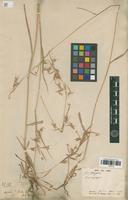
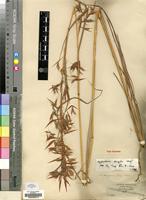
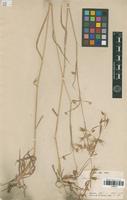
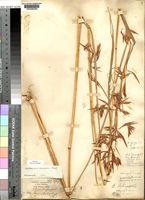
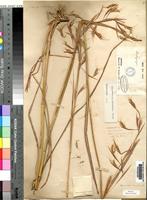
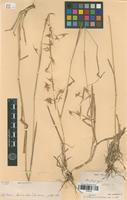
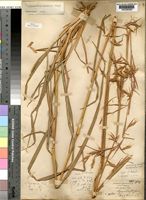
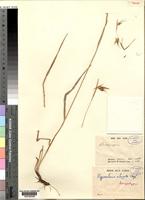
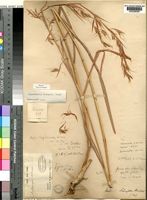
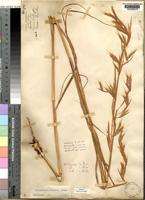
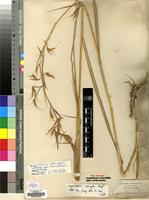
Perennial, 2–4 ft. high. Culms rising from a short oblique rhizome, often closely fascicled or accompanied by intravaginal innovations whose inner sheaths are covered with white hairs at the very base, terete, usually stout, glabrous, smooth, erect or geniculately ascending, usually stiff, simple for 3–5 internodes below the panicle. Leaf-sheaths terete, glabrous, pruinose below the nodes, rarely subhirsute upwards, smooth, firm, the lowest longer than the internodes, often slipping off the culm and then gradually breaking up, those of the innovations compressed and keeled upwards; ligules scarious, firm, rounded, 1–2 lin. long; blades linear from a more or less narrowed or almost equally wide base, which may be narrower than the sheath or pass quite gradually into it, long-tapering upwards to a fine point, up to over 1 ft. by up to 3 (rarely 4) lin., firm, rigid, pale or glaucous-green, glabrous or very sparingly hairy on the back or with some long stiff hairs above the ligule, smooth below, rough on the face upwards, margins scabrid, at least upwards, midrib comparatively slender, broader and whitish above, primary lateral nerves 3–5 on each side, slender. Spatheate panicle narrow, very lax, up to over 1 ft. long; primary axis rather stiff, its 6–8 internodes gradually decreasing upwards (the lowest up to over 1/2 ft. long); tiers few-rayed, the lower and intermediate mostly mixed, their compound rays up to 4-noded, up to over 1/2 ft. long and very slender; secondary tiers usually reduced to a single ray; ultimate rays 2–1 in. long, very slender, often finely filiform and arching upwards; subtending leaves resembling the preceding ones, the upper with much reduced stiff blades or spatheoloid. Spatheoles cymbiform, long-lanceolate, finely acuminate, 1 1/4–2 in. long, standing out more or less horizontally or nodding, scarious, reddish or purplish and slightly glaucous, glabrous, at length sometimes loosely inrolled from the margins; peduncles filiform, at length 1–2 in. long, long-bearded upwards, hairs whitish, about 2 lin. long, very fine, obscurely tubercle-based. Racemes rather dense, usually more or less villous with white hairs, rarely glabrous except for the cilia of joints and pedicels, subcontiguous or slightly diverging, 6–12-awned per pair; bases very short, obliquely truncate, more or less (often densely) bearded like the peduncle; joints finely filiform, shortly ciliate, up to over 1 1/4 lin. long; pedicels very similar, slightly longer and finer. Homogamous pair of spikelets 1 at the base of the lower raceme only. Fertile spikelet linear-oblong, 2 1/4–3 lin. long, pale with a tinge of violet or dark purple along the shallow median depression of the lower glume or dark purple almost all over; callus cuneate, subacute, variegated with a white band across the junction with the free part of the glume, shortly bearded. Glumes equal, subchartaceous; lower truncate, flat on the back with a shallow median depression, rounded on the sides, more or less hairy to villous, rarely glabrous, 7–9-nerved, margins narrowly involute, inflexed towards the tips, the fine keels rigidly ciliolate; upper glume thinner, obtuse or deltoid-truncate, 3-nerved, spreadingly ciliate upwards. Lower valve reduced to an oblong obtuse loosely ciliate faintly 2-nerved hyaline valve. Upper floret hermaphrodite: valve stipitiform, with two minute glabrous teeth, sparingly ciliolate below them; awn 10–15 lin. long, fulvous, rarely the hirtellous column darker; valvule 0. Anthers 1/2 lin. long. Pedicelled spikelets ♂ or neuter, linear-lanceolate, 2 1/2–3 1/2 lin. long, glabrous or hairy; lower glume acute to mucronulate, 9-nerved, rigidly ciliolate along the keels; upper acute, 3-nerved, ciliate; valves hyaline, linear-oblong (the lower) to spatheolate-linear (the upper), 1-nerved, ciliate, the upper if with a ♂ flower up to 2 1/2 lin. long. Homogamous spikelets similar to the pedicelled member of the heterogamous pairs, but slightly larger, up to 4 lin. long.