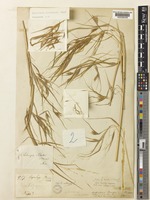
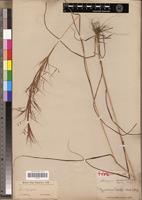
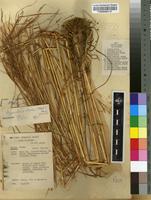
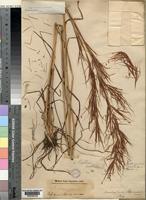
Annual, up to 6 or even 8 ft. high. Culms erect, solitary or fascicled, slender, simple and 3–5-noded below the panicle. Leaf-sheaths terete, or the lower keeled upwards, glabrous and smooth; ligules very short, truncate, ciliolate, glabrous; blades narrowly linear from an equally wide or slightly attenuated base, up to 1 ft. by 1 1/2–2 lin., long-tapering to a fine point, somewhat flaccid, glabrous or hairy behind the ligule, more or less rough all over the upper surface and scaberulous along the margins, midrib slender, lateral nerves close and fine, slightly prominent above. Spatheate panicle decompound, rather dense, of about 7 upwards approximate tiers, most of the rays of the primary tiers (except of the uppermost) compound, some of the lowest up to 4-noded and up to over 1/2 ft. long, with secondary and occasionally tertiary tiers, the majority 1-noded, bearing a fan-shaped frequently many- (15- or more-) rayed secondary tier, these fan-shaped tiers more or less imbricate, ultimate rays about 1/2 in. long, very slender; lower subtending leaves similar to the preceding ones, the following spatheaceous with narrow reduced blades, or the uppermost spatheoloid and up to over 3 in. long. Spatheoles very narrow, linear, long-tapering to a fine point, 1 1/2–1 3/4, rarely 2, in. long, scarious, reddish, at length inrolled and almost subulate; peduncles very finely filiform, slightly flexuous or quite straight, finely scaberulous upwards, sometimes with a few very fine white hairs, permanently shorter (1–1 1/4 in. long) than the spatheole. Racemes subparallel or the lower more or less spreading, never epinastically reflexed, rather loose, 4–5 lin. long, 2-awned per pair, greenish, one sessile, the other with a very finely filiform base, 2 1/2–4 1/2 lin. long and glabrous, or very minutely puberulous above the homogamous spikelets, bases disarticulating very obliquely, and tips subsubulate; terminal pedicels finely filiform, shortly ciliolate, up to 1 1/2 lin. long, those of the homogamous pairs shorter, finely puberulous to almost glabrous. Homogamous pair of spikelets 1 at the base of each raceme. Fertile spikelet linear-oblong, subacuminate, dorsally flattened and rounded at the sides, including the callus 2 1/2 lin. long, glabrous, pale with reddish tips; callus 1 lin. long, bearded with white hairs, the uppermost of its own length. Glumes equal, thinly chartaceous, lower minutely truncate or 2-denticulate, reddish upwards, 9-nerved, the inner 3 or 5 nerves more or less raised on the back particularly towards the tips; margins very narrowly involute, inflexed in the upper quarter, keels fine, scabrid; upper glume oblong, very shortly deltoid-acute to subtruncate, 3-nerved, ciliolate upwards. Lower floret reduced to a linear-oblong obtuse spreadingly ciliate nerveless hyaline valve. Upper floret hermaphrodite; valve stipitiform with 2 small hyaline teeth, awn 1 1/4 to over 1 3/4 in. long, slender, column fulvously hairy, the hairs varying up to 1 1/2–2 lin.; anthers 3/4 lin. long. Pedicelled spikelets ♂ (or neuter ?), linear-lanceolate, 2–2 1/2 lin. long, glabrous; lower glume very acute, mucronulate to subaristulate, 11-nerved, upper acute, 3-nerved, ciliate; valves hyaline, oblong, obtuse, reversedly ciliate, the lower sub-3-nerved, 2 lin. long, the upper shorter and narrower, 1 lin. long; anthers 1 1/4 lin. long. Homogamous spikelets like the pedicelled but muticous.