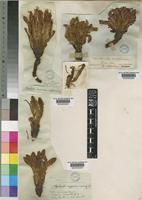
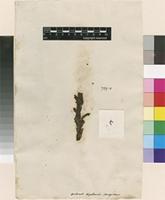
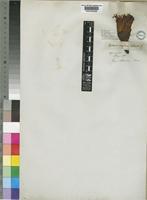
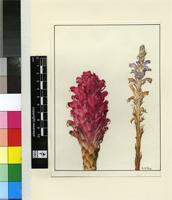
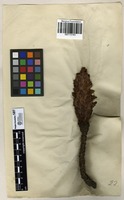
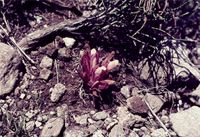
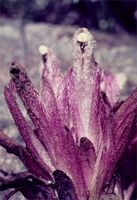
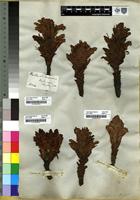
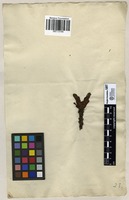
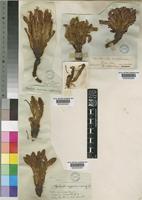
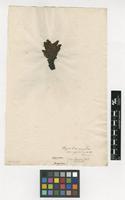
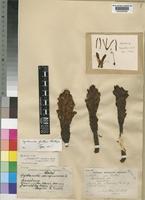
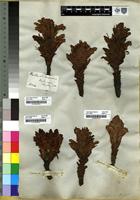
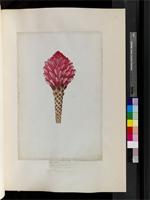
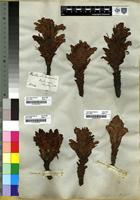
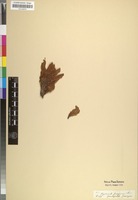
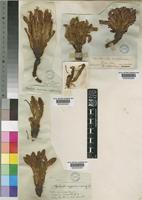
an erect herb, 3–9 in. high; root parasitical on bulbs or on the roots of Tripteris, Passerina, Aspalathus, &c.; stem fleshy, sometimes almost woody, simple, white, terete, densely clothed with scale-like leaves, as thick as a man's finger; leaves imbricate, ovate or oblong, very obtuse, somewhat or scarcely narrowed at the base, sessile, adpressed or but little spreading, entire, fleshy, somewhat concave, 1/2–1 1/2 in. long by 1/4– 3/8 in. broad or the lower smaller, pale rosy or scarlet, more or less minutely viscid-tomentose on the back, glabrous within; flowers numerous, sessile, 1 1/4–2 in. long; spikes terminal, dense, 2 1/2–6 in. long, oblong or pyramidal, about three times as thick as the stem; bract similar to the leaves, about 1/2 in. long; bracteoles opposite, linear-oblong, 4/5–1 in. long, obtuse, puberulous or pubescent with purple hairs; calyx 1 1/8–1 1/4 in. long, 5-cleft; lobes oblong-lanceolate, obtuse, 3/5– 4/5 in. long, with purple pubescence outside; corolla purplish, white below, shaggy outside, subcylindrical, somewhat curved, ringent, unilabiate; lip obtuse, subfornicate, emarginate; mouth vertical, 3/8 in. long; anthers dehiscing on the upper side; stigma thickened at the apex, emarginate, whitish. null