JSTOR Global Plants Home
  • Home
  • Browse
  • About
  • Access
  • Account
    • Saved Items
    • Profile
  • Log in

Global Plants

Skip to Main Content
  • JSTOR Global Plants Home
  • Global Plants

    • Browse
    • About
    • Access
    • Account
      • Saved Items
      • Profile
Log in
  • Browse
  • About
  • Access
  • Account
    • Saved Items
    • Profile
Advanced Search

Compilation
Hymenophyllum capillare

12 Images see all

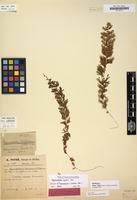
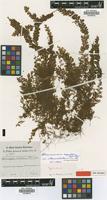
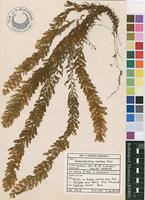
Holotype of Hymenophyllum holotrichum Peter [family HYMENOPHYLLACEAE]
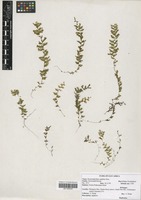
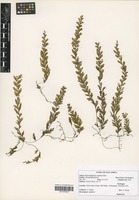
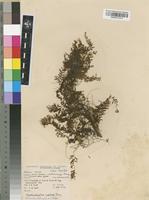
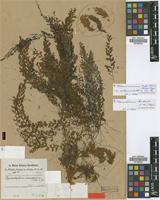
Filed as Hymenophyllum capillare Desv. [family HYMENOPHYLLACEAE]
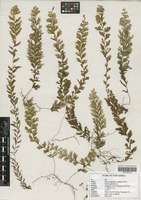
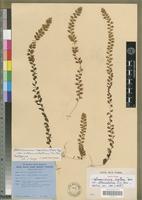
Type of Sphaerocionium capillare (Desv.) var. alternialatum Pic.Serm. [family HYMENOPHYLLACEAE]
Type of Hymenophyllum holotrichum Peter [family PTERIDOPHYTA]
Filed as Hymenophyllum capillare Desv. [family HYMENOPHYLLACEAE]
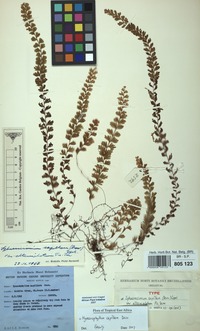
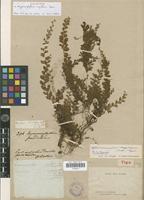
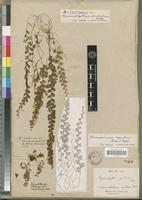
Holotype of Hymenophyllum capillare Desv. [family PTERIDOPHYTA]
Filed as Hymenophyllum capillare Desv. [family HYMENOPHYLLACEAE]
Type of Hymenophyllum anisopterum Peter [family PTERIDOPHYTA]
Lectotype of Hymenophyllum pendulum Bory [family PTERIDOPHYTA]
Isotype of Sphaerocionium capillare (Desv.) Copel. var. alternialatum Pic.Serm. [family PTERIDOPHYTA]
Previous
Next

Name

Identification
Hymenophyllum capillare Desv. [family HYMENOPHYLLACEAE ] (stored under name); Verified by Burrows, J.E.,
Related name
  • Sphaerocionium capillare
  • Hymenophyllum capillare
  • Hymenophyllum pendulum

Flora

Entry for Hymenophyllum capillare Desv. [family HYMENOPHYLLACEAE]
Herbarium
Royal Botanic Gardens, Kew (K)
Collection
Flora of Tropical East Africa
Resource Type
Reference Sources
Entry From
Flora of Tropical East Africa, page 1, (2008) Author: Henk Beentje
Names
Hymenophyllum capillare Desv. [family HYMENOPHYLLACEAE], in Mém. Soc. Linn. Paris 6, 2: 333 (1827), based on T. hirsutum Thouars in Fl. Tristan Ac.: 34 (1804), non L.; Taton in Bull. Soc. Roy. Bot. Belg. 78: 19 (1946); Alston, Ferns W.T.A.: 32 (1959); Tardieu in Fl. Cam. Pterid.: 75 (1964); Schelpe in F.Z. Pterid.: 80 (1970); Benl, Pter. Fernando Po: 7 (1980); Burrows, S. Afr. Ferns: 99, fig. map (1990). Type: Tristan da Cunha [Tristan d’Acugna], without collector or number (not found) (see Note)
Hymenophyllum holotrichum Peter [family HYMENOPHYLLACEAE], F.D.-O.A.: 16 & Descr.: 1, t. 1.3, 4 (1929). Type: Tanzania, Kilimanjaro, near Moshi, Peter 1268 (B!, lecto.)
Hymenophyllum anisopterum Peter [family HYMENOPHYLLACEAE], F.D.-O.A.: 15 & Descr.: 1, t. 1.2 (1929). Type: Tanzania, Kilimanjaro above Bismarck Hill, Peter 890b (B, holo.)
Sphaerocionium capillare (Desv.) Copel. [family HYMENOPHYLLACEAE], in Philipp. J. Sci. 67: 33 (1938); J.P. Roux, Conspect. southern Afr. Pteridoph.: 44 (2001)
Sphaerocionium capillare Pic.Serm. var. alternialatum [family HYMENOPHYLLACEAE], in Webbia 23: 196 (1968). Type: Kenya, Mt Kenya, Kathitha R., Schelpe 2592 (Herb. Pic.Serm., holo.; BM, BR!, P!, iso.)
Hymenophyllum capillare (Pic.Serm.) Faden var. alternialatum [family HYMENOPHYLLACEAE], in U.K.W.F.: 28 (1974), syn. nov.
Information
Pendulous epiphyte or hanging from rocks; rhizome long-creeping, filiform, glabrous or with long-armed stellate hairs. Fronds 1–5 cm apart, pendulous; stipe 1–6 cm long, terete, filiform, with partly deciduous branched stellate hairs; lamina linear in outline, to 6–70x2–3(–4) cm, 2–3-pinnatifid; rachis terete almost to apex, not winged, with stellate hairs; pinnae up to 30 on each side of the rachis, to 2x1 cm, the lowermost smaller and remote; pinnules up to 9, more developed on acroscopic side, linear, entire or lobed, ultimate segments to 9x1.5 mm, rounded to slightly emarginate, margin entire, with stalked stellate hairs on margin and veins. Sori at the lobe apices in distal part of pinnae, obconic with rounded valves, 1–1.6 mm in diameter, pubescent with stellate hairs; receptacle included. Fig. 1: 5–8, p. 4.
Range
DISTR. U 2; K 3–5, 7; T 2, 3, 6, 7 widespread in tropical Africa from Ghana to South Africa; Mascareignes, Madagascar
Altitude range
(1000–)1650–3150 m
Distribution
KENYA Meru District Nyambeni Hills, Kirima Peak, Oct. 1960, Verdcourt 2947!KENYA Kericho District SW Mau Forest, 16 km SSE of Kericho, Kiptiget R., June 1972, Faden & Grumbley 72/335!KENYA Teita District Kasigau, main peak, Nov. 1994, Luke 4214!TANZANIA Arusha District Mt Meru, Jekukuma R., Mar. 1966, Greenway & Kanuri 12464!TANZANIA Kilimanjaro, Old Moshi, above Kidia, Dec. 1995, Hemp 941!TANZANIA Morogoro District N Uluguru Forest Reserve, Palu, Dec. 1993, Kisena 985!TANZANIA Rungwe District Rungwe, Aug. 1911, Stolz 873!TANZANIA Lushoto District E Usambara, Mazumbai, Nov. 1974, Balslev 303!TANZANIA Iringa District Udzungwa Mountain National Park, Luhomero Mt, Oct. 2000, Luke et al. 6982!UGANDA Ruwenzori, Nyinabitaba–Kichuchu, Jul. 1951, Osmaston 3864! & Nyinabitaba Hut, Dec. 1950, G. Wood 225!UGANDA Ankole District Kasyoha–Kitomi Forest Reserve, near Nzozia R., Jun. 1994, Poulsen et al. 624!
Notes
USES. None recorded. CONSERVATION Widespread; least concern (LC) Roux in his Conspectus (under Sphaerocionium capillare) has as type Reunion [Ile Bourbon], J.M.C. Richard s.n. (P!, holo.) but this specimen is not mentioned in the protologue and so cannot be the type – I have not seen a designaton as lectotype. Pichi Sermolli described his var. alternialatum based on a specimen with long narrow fronds, with the pinnae set apart and long-decurrent; intermediates with the typical taxon occur for both spacing and extent of decurrence and I have included the variety in the synonymy. Several specimens at major herbaria such as Berlin and Paris have been named as a forma or a varietymajorRosenst. ormajusRosenst. – some of these have been identified as such by Rosenstock himself, some by Bonaparte. I do not believe the name has been published. There seems to be no difference from other material in this species. Var.alternialatumwas distinguished by having the pinnules slightly decurrent on the rachis. I do not believe this warrants varietal status.

Related Materials

  • Terms and Conditions
  • Privacy Policy
  • Cookie Policy
  • Cookie Settings
  • Accessibility
  • Help
  • Contact Us
  • Facebook
  • Twitter
ITHAKA

JSTOR is part of ITHAKA, a not-for-profit organization helping the academic community use digital technologies to preserve the scholarly record and to advance research and teaching in sustainable ways.

©2000-2026 ITHAKA. All Rights Reserved. JSTOR®, the JSTOR logo, JPASS®, Aluka®, and ITHAKA® are registered trademarks of ITHAKA.

╳