JSTOR Global Plants Home
  • Home
  • Browse
  • About
  • Access
  • Account
    • Saved Items
    • Profile
  • Log in

Global Plants

Skip to Main Content
  • JSTOR Global Plants Home
  • Global Plants

    • Browse
    • About
    • Access
    • Account
      • Saved Items
      • Profile
Log in
  • Browse
  • About
  • Access
  • Account
    • Saved Items
    • Profile
Advanced Search

Compilation
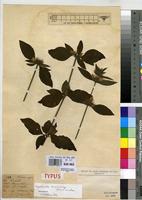
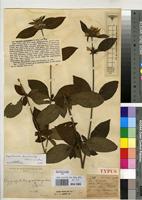
Hygrophila quadrangularis

2 Images see all

Type of Hygrophila quadrangularis De Wild. [family ACANTHACEAE]
Previous
Next

Name

Identification
Hygrophila quadrangularis De Wild. [family ACANTHACEAE ] Verified by Not on sheet, Dyschoriste trichocalyx (Oliv.) Lindau [family ACANTHACEAE ] (stored under name); Verified by Vollesen K., 1993
Related name
  • Dyschoriste trichocalyx
  • Hygrophila quadrangularis

Flora

Entry for DISPERMA quadrangulare C. B. Clarke [family ]
Herbarium
Royal Botanic Gardens, Kew (K)
Collection
Flora of Tropical Africa
Resource Type
Reference Sources
Entry From
Flora of Tropical Africa, page 1, (1900) Author: (By I. H. Burkill and C. B. Clarke.)
Names
DISPERMA quadrangulare C. B. Clarke [family ]
Nomaphila quadrangularis Klotzsch [family ACANTHACEAE], in Peters, Reise Mozamb. 197.
Hygrophila quadrangularis Lindau [family ACANTHACEAE], in Engl. Pfl. Ost-Afr. C. 367 partly.
Information
Large, subscandent; branches sharply quadrangular. Leaves up to 8 by 3 1/4 in., spathulate-elliptic, hardly petioled, thin in texture, very sparsely hairy, cystoliths obscure; margin entire, obscurely waved. Inflorescence in viscid-hairy axillary panicles 3–6 in. long, but (by the falling of the floral leaves) apparently a terminal panicle 14 by 8 in.; bract 1/3 in. long, oblong; bracteoles similar, rather smaller. Calyx 1/2 in. long, divided 1/3– 1/2 the way down, more or less viscid-hairy; teeth narrow-lanceolate. Corolla 2/3 in. long (linear-cylindric portion 1/3 in. long), purple with brown transverse marks and strong deflexed simple hairs in the throat. Stamens, anthers, pollen, pistil, stigmas, and ovules as of D. kilimandscharicum. Capsule (and seeds) as of D. kilimandscharicum, but a little larger, 1/4 in. long.
Distribution
German East Africa Mozamb. Dist. Bibisande, Stuhlmann, 409! Usukuma; Usiha, Fischer, 493!Portuguese East Africa Mozamb. Dist. Rios de Sena, Peters, 8!Nyasaland Mozamb. Dist. Katunga, on the River Shire, Scott!
Notes
This fine plant has all the appearance of one of the large rambling Indian Strobilanthes: except by the number of ovules it might be placed in that genus. Klotzsch has misled everybody by printing that the cells of the ovary are vieleiig (many-ovuled) instead of viereiig (4-ovuled).

Related Materials

  • Terms and Conditions
  • Privacy Policy
  • Cookie Policy
  • Cookie Settings
  • Accessibility
  • Help
  • Contact Us
  • Facebook
  • Twitter
ITHAKA

JSTOR is part of ITHAKA, a not-for-profit organization helping the academic community use digital technologies to preserve the scholarly record and to advance research and teaching in sustainable ways.

©2000-2026 ITHAKA. All Rights Reserved. JSTOR®, the JSTOR logo, JPASS®, Aluka®, and ITHAKA® are registered trademarks of ITHAKA.

╳