

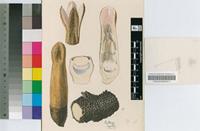
Name
Identification
Hydnora solmsiana Dinter [family HYDNORACEAE ]
Related name
- Hydnora solmsiana
Flora
Entry for Hydnora abyssinica A. Braun ex Schweinf. [family HYDNORACEAE]
Herbarium
Royal Botanic Gardens, Kew (K)
Collection
Flora Zambesiaca
Resource Type
Reference Sources
Entry From
FZ, Vol 9, Part 2, page 16, (1997) Author: Lytton J. Musselman
Names
Hydnora abyssinica A. Braun ex Schweinf. [family HYDNORACEAE], Beitr. Fl. Aethiop.: 217 (1867). —Engler, Pflanzenw. Ost-Afrikas C: 169 (1895); Bot. Jahrb. Syst. 28: 386 (1900). —Baker & C.H. Wright in F.T.A. 6, 1: 133 (1909).TAB. 7.Type from Ethiopia.
Hydnora johannis Becc. [family HYDNORACEAE], in Nuovo Giorn. Bot. Ital. 3: 5 (1871). —Solms-Laubach in A. Engler, Pflanzenr. [IV, fam. 76] 5: 7 (1901). —Harms in Engler & Prantl, Pflanzenfam. ed. 2, 16B: 291 (1935). —Lebrun in F.C.B. 1: 393 (1948). —Malaisse in Bull. Jard. Bot. Belg. 52: 115 (1982). —Musselman in Notes Roy. Bot. Gard. Edinburgh 42: 23, fig. on page 24 (1984); in Dinteria, No. 19: 77 (1987).Type from Ethiopia.
Hydnora bogosensis Becc. [family HYDNORACEAE], in Nuovo Giorn. Bot. Ital. 3: 6 (1871).Type from Ethiopia.
Hydnora hanningtonii Rendle [family HYDNORACEAE], in J. Bot. 34: 55 (1896).Type from Kenya.
Hydnora abyssinica var. quinquefida Engl. [family HYDNORACEAE], Bot. Jahrb. Syst. 28: 386 (1900).Type from Tanzania.
Hydnora solmsiana Dinter [family HYDNORACEAE], in Deutsch-Sudw.-Afr.: 57 (1909). —Schreiber in Merxmuller, Prodr. Fl. SW. Afrika, fam. 41: 1 (1968).Type from Namibia.
Hydnora gigantea Chiov. [family HYDNORACEAE], Result. Sc. Miss. Stephan-Paoli Somal. Ital. 1: 156 (1916).Type from Somalia.
Hydnora africana [family HYDNORACEAE], sensu Eyles in Trans. Roy. Soc. South Africa 5: 345 (1916).
Hydnora ruspolii Chiov. [family HYDNORACEAE], in Boll. Soc. Bot. Ital. 1917: 57 (1917).Type from Ethiopia.
Hydnora michaelis Peter [family HYDNORACEAE], in Feddes Repert. Spec. Nov. Regni Veg., Beih. 40 [Peter, Fl. Deutsch-Ostafrika], part 2: 185 (1932).Type from Ethiopia.
Hydnora cornii Vacc. [family HYDNORACEAE], in Nouvo Giorn. Bot. Ital. n.s., 39: 304 (1932).Type from Somalia.
Information
A subterranean root parasite.The plant-body rhizome-like, verrucose, up to c. 10 cm wide, ± irregular in shape and somewhat flattened, simple or with widely spreading horizontal branches, firmly-fleshy, brick-red inside, containing mucilage ducts, with sticky exudate when fresh, rich in tannins.Branches ± terete and densely covered with small conical warts.Flowers emerging directly from the “rhizome” and branches, remaining partially below ground, solitary or several remotely scattered.Perianth fleshy-coriaceous, 5–25 cm long, tube 3–4 cm in diameter, brown and roughly corky outside, pinkish inside.Perianth lobes usually 4, appearing above ground, fully patent in wet weather and lying on the soil surface, otherwise connivent or even connate at the tip, 6–8 cm long, lanceolate, thickly fleshy, broadly channelled and glandular on the inside; the lobe tips (cucullus) ± thickened, triangular in cross-section or grooved outside, the adjacent cucullus faces glabrous and cushion-like; the margins below the lobe-tips broad and beset with subulate setae.Anthers continuously joined at their bases in a series of large inverted “V”s forming a wavy ring, the anther structure transversally striate and divided into very numerous horizontal pollen sacs; pollen sticky, adhering to the anthers.Ovary unilocular, with numerous infolded, pendant placentas.Stigma sessile, cushion-shaped, 3–4(5)-lobed; each lobe finely ribbed and covered with a brown liquid in living material.Fruit entirely subterranean, fleshy, 10–15 cm in diameter, globose, many-seeded, often splitting irregularly at maturity.Outer layer of fruit a scaly periderm; inner pericarp mealy, white, very sweet to taste.Seeds brown, 1–1.77 mm, oblong to globose.Seedlings unknown.
Habitat
In Acacia woodland and scrub, Acacia-Commiphora scrub and grassland with scattered Acacia spp., usually on black cotton, clay and sandy alluvial soils, also on rocky slopes. Parasitic on Acacia spp. but also reported on Albizia, Delonix and probably Commiphora spp.
Distribution
Zimbabwe W Bulawayo, 15.iv.1986, Musselman & Obilana s.n. (ODU; M).Zimbabwe C Shurugwi Distr., Umcima Farm on Umtebekwa (Tebakwe) R., 2.i.1965, J. Guyin GHS 159891 (K; SRGH); Gweru Distr., 21.ii.1967, Biegel 1929 (K; SRGH).Botswana N Okavango Swamp, P.A. Smith s.d. (ODU).
Distribution (external)
Sudan
Ethiopia
Somalia
Uganda
Kenya
Tanzania
South Africa (Northern Province)
Swaziland
Notes
Plants usually flower after the onset of the rains.Flowers are extremely fetid, visited by beetles.Fruits develop about five months after the flowers appear, are scaly brown and entirely subterranean.Fruit is sweet, with white flesh and abundant brown seeds.Fruits are frequently collected as food by man and eaten by animals.Other parts of the plant are eaten by animals.Roots are used as medicine for diarrhoea and to staunch haemorrhaging.In H. africana (from Angola and Namibia and the Cape Province in South Africa) the branches are 5–7-angled with warts only on the angles, and the perianth usually 3-lobed with the lobe margins setose to the apex.