JSTOR Global Plants Home
  • Home
  • Browse
  • About
  • Access
  • Account
    • Saved Items
    • Profile
  • Log in

Global Plants

Skip to Main Content
  • JSTOR Global Plants Home
  • Global Plants

    • Browse
    • About
    • Access
    • Account
      • Saved Items
      • Profile
Log in
  • Browse
  • About
  • Access
  • Account
    • Saved Items
    • Profile
Advanced Search

Compilation
Hydnora johannis

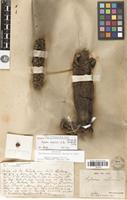
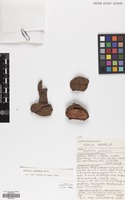
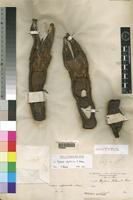
3 Images see all

Isotype of Hydnora abyssinica A. Braun [family HYDNORACEAE]
Filed as Hydnora africana Thunb. [family HYDNORACEAE]
Holotype of Hydnora johannis Becc. [family HYDNORACEAE]
Previous
Next

Name

Identification
Hydnora abyssinica A.Braun [family HYDNORACEAE ] (stored under name); Verified by Data not digitized, Hydnora johannis Becc. [family HYDNORACEAE ] Verified by Data not digitized,
Related name
  • Hydnora johannis
  • Hydnora abyssinica

Flora

Entry for HYDNORA johannis Becc. [family HYDNORACEAE]
Herbarium
Royal Botanic Gardens, Kew (K)
Collection
Flora Somalia
Resource Type
Reference Sources
Entry From
Flora Somalia, Vol 1, (1993) Author: by L. J. Musselman [updated by M. Thulin 2008]
Names
HYDNORA johannis Becc. [family HYDNORACEAE], (1871). Fig. 16.
HYDNORA bogosensis Becc. [family HYDNORACEAE], (1871).
HYDNORA abyssinica A. Br. ex Decne. [family HYDNORACEAE], (1873).
HYDNORA ruspolii Chiov [family HYDNORACEAE], (1916).
HYDNORA gigantea Chiov. [family HYDNORACEAE], (1916).
HYDNORA gigantea Chiov. var. trimera [family HYDNORACEAE], Result. Sci. Miss. Stefanini-Paoli: 157 (1916);. type: S Somalia, Paoli 980 & 1035, in part (?FT syn., not seen).
HYDNORA johannis (Chiov.) Vaccaneo forma trimera [family HYDNORACEAE], in Atti Acad. Naz. Lincei Mem. 5: 414 (1934);. type: S Somalia, Paoli 980 & 1035, in part (?FT syn., not seen).
HYDNORA cornii Vaccaneo [family HYDNORACEAE], (1932);. type: S2, “Afgoi”, Guidotti s.n. (not seen).
Information
Roots pink to flesh-red when fresh, with sticky exudate, extremely bitter and astringent, covered (except for the tip) with irregularly distributed, less than 0.5 cm long warty outgrowths from which haustoria are produced. Buds scattered along the roots, usually in clusters of 2–4. Flowers bisexual, (3–)4(–5)-merous, 5–25 cm long, the length depending on the depth of the root, with a foetid smell. Perianth-lobes 6–8 cm long, patent and resting on the soil, or lobes not reflexed and flower opening by a separation of the lobes, with a well developed cucullus. Anthers 2.5–3 x 2–2.5 cm; pollen very sticky. Fruit globose, 10–15 cm in diam., entirely subterranean, often splitting irregularly after maturation, outer layer scaly, inner layer mealy, white, very sweet, like the placentas. Seeds brown, very hard, oblong to globose, 1–1.8 mm long.
Range
N1, 2; C1, 2; S1, 2 widespread in tropical Africa
Altitude range
100–1170 m.
Distribution
SOMALIA Gillett 4071; Gillett & Watson 23588; Beckett 929.
Distribution (external)
Eritrea
Ethiopia
Yemen
Notes
Like (Som.). The fruits are edible and the roots are used against diarrhoea and as a source of tannin.

Related Materials

  • Terms and Conditions
  • Privacy Policy
  • Cookie Policy
  • Cookie Settings
  • Accessibility
  • Help
  • Contact Us
  • Facebook
  • Twitter
ITHAKA

JSTOR is part of ITHAKA, a not-for-profit organization helping the academic community use digital technologies to preserve the scholarly record and to advance research and teaching in sustainable ways.

©2000-2026 ITHAKA. All Rights Reserved. JSTOR®, the JSTOR logo, JPASS®, Aluka®, and ITHAKA® are registered trademarks of ITHAKA.

╳