JSTOR Global Plants Home
  • Home
  • Browse
  • About
  • Access
  • Account
    • Saved Items
    • Profile
  • Log in

Global Plants

Skip to Main Content
  • JSTOR Global Plants Home
  • Global Plants

    • Browse
    • About
    • Access
    • Account
      • Saved Items
      • Profile
Log in
  • Browse
  • About
  • Access
  • Account
    • Saved Items
    • Profile
Advanced Search

Compilation
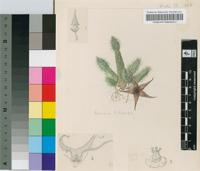
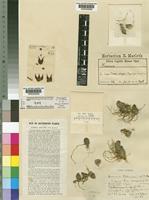
Huernia pillansii

5 Images see all

Huernia pillansii N.E.Br.
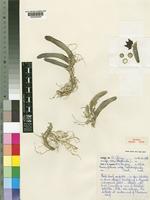
Isotype of Huernia pillansii N.E.Br. subsp. echidnopsioides L.C.Leach [family ASCLEPIADACEAE]
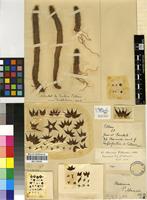
Type of Huernia pillansii N.E.Br. [family ASCLEPIADACEAE]
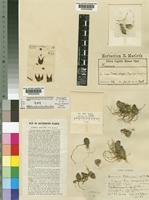
Type of Huernia pillansii N.E.Br. [family APOCYNACEAE]
Huernia pillansii N.E.Br. [family ASCLEPIADACEAE]
Previous
Next

Name

Identification
Huernia pillansii N.E.Br. [family APOCYNACEAE ]
Related name
  • Huernia pillansii

Flora

Entry for HUERNIA Pillansii N. E. Br. [family ASCLEPIADACEAE]
Herbarium
Royal Botanic Gardens, Kew (K)
Collection
Flora Capensis
Resource Type
Reference Sources
Entry From
Flora Capensis, Vol 4, page 518, (1909) Author: By N. E. BROWN.
Names
HUERNIA Pillansii N. E. Br. [family ASCLEPIADACEAE], in Gard. Chron. 1904, xxxv. 50, Pillansi, by error
Information
plant densely tufted; stems 3/4–1 1/2 in. long, 1/2– 2/3 in. in diam., erect or ascending, subglobose when young, becoming ovoid or cylindric, densely covered with conical recurved bristle-pointed tubercles 1 1/2–2 lin. long, in 20–24 vertical or spiral series, glabrous, green, or dull purplish where exposed to the sun; flowers 1–3 together near the base of the young stems, successively developed; pedicels 1 1/2–2 lin. long, glabrous; sepals 2–3 lin. long, 2/3–1 lin. broad, ovate-anceolate at the base, attenuate into filiform recurving tips, glabrous; corolla 1–1 1/4 in. in diam.; tube campanulate, about 1/3 in. long and as much in diam. outside; lobes abruptly and horizontally spreading from the tube, recurved, 5–6 lin. long, 3–3 1/2 lin. broad at the base, whence they gradually taper to a fine acuminate point, glabrous outside; inner surface covered on the lobes and in the throat of the tube with small fleshy terete obtuse erect processes 1/4– 1/3 lin. long, smooth in the lower part of the tube, pale yellow, becoming pinkish-cream in the tube, covered with small crimson spots and the tips of the processes also crimson; outer corona 5-lobed, black or purple-black; lobes about 3/4 lin. long and broad, subquadrate or oblong, very shortly and obtusely bifid to acutely bifid to the middle, when the whole appears to consist of 5 pairs of small deltoid teeth; inner corona-lobes about 1 lin. long, connivent-erect, with very slightly spreading tips, dorsally flattened, linear, slightly humped at the base, minutely papillate at the obtuse slightly thickened apex, dark purple-brown; staminal column about 1 1/4 lin. long. null
Distribution
CENTRAL REGION Laingsburg Div.; stony places near Matjesfontein, Pillans, 23! Marloth, 3308! and cultivated specimen! Prince Albert Div.; near Prince Albert, Bolus (ex Pillans).
Notes
This is one of the most distinct species of this genus, no other having similar stems, which resemble those of a Trichocaulon in miniature. The flowers are somewhat like those of H. Hystrix.

Related Materials

  • Terms and Conditions
  • Privacy Policy
  • Cookie Policy
  • Cookie Settings
  • Accessibility
  • Help
  • Contact Us
  • Facebook
  • Twitter
ITHAKA

JSTOR is part of ITHAKA, a not-for-profit organization helping the academic community use digital technologies to preserve the scholarly record and to advance research and teaching in sustainable ways.

©2000-2026 ITHAKA. All Rights Reserved. JSTOR®, the JSTOR logo, JPASS®, Aluka®, and ITHAKA® are registered trademarks of ITHAKA.

╳