JSTOR Global Plants Home
  • Home
  • Browse
  • About
  • Access
  • Account
    • Saved Items
    • Profile
  • Log in

Global Plants

Skip to Main Content
  • JSTOR Global Plants Home
  • Global Plants

    • Browse
    • About
    • Access
    • Account
      • Saved Items
      • Profile
Log in
  • Browse
  • About
  • Access
  • Account
    • Saved Items
    • Profile
Advanced Search

Compilation
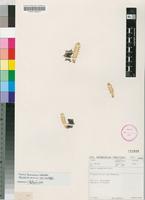
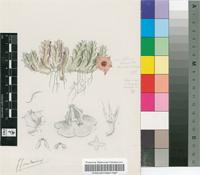
Huernia loeseneriana

2 Images see all

Isoneotype of Huernia loeseneriana Schltr. [family APOCYNACEAE]
Huernia loeseneriana Schltr.
Previous
Next

Name

Identification
Huernia loeseneriana Schltr. [family APOCYNACEAE ]
Related name
  • Huernia loeseneriana

Flora

Entry for HUERNIA loeseneriana Schlechter [family ASCLEPIADACEAE]
Herbarium
Royal Botanic Gardens, Kew (K)
Collection
Flora Capensis
Resource Type
Reference Sources
Entry From
Flora Capensis, Vol 4, page 518, (1909) Author: By N. E. BROWN.
Names
HUERNIA loeseneriana Schlechter [family ASCLEPIADACEAE], in Engl. Jahrb. xx. Beibl. 51, 55;—Schlechter in Journ. Bot. 1898, 485.
Information
stems erect or ascending 1–2 1/2 in. long, acutely 4-angled, 1/2– 3/4 in. square, green, purple-tinted at the tips; teeth deltoid, acute, 1–1 1/2 lin. long; flowers 1–2 together, near the base of the young stems; pedicels 2–3 lin. (up to 1/2 in., Schlechter) long; sepals 1/4 in. (1/8 in., Schlechter) long, subulate from an ovate base; corolla campanulate, with the tube widening upwards and gradually passing into the spreading lobes, scarcely 1 in. in diam. (about 2/3 in. long and nearly 1/2 in. in diam., verrucose and brownish within, paler outside, Schlechter), very minutely asperate and brownish-purple outside, covered inside from the middle of the tube nearly to the tips of the lobes with short stiff compressed-conical obtuse processes, dull yellow, covered with very crowded narrow broken transverse lines and spots of dull brownish-crimson, and entirely of that colour at the base of the tube, but darker; tube 1/3 in. long; lobes 1/4 in. long and rather more in breadth at the base, broadly deltoid, very acute; outer corona-lobes about 3/4 lin. long and broad, subquadrate, subtruncate at the apex, black, with a velvet-like surface; inner corona-lobes 1–1 1/4 lin. long, connivent-erect with diverging tips, much exceeding the anthers, linear-subulate, thickened and knob-like at the minutely scabrous apex, with a transverse ridge at the base, dull purplish-red, brownish at the tips. null
Distribution
KALAHARI REGION Transvaal; mountains around Pretoria, Burtt Davy, 2446! Schlechter, near the Olifants River, 5000 ft., Schlechter, 3774.
Notes
I have not seen an authentic specimen of this species and describe entirely from a living plant sent to Kew by Mr. Burtt Davy, which quite accords with Schlechter's description except as to the few characters inserted in brackets, and comes from the same general locality. In a , however, Dr. Schlechter states that the corolla-tube of this species is longer than that of any other known to him and somewhat resembles that of a Decabelone (Tavaresia), although he describes the entire corolla as being only “about 1.5 cm. long,” i.e. about 2/3 in.

Related Materials

  • Terms and Conditions
  • Privacy Policy
  • Cookie Policy
  • Cookie Settings
  • Accessibility
  • Help
  • Contact Us
  • Facebook
  • Twitter
ITHAKA

JSTOR is part of ITHAKA, a not-for-profit organization helping the academic community use digital technologies to preserve the scholarly record and to advance research and teaching in sustainable ways.

©2000-2026 ITHAKA. All Rights Reserved. JSTOR®, the JSTOR logo, JPASS®, Aluka®, and ITHAKA® are registered trademarks of ITHAKA.

╳