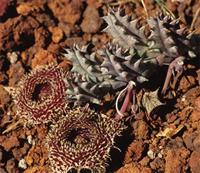
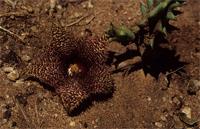
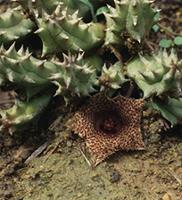
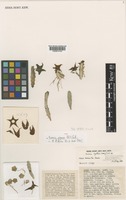
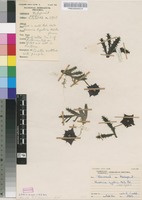
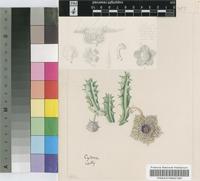
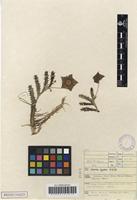
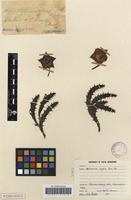
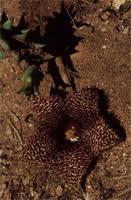
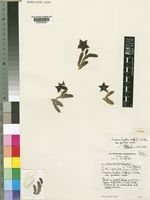
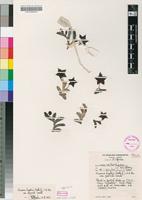
stems usually 2–3 (rarely, under cultivation, up to 5) in. high, 4–6 lin. thick, 5-angled, glabrous, pale green, very slightly glaucous, sometimes tinted with dull purplish; teeth conical, acute, very spreading; flowers 2–5 together near the base of the stems, successively developed; pedicels 3/4–1 1/2 in. long, glabrous; sepals 4 lin. long, 3/4 lin. broad, subulate from an ovate-lanceolate base, glabrous; corolla shortly pointed and with a small tooth at each angle in bud; when expanded 1–1 1/2 in. in diam.; tube short, campanulate, about 1/4 in. long and 1/2 in. in diam. outside; lobes abruptly and horizontally spreading from the tube, with recurved tips, 1/2– 2/3 in. long and nearly as broad at the base, deltoid-ovate, acute; outside glabrous, but minutely papillate, pitted, prominently 3-nerved on the lobes; inner surface (except within the tube) covered with spine-like acute fleshy processes, ochreous-yellow, marked with crimson spots on the lobes and with numerous transverse crimson lines within the smooth and paler tube; outer corona-lobes half as long as broad, truncate, broadly emarginate or obscurely 3-toothed at the apex, black (apparently yellowish in a dried flower of Wood 10813); inner corona-lobes 1 1/2 lin. long, erect, much exceeding the staminal column, linear, with a transverse thickening or ridge on the back below and expanded at the apex into a horizontally spreading process somewhat resembling an inverted foot, yellow, dotted on the upper part with crimson. null