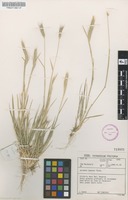
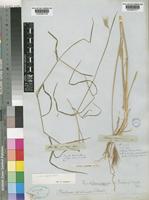
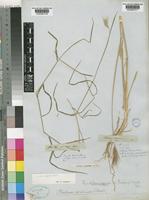
perennial, tufted; culms slender, erect or geniculate-ascending, 1–2 ft. long, glabrous, smooth, 4-noded, internodes exserted; sheaths rather tight, thin, striate, glabrous, or the lower hairy, at length withering away or breaking up into fine fibres; ligule very short, truncate, hyaline; blades linear, long tapering to a fine point, 2–10 in. by 1 1/2–3 lin., flat, slightly involute, somewhat stiff to flaccid, subglaucous, glabrous, or sparingly hairy, closely striate and scabrid on the upper side; spike erect, straight or flexuous, 1–3 in. long, light green to glaucous, bristle often purple; rhachis fragile, flattened, margins scabrid; spikelets 3 at each node, intermediate sessile, hermaphrodite, lateral shortly pedicelled, ♂ or barren; glumes equal, reduced to straight scabrid bristles, slightly channelled on the inner side, 6–9 lin. long, those of the intermediate spikelet close to the floret, of the lateral more or less distant from it; valve of hermaphrodite floret lanceolate, subinvolute, gradually narrowed into the awn, 3 1/2–4 1/2 lin. long, herbaceous-chartaceous, smooth or scabrid in the upper part, 5-nerved; awn exceeding the glumes; pales narrow, keels scaberulous; anthers over 2 lin. long; grain more or less adhering to the valve and pale, oblong, 2 lin. long, semiterete, deeply grooved in front; embryo 1/2 lin. long; ♂ or barren spikelets similar to the hermaphrodite, but smaller and with the awn exceeded by the glumes. null