JSTOR Global Plants Home
  • Home
  • Browse
  • About
  • Access
  • Account
    • Saved Items
    • Profile
  • Log in

Global Plants

Skip to Main Content
  • JSTOR Global Plants Home
  • Global Plants

    • Browse
    • About
    • Access
    • Account
      • Saved Items
      • Profile
Log in
  • Browse
  • About
  • Access
  • Account
    • Saved Items
    • Profile
Advanced Search

Compilation
Hoodia bainii

6 Images see all

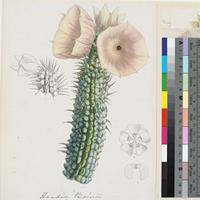
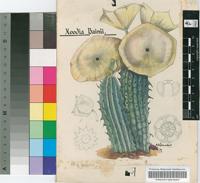
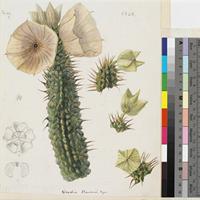
Hoodia bainii Dyer published illustration from Curtis's Botanical Magazine
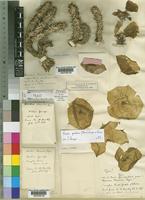
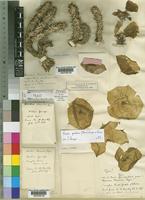
Hoodia gordonii (Masson) Sweet ex Decne. [family ASCLEPIADACEAE]
Type of Hoodia bainii Dyer [family ASCLEPIADACEAE]
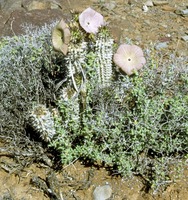
Hoodia bainii Dyer
Hoodia bainii Dyer
Hoodia bainii Dyer original illustration from Curtis's Botanical Magazine
Previous
Next

Name

Identification
Hoodia bainii Dyer [family APOCYNACEAE ]
Related name
  • Hoodia bainii

Flora

Entry for HOODIA Bainii Dyer [family ASCLEPIADACEAE]
Herbarium
Royal Botanic Gardens, Kew (K)
Collection
Flora Capensis
Resource Type
Reference Sources
Entry From
Flora Capensis, Vol 4, page 518, (1909) Author: By N. E. BROWN.
Names
HOODIA Bainii Dyer [family ASCLEPIADACEAE], in Bot. Mag. t. 6348;—N. E. Br. in Hook. Ic. Pl. under t. 1905, p. 3; K. Schum. in Engl. und Prantl, Pflanzenfam. iv. ii. 275; Schlechter in Journ. Bot. 1898, 475.
Information
plant 6–8 in. high in the specimens seen (12–15 in., Barkly), bushily branched; branches 1–1 1/2 in. thick, with 12–15 tuberculate angles, glabrous, green, somewhat glaucous; tubercles tipped with a slender pale brown spine 3 1/2–5 lin. long; flowers 1–2 together, glabrous in all parts; pedicels 1/4– 1/2 in. long; sepals 2–2 1/2 lin. long, ovate-lanceolate, acuminate; corolla in bud hemispheric at the basal part, 5-winged above, truncate, with a short central point, when expanded 2 1/2–3 in. in diam., cup-shaped, about 1 in. deep, subtruncate at the margin with 5 subulate or awn-like points 1 1/2–3 lin. long, glabrous, smooth, not papillate on the central part, light yellow or pale buff, sometimes tinged with pinkish or very pale purple; tube obsolete, represented by a slight depression from which the blackish corona is exserted or its margin resting upon the rim, when dried contained in a very small cup; outer corona 1 3/4–2 lin. in diam., cupular, 5-lobed; lobes 1/4– 1/3 lin. long, nearly 1 lin. broad, transverse, emarginate; inner corona-lobes 2/5 lin. long, oblong, obtuse, closely incumbent upon the backs of the anthers and not exceeding them, dorsally connected to the inflexed sinuses of the outer corona; follicles 4–5 in. long, 4–5 lin. thick, terete-fusiform, tapering to a beak, glabrous, smooth; seeds 3–3 1/2 lin. long, 1 1/2 lin. broad, ovate, flat, with a slightly thickened margin, glabrous, smooth, light brown. null
Distribution
CENTRAL REGION Prince Albert or Beaufort West Div.; Dwyka River and Uitkyk, Bain, 11! and cultivated specimens! near Grootfontein, Pillans! Carnarvon Div.; near Van Wyks Vlei, Alston in Herb. Pillans, 127!SOUTH AFRICA without locality, Drège, 5617!
Notes
According to Mr. Bain this is called “Wolve n'Gaap” by the Hottentots. Both Sir Henry Barkly and Mr. Pillans state that this plant is 12–15 in. high, yet neither of the 4 living plants sent to England were more than half as tall, and Mr. Pillans speaks of it as “a stunted species.” Have two closely allied forms been confused? Specimens collected by Orpen at St. Clair near Douglas in Herbert Div., and distributed by MacOwan under no. 3397, may possibly belong to this species, but living material is needed to properly identify the plant.

Related Materials

  • Terms and Conditions
  • Privacy Policy
  • Cookie Policy
  • Cookie Settings
  • Accessibility
  • Help
  • Contact Us
  • Facebook
  • Twitter
ITHAKA

JSTOR is part of ITHAKA, a not-for-profit organization helping the academic community use digital technologies to preserve the scholarly record and to advance research and teaching in sustainable ways.

©2000-2026 ITHAKA. All Rights Reserved. JSTOR®, the JSTOR logo, JPASS®, Aluka®, and ITHAKA® are registered trademarks of ITHAKA.

╳