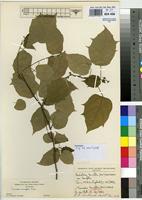
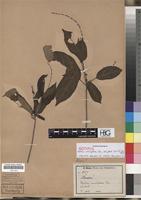
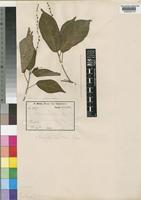
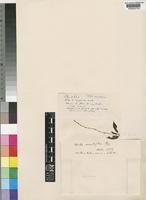
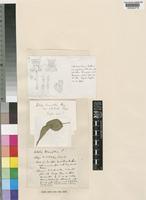
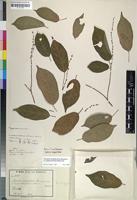
A shrub, 7–10 ft. high, wood soft, twigs pubescent. Leaves distinctly petioled, membranous, ovate, shortly and abruptly acuminate, base rounded, margin entire or casually unequally 3-lobed, 2 1/2–3 in. long, 1 1/4–2 in. wide; nerves 3–4 on each side, the lowest pair quite basal, dark green above, paler beneath, sparingly pubescent above, more densely pubescent, sometimes almost velvety, especially on the nerves beneath; petiole pubescent, 1/2–1 1/4 in. long; stipules caducous. Flowers in subspicate racemes, 2–2 1/2 in. long, terminating the leafy twigs; males in pairs or solitary, females solitary; male pedicel 1–1 1/2 lin. long, female pedicel 2 1/2 lin. long; bracts lanceolate, membranous, very small; bracteoles minute. Male: Calyx ovoid, obtuse, closed in bud, splitting into 2–5 valvate segments, pubescent outside with spreading hairs. Petals 5, less often 4, orbicular, shortly clawed, much shorter than the calyx-segments, pubescent on the inner face with long viscid hairs. Stamens 8–12, outer 5, less often 4, surrounded by a ring of glands alternating with the petals and filaments of the outer series; filaments considerably longer than anthers, clothed in the lower half with long viscid hairs. Female calyx ovoid, much larger than the male; lobes divided nearly to the base, subspathulate, 3 larger than the remaining 2, pubescent externally. Petals much shorter than the calyx-lobes. Ovary sparingly setose. Capsule 3-coccous.