JSTOR Global Plants Home
  • Home
  • Browse
  • About
  • Access
  • Account
    • Saved Items
    • Profile
  • Log in

Global Plants

Skip to Main Content
  • JSTOR Global Plants Home
  • Global Plants

    • Browse
    • About
    • Access
    • Account
      • Saved Items
      • Profile
Log in
  • Browse
  • About
  • Access
  • Account
    • Saved Items
    • Profile
Advanced Search

Compilation
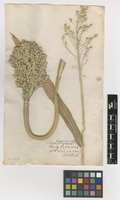
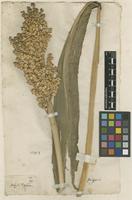
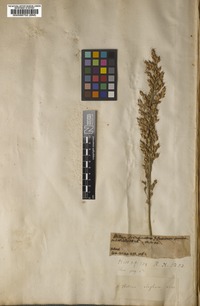
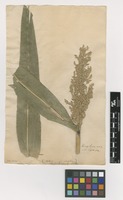
Holcus sorghum

8 Images see all

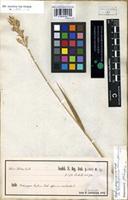
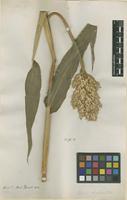
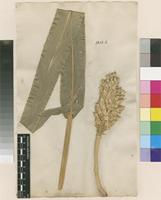
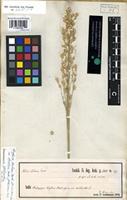
Syntype of Holcus dochna Forssk. [family GRAMINEAE]
Filed as Holcus sorghum L. [family POACEAE]
Filed as Sorghum indet [family POACEAE]
Filed as Holcus sorghum L. [family POACEAE]
Previous
Next

Name

Identification
Sorghum indet [family POACEAE ] (stored under name); Holcus sorghum L. [family POACEAE ] Verified by D. Solander,
Related name
  • Holcus sorghum
  • Sorghum indet

Flora

Entry for ANDROPOGON Sorghum Brot. [family POACEAE]
Herbarium
Royal Botanic Gardens, Kew (K)
Collection
Flora Capensis
Resource Type
Reference Sources
Entry From
Flora Capensis, Vol 7, page 310, (1900) Author: (By O. STAPF.)
Names
ANDROPOGON Sorghum Brot. [family POACEAE], Fl. Lus. i. 88;—Kunth, Enum. i. 501; Steud. Syn. Pl. Glum. i. 393; Körnicke und Werner, Handb. Getreidebau. i. 294–315; Hook. f. Fl. Brit. Ind. vii. 183; K. Schum. in Engl. Pfl. Ost-Afr. B. 34.
ANDROPOGON Sorghum Hack. subsp. sativus [family POACEAE], Androp. in DC. Monogr. Phan. vi. 505.
Holcus Sorghum Linn. [family POACEAE], Spec. Plant. 1047; Gærtn. Fruct. ii. 2, t. 80; Lamk. Illustr. t. 838.
Information
annual; leaves as in A. halepensis, but the ligule often glabrous or glabrescent; panicle very variable, from effuse to compact; rhachis of racemes tough, joints and pedicels half as long as the sessile spikelets or very often much shorter, more or less ciliate; sessile spikelets very variable in shape and size, on the whole broader than in A. halepensis, 2–3 1/2 lin. by 1 1/4–2 1/2 lin., pale, reddish, brown or at length black, usually shining; lower glume coriaceous, or more or less herbaceous, particularly towards the tips, rarely quite thin except at the base, often prominently nerved in the herbaceous part, hairy, rarely quite glabrous, otherwise as in A. halepensis, awn 2 1/2–7 1/2 lin. long, more or less reduced or 0; grain obovate to globose; pedicelled spikelets ♂ or more frequently barren and more or less reduced. null
Range
Cultivated in numberless forms in the tropical and subtropical regions, particularly in the Old World, and in the warmer parts of the temperate zones of both hemispheres.
Notes
A great many varieties have been described; of these 7 are said to occur in South Africa. As I have, however, seen only a few specimens from that region, I must rely mainly on Hackel's, Körnicke's, and K. Schumann's descriptions which, unfortunately, are not always reconcilable. The following disposition is therefore only a provisional attempt, principally intended to give the student an idea in which directions the variation takes place chiefly, and to enable him to collect judiciously further material of this most important native cereal. The cereal of the Kaffirs, generally known as the Kaffir corn; occasionally grown in gardens in the western parts of the Cape Colony. I have seen only a few South African specimens, and as some of them are rather young or otherwise imperfect, the following determinations will have to be revised along with those by other authors, as soon as more complete material is at hand. VAR. saccharatus is very probably represented by a young specimen in the Kew herbarium distributed by Drège under the name “ Sorghum bicolor ,” and without locality. It is said to be the commonest form grown in tropical Africa, and is also cultivated in tropical Arabia, India, Southern Europe and the United States of North America. Var. Usorum is indicated by Nees from Dutoits Kloof, in Worcester Div., and from the country of the Koosa Kaffirs (“ tUs” Kaffirs of Nees, whence the name, approximately between the Great Fish River and Key River), and a flowering specimen collected by Wood (3990) near the Umvoti River, Natal, belongs very likely to it. Var. Schenkii was collected by Schenk on the Bosch Veldt, north of the Magalies Mountains, in the Transvaal, whilst var. Neesii is recorded from the Koosa Country and from Wilgebosch Spruit, in the Orange Free State (?). To the latter variety are evidently referable some specimens gathered by Burchell (5278!) at “Kaatje's Kraal,” in Knysna Div., and at Takun in Bechuanaland (2214!), as well as a specimen in Thunberg's herbarium, marked Sorghum Caffrorum. The Knysna specimens represent, however, 2 forms, one having almost black mature glumes, whilst, in the other, their colour is the same as in the flowering state. The Takun specimen is in flower. All of Burchell's specimens agree otherwise exactly. Their panicles are erect, oblong, the rhachis and the branches are villous at the nodes and more or less hairy above them. The spikelets answer the description of those of var. Neesii; they are, however, not always very obtuse, but often apiculate. Var. Schenkii as well as var. Neesii is said to be grown also in various parts of tropical Africa.

Related Materials

  • Terms and Conditions
  • Privacy Policy
  • Cookie Policy
  • Cookie Settings
  • Accessibility
  • Help
  • Contact Us
  • Facebook
  • Twitter
ITHAKA

JSTOR is part of ITHAKA, a not-for-profit organization helping the academic community use digital technologies to preserve the scholarly record and to advance research and teaching in sustainable ways.

©2000-2026 ITHAKA. All Rights Reserved. JSTOR®, the JSTOR logo, JPASS®, Aluka®, and ITHAKA® are registered trademarks of ITHAKA.

╳