

Compilation
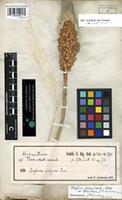
Holcus durra
1 Images see all
Name
Identification
Holcus durra Forssk. [family GRAMINEAE ] Verified by Not on Sheet, Sorghum durra (Forssk.) Stapf [family GRAMINEAE ] Verified by J.D. Snowden, 1936 Sorghum bicolor (L.) Moench [family GRAMINEAE ] (stored under name); Verified by Not on Sheet, Sorghum vulgare Pers. [family GRAMINEAE ] Verified by P. Ascherson, 1881
Related name
- Sorghum durra
- Holcus durra
- Sorghum vulgare
- Sorghum bicolor
Flora
Entry for SORGHUM Durra Stapf [family POACEAE]
Herbarium
Royal Botanic Gardens, Kew (K)
Collection
Flora of Tropical Africa
Resource Type
Reference Sources
Entry From
Flora of Tropical Africa, Vol 9, page 1, (1917) Author: (By O. STAPF.)
Names
SORGHUM Durra Stapf [family POACEAE]
Holcus Durra Forsk. [family POACEAE], Fl. Ægypt.-Arab.174.
Holcus Duna Gmelin [family POACEAE], (sphalm.), Syst. 173.
Andropogon Sorghum Koern. var. ægyptiacus [family POACEAE], in Aschers. & Schweinf. Ill. Fl. Égypte, 164.
Andropogon Sorghum Hack. var. Durra [family POACEAE], in DC. Monogr. Phan.vi. 516.
Andropogon Sorghum Hack. var. ægyptiacus [family POACEAE], in DC. Monogr. Phan.vi. 516.
Andropogon Sorghum Chiov. var. Durra [family POACEAE], in Ann. Istit. Bot. Roma, viii. 24.
Andropogon Sorghum Koern. var. niloticus [family POACEAE], in Aschers. & Schweinf. l.c. 778, 779.
Andropogon Sorghum Koern. var. schweinfurthianus [family POACEAE], in Aschers. & Schweinf. l.c. 778, 779.
Andropogon Sorghum Koern. var. arabicus [family POACEAE], in Bull. Herb. Boiss. ii. App. ii. 12 (probably).
Andropogon Sorghum Koern. var. rubrocernuus [family POACEAE], in Bull. Herb. Boiss. ii. App. ii. 12 (probably).
Information
Annual. Culms stout, up to 14 (or even more) ft. high, 20–40-noded. Leaf-sheaths finely pubescent at the nodes; ligules very short, shortly ciliate; blades up to over 15 in. by 2 in., quite glabrous (? always). Panicle usually quite compact, ovoid or ellipsoid, erect or sometimes recurved, 4–6 in. by 2–4 in.; branches erect, more or less flexuous, rather slender, rough to spinulously ciliolate, particularly upwards, ciliate to subvillous at the base, the longest up to one half or a third the length of the panicle, divided from very low down. Racemes compact, tough, about 4 lin. long (in flower), mostly 3- or 4-noded; joints somewhat stout, flattened, 1/2 to almost 1 lin. long, whitish-ciliate; pedicels similar, but still shorter. Sessile spikelet rhombic-obovoid, subacute (in flower), 2 1/2–3 lin. by 1 1/2–2 lin., greenish or straw-colour with greenish tips, ultimately whitish or variously brown, dark red or black, awned or awnless, callus-beard scanty. Glumes equal, coriaceous up to beyond one half or two-thirds, then papery, unevenly strigillose, particularly at the tips and sides; lower with a broad triangular greenish strongly nerved tip, about 12-nerved with 3 or 4 finer nerves interspersed, 2-keeled upwards (keels rough), more or less flattened out and very broad to rotundate when mature with the tips worn off and the back glossy; upper broad, 9-nerved with some additional finer nerves, slightly keeled upwards. Valves ciliate; lower ovate-elliptic, over 2 lin. long; upper broad-ovate, 2-toothed, 2 lin. long, awn up to 5 lin. long, mostly much shorter and then hardly twisted and differentiated into column and bristle or quite suppressed. Anthers over 1 lin. long. Grain subglobose, slightly compressed, with a broad rounded much exposed top, white, yellow or variously reddish, 2 1/2 lin. by 2 1/2 lin., nerveless, embryo-mark faint. Pedicelled spikelet neuter (? always), persistent, lanceolate to linear-oblong, subacute, up to 3 lin. long, greenish or reddish, lower 11-, upper 7-nerved.
Range
The most commonly cultivated Sorghum of Egypt, also grown in Arabia and more sparingly in India and Afghanistan. This is also the “ Durra ” of the United States of N. America, where it has been grown as a grain corn to some extent since 1874.
Distribution
Eritrea Nile Land Sambar, Island of Scek Said, Terracciano & Pappi, 2789.Sudan Nile Land Geteina District, without further indication of origin, Rubber Exhibition, London, 1914!
Notes
A young specimen collected by the Rev. W. E. Taylor in the Rabai Hills near Mombasa, B. E. Africa, is very probably referable to S. Durra. The Sudan specimens represent 3 distinct varieties, but owing to lack of material it has not been possible to refer them with certainty to any of Koernicke's varieties described above. They are distinct enough to deserve being mentioned and briefly characterised. They are:—