JSTOR Global Plants Home
  • Home
  • Browse
  • About
  • Access
  • Account
    • Saved Items
    • Profile
  • Log in

Global Plants

Skip to Main Content
  • JSTOR Global Plants Home
  • Global Plants

    • Browse
    • About
    • Access
    • Account
      • Saved Items
      • Profile
Log in
  • Browse
  • About
  • Access
  • Account
    • Saved Items
    • Profile
Advanced Search

Compilation
Holcus bicolor

8 Images see all

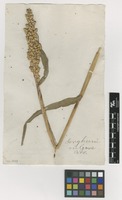
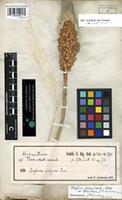
Filed as Holcus saccharatus L. [family POACEAE]
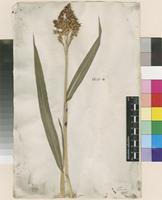
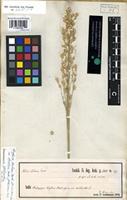
Filed as Holcus niger Ard. [family POACEAE]
Syntype of Holcus dochna Forssk. [family GRAMINEAE]
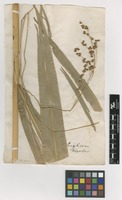
Filed as Holcus bicolor L. [family POACEAE]
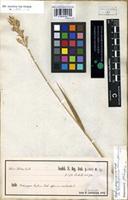
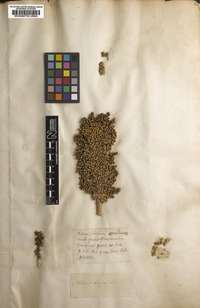
Lectotype of Holcus bicolor L. [family POACEAE]
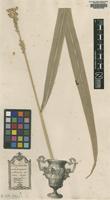
Holotype of Holcus durra Forssk. [family GRAMINEAE]
Filed as Holcus bicolor L. [family POACEAE]
Previous
Next

Name

Identification
Holcus bicolor L. [family POACEAE ] (stored under name); Verified by D. Solander, Sorghum bicolor (L.) Moench [family POACEAE ]
Related name
  • Holcus bicolor
  • Sorghum bicolor
  • Holcus niger

Flora

Entry for Sorghum bicolor (L.) Moench [family POACEAE]
Herbarium
Royal Botanic Gardens, Kew (K)
Collection
Flora of Tropical East Africa
Resource Type
Reference Sources
Entry From
Flora of Tropical East Africa, page 451, (1982) Author: W. D. CLAYTON and S.A. RENVOIZE
Names
Sorghum bicolor (L.) Moench [family POACEAE], Meth.: 207 (1794)
Holcus bicolor L. [family POACEAE], Mant. Pl. Alt: 301 (1771);
Holcus saccharatus L. [family POACEAE], Sp. Pl.: 1047 (1753), nom. confus .;
Sorghum vulgare Pers. [family POACEAE], Syn. PL: 101 (1805), nom. superfl.
Notes
is an important tropical cereal. It was probably first domesticated in the Sudan zone over 3000 years ago, spreading thence throughout tropical Africa, and eventually into east Asia; it has been introduced into America in recent times. Its taxonomy has been studied in detail by Snowden (The cultivated races of Sorghum (1936)), who recognised 28 species, but it is now generally agreed that these are best regarded as cultivars, which Harlan and de Wet (in Crop Science 12: 172–176 (1972)) have grouped into five basic races. Current views on the origin and classification of the cultivated races and their wild allies have been summarized by De Wet (in Amer. Journ. Bot. 65: 477–484 (1978)).

Related Materials

  • Terms and Conditions
  • Privacy Policy
  • Cookie Policy
  • Cookie Settings
  • Accessibility
  • Help
  • Contact Us
  • Facebook
  • Twitter
ITHAKA

JSTOR is part of ITHAKA, a not-for-profit organization helping the academic community use digital technologies to preserve the scholarly record and to advance research and teaching in sustainable ways.

©2000-2026 ITHAKA. All Rights Reserved. JSTOR®, the JSTOR logo, JPASS®, Aluka®, and ITHAKA® are registered trademarks of ITHAKA.

╳