JSTOR Global Plants Home
  • Home
  • Browse
  • About
  • Access
  • Account
    • Saved Items
    • Profile
  • Log in

Global Plants

Skip to Main Content
  • JSTOR Global Plants Home
  • Global Plants

    • Browse
    • About
    • Access
    • Account
      • Saved Items
      • Profile
Log in
  • Browse
  • About
  • Access
  • Account
    • Saved Items
    • Profile
Advanced Search

Compilation
Holarrhena tettensis

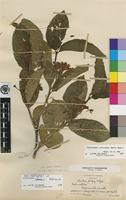
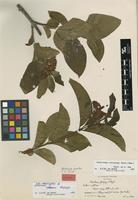
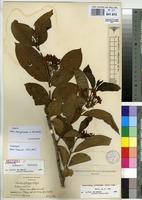
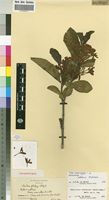
4 Images see all

Isoneotype of Holarrhena tettensis Klotzsch [family APOCYNACEAE]
Neotype of Holarrhena tettensis Klotzsch [family APOCYNACEAE]
Isoneotype of Holarrhena tettensis Klotzsch [family APOCYNACEAE]
Previous
Next

Name

Identification
Holarrhena tettensis Klotzsch [family APOCYNACEAE ] Verified by Not on sheet, Holarrhena pubescens (Buch.-Ham.) Wall. ex G.Don [family APOCYNACEAE ] (stored under name); Verified by de Kruif A.P.M., 1980
Related name
  • Holarrhena pubescens
  • Holarrhena tettensis
  • Holarrhena febrifuga

Flora

Entry for HOLARRHENA febrifuga Klotzsch [family APOCYNACEAE]
Herbarium
Royal Botanic Gardens, Kew (K)
Collection
Flora of Tropical Africa
Resource Type
Reference Sources
Entry From
Flora of Tropical Africa, Vol 4, Part 1, page 24, (1904) Author: (By Otto Stapf.)
Names
HOLARRHENA febrifuga Klotzsch [family APOCYNACEAE], in Peters, Reise Mossamb. Bot. 277. —Engl. Pfl. Ost-Afr. A. 33, 76; K. Schum. in Engl. l.c. C. 315, and in Engl. & Prantl, Pflanzenfam. iv. ii. 137. De Wild. Études Fl. Katanga, i. 101.
HOLARRHENA tettensis Klotzsch [family APOCYNACEAE], l.c. 278.
HOLARRHENA glabra Klotzsch [family APOCYNACEAE], l.c. 279.
HOLARRHENA Fischeri K. Schum. [family APOCYNACEAE], in Engl. l.c. 316, and in Engl. & Prantl, l.c.
Information
A small tree, up to 25 ft. high; young branches generally more or less pubescent or tomentose, later on glabrescent, rarely glabrous from the beginning, terete, brown, copiously dotted with lenticels. Leaves elliptic or oblong, rarely ovate or roundish, obtuse, shortly acuminate or acute, rounded or acute at the base, 2–6 in. long, 1 1/2–3 in. broad, hairy on both sides, often tomentose beneath, or glabrescent or quite glabrous; secondary nerves 8–14 on each side; veins in glabrous specimens sometimes distinct; petioles 2–3 lin. long. Corymbs pubescent to almost villous, rarely glabrous; peduncle about 3 lin. or less long; pedicels up to 5 lin. long. Calyx 3–5 lin. long, pubescent, rarely glabrous; sepals subulate, the inner with 1 or 2 small basal glands within. Corolla-tube puberulous, rarely glabrous without, about 6–8 lin. long; lobes oblong or obovate-oblong, as long as the tube or slightly shorter. Anthers slightly over 1/2 lin. long, decurrent tips very slender, about 1/3– 1/4 the length of the polliniferous part of the anther-cell. Follicles very slender, more or less constricted between the seeds, 10–12 in. long. Seeds 7–9 lin. long, coma 1 1/2 in. long.
Distribution
German East Africa Mozamb. Dist. Uhoka?, Lake Victoria, Stuhlmann, 740! Usambara; Masheua, Holst, 8837! Usaramo; Kisangiie, 1000 ft., Goetze, 36! Kingani River, Stuhlmann, 6579! Dilangita, Stuhlmann, 6630! Dindu (Dunda?), Stuhlmann, 6413! Khutu; Mbwiga, 1300–1500 ft., Speke & Grant! Unyamwezi; Usuri, Fischer, 378! Lutanda (Lutindi?), Fischer, 376! Ulugurn district, Stuhlmann! Ndalapori, Trotha!Portuguese East Africa Mozamb. Dist. Morambala Mountain, up to 3000 ft., Waller! Sena, Kirk! Tete, Peters! Kirk!Nyasaland Mozamb. Dist. Stevenson Road, 4000–5000 ft., Scott-Elliot, 8419! Blantyre, Buchanan, 32 Manganja Hills, 1000–3000 ft., Meller! Mount Malosa, Whyte! Zomba, Whyte, 89! Lake Shirwa, McClounie, 70! Namasi, Cameron, 4! and without precise locality, Buchanan, 484! 1114!Congo South Central Katanga; Lukofu, Verdick, 27!
Notes
The specimens collected by Speke and Grant and by Scott-Elliot represent a perfectly glabrous state and have eglandular calyces (H. febrifuga, var. glabra, Oliver in Trans. Linn. Soc. xxix. 108); but they differ in no other point from the typical form; on the other hand, Fischer, 378, has densely tomentose leaves. H. febrifuga is the “ Quina ” of the Portuguese of Mozambique and used as a tonic and febrifuge. It is mentioned and figured under the native name Kumbanzo in Livingstone, Miss. Trav. 648.

Related Materials

  • Terms and Conditions
  • Privacy Policy
  • Cookie Policy
  • Cookie Settings
  • Accessibility
  • Help
  • Contact Us
  • Facebook
  • Twitter
ITHAKA

JSTOR is part of ITHAKA, a not-for-profit organization helping the academic community use digital technologies to preserve the scholarly record and to advance research and teaching in sustainable ways.

©2000-2026 ITHAKA. All Rights Reserved. JSTOR®, the JSTOR logo, JPASS®, Aluka®, and ITHAKA® are registered trademarks of ITHAKA.

╳