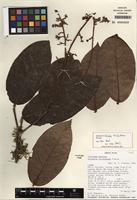
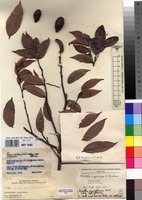
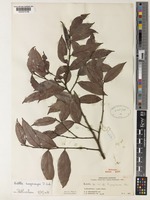
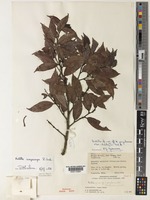
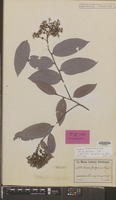
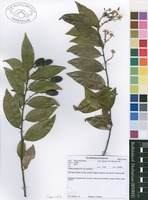
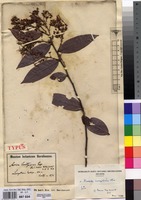
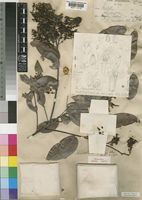
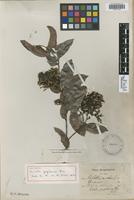
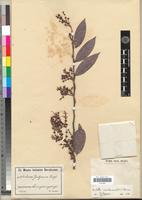
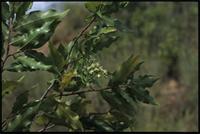
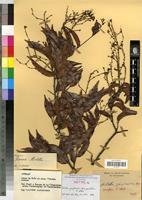
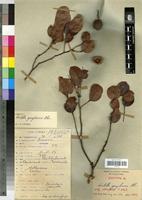
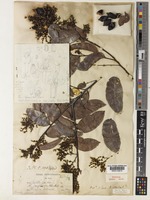
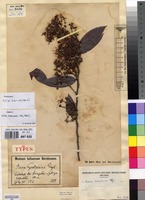
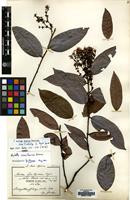
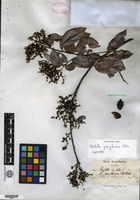
An evergreen tree up to 25 m. tall with blackish bark, or rarely a shrub. Young branchlets closely pubescent to densely villous with spreading light brown hairs; older branches commonly glabrescent, black or almost so. Leaves shortly petiolate, leathery, shining (especially on the upper surface), ovate-elliptic to oblong-elliptic, 3.8–8.5 × 1.4–4.3 cm. (commonly about 8 × 4 cm.), ± acute or shortly acuminate, basally short-cuneate to sub-cordate but commonly rounded or ± so, glabrous (or pubescent on the midrib and nerves beneath when immature), reticulately nerved on both sides, but more obscurely so beneath. Inflorescence a terminal or axillary dense panicle up to 15(–18) × 11 (–14) cm., the branchlets velvety; lower bracts ovate to oblong-lanceolate, ± densely pubescent and eglandular; upper bracts ovate-reniform, usually with many obvious unequally-stalked glands on the margins (rarely eglandular, or with the glands sessile and hidden in the indumentum). Flowers greenish-white. Calyx-tube 6–9 mm. long, 1.1–1.8 mm. broad, slightly expanded above, abruptly enlarged at the base, hairy; lobes oblong, 4–5 mm. long, usually glandular on the margins. Petals scarcely exceeding the calyx-lobes, oblong-elliptic to obovate, ± twisted. Stamens up to 1 cm. long (? longer), long-exserted; staminodes very short. Ovary densely shaggy; style 1.2 cm. long (? longer), with many ± spreading hairs in the lower part. Fruit dark brown, ellipsoid, basally narrowed, 1.8–2.3(–2.6) × 1.1–1.2 cm., obtuse; pericarp externally subglabrous, densely lanate within. Fig. 8/5, 6, p. 57.