

Compilation
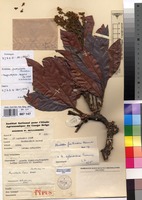
Hirtella fruticulosa
1 Images see all
Name
Identification
Hirtella fruticulosa Hauman [family CHRYSOBALANACEAE ] Verified by Not on sheet, Magnistipula sapinii De Wild. [family CHRYSOBALANACEAE ] (stored under name); Verified by Not on sheet,
Related name
- Magnistipula sapinii
- Hirtella fruticulosa
Flora
Entry for Magnistipula sapinii De Wild. [family CHRYSOBALANACEAE]
Herbarium
Royal Botanic Gardens, Kew (K)
Collection
Flora Zambesiaca
Resource Type
Reference Sources
Entry From
FZ, Vol 4, Part 0, page 33, (1978) Author: F. White
Names
Magnistipula sapinii De Wild. [family CHRYSOBALANACEAE], in Bull. Jard. Bot. Brux. 3: 262 (1911); 4: 81 (1914). TAB. 12 fig. A. Type from Zaire.
Hirtella eglandulosa Greenway [family CHRYSOBALANACEAE], in Kew Bull. 1928: 199 (1928).—Hauman in F.C.B. 3: 39 (1952).—F. White, F.F.N.R.: 69 (1962). Type: Zambia, Barotseland, Mongu Distr., Sefula, 915 m., fl. viii.1921, Borle 254 (FHO; K, holotype; PRE).
Hirtella sapinii De Wild. A. Chev. [family CHRYSOBALANACEAE], in Bull. Mus. Hist. Nat. Paris, Sér. 2, 3: 195 (1931).—Hauman, tom. cit.: 38 (1952). Type as for Manistipula sapinii.
Hirtella fruticulosa Hauman [family CHRYSOBALANACEAE], in Bull. Jard. Bot. Brux. 21: 182 (1951). Types from Angola and Zaire.
Magnistipula eglandulosa Greenway R. A. Grah. [family CHRYSOBALANACEAE], in Kew Bull. 1957: 407 (1957).— Mendes in C.F.A. 4: 19 (1970). Type as for Hirtella eglandulosa.
Information
Rhizomatous geoxylic suffrutex usually less than 20 cm. tall; young branchlets, petioles and inflorescence-axes fulvous-tomentellous. Leaf-lamina up to 16 x 4·5 cm., oblanceolate, apex usually acutely subacuminate, rarely cuspidate or rounded, base usually obtuse, rarely acute, sparsely strigulose on both surfaces, especially on the nerves, venation closely reticulate, slightly prominent beneath, more definitely so above; petiole c. 0·2 cm. long; stipules c. 0·6 cm. long, subulate, persistent. Inflorescence up to 17 x 4 cm., terminal, an elongate, very contracted thyrse with very few, markedly ascending lateral branches, most flowers being borne in subsessile cymules on the main axis; bracts c. 0·3 cm. long, narrowly deltate, with a pair of large sessile glands at base; pedicels 0·2–0·5 cm. long. Receptacle-tube slightly curved, slightly gibbous, adaxial length 0·4 cm., abaxial length 0·7 cm., sepals 0·35–0·5 cm. long. Petals 0·5–0·6 cm. long. Ungulate, very shortly unguiculate. Fertile stamens 7; filaments 0·35–0·4 cm. long; staminodes 8, 0·2 cm. long, narrowly deltate, fused in lower 1/2 to form a “comb”. Style 0·4 cm. long, glabrous. Drupe c. 3·5 x 2·0 cm., ellipsoid, fulvous-tomentose.
Habitat
Apparently confined to Kalahari Sands, where it is characteristic of seasonally waterlogged sites such as the edges of dambos.
Distribution
Zambia W Mwinilunga Distr., N. of Kalene Hill, fl. 24.ix.1952, Angus 535 (BM; COI; FHO; K).Zambia B Mongu Distr., Mombo, fl. 17.xi.1962, Robinson 5503 (K; SRGH).
Distribution (external)
Angola
Zaire
Notes
The plant from which the type of H. eglandulosa was obtained was described by its collector as a “small tree”. No subsequent observer in the field (including myself) has been able to confirm this. Although the type specimen consists of flowering shoots arising from the previous year’s growth and is not attached to a subterranean rootstock, there can be little doubt that it was collected from a geoxylic suffrutex which had escaped burning the year before. It can easily be matched with similar specimens which are demonstrably suffrutices or have been described by their collectors as such. Magnistipula sapinii was also described by its author as a small tree, but this again has not been subsequently confirmed. Some of the material cited by Hauman (e.g. Overlaet 941) was undoubtedly collected from suffruticose plants. Material cited by Hauman as H. eglandulosa and H. sapinii is, to my eye, indistinguishable.