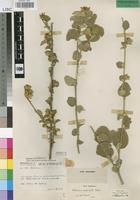
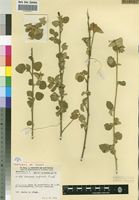
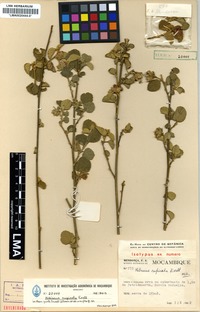
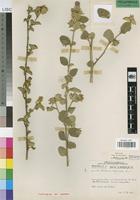
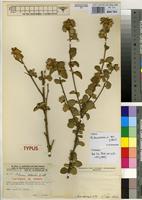
Shrub or perennial herb 1·5 m. tall; stems densely tomentose. Leaf-lamina up to 5 × 4·5 cm., broadly ovate to suborbicular, stellate-tomentose on both surfaces, apex rounded, margin crenate-dentate, base rounded or truncate 5–7 nerved; petiole up to 1 cm. long; stipules 2–3 mm. long, subulate. Flowers 1·5 cm. in diam., red, solitary in the axils of the upper leaves and leaf-like bracts; peduncle 1–5 cm. long, articulated mm. below the apex. Epicalyx of c. 7 bracts; bracts 5–6 × 1·5–2 mm., linear or linear-oblong. Calyx 5–12 mm. long, stellate-tomentose; lobes up to 12 × 4·5 mm., lanceolate-triangular, shortly connate at the base. Petals 10–20 × 5–10 mm., obovate. Staminal tube 2 mm. long; free parts of filaments 3–3·5 mm. long. Style-branches 5–6 mm. long. Capsule 8–10 mm. in diam., subglobose, minutely pubescent. Seeds with silky floss.
Habitat
Among rocks.
Range
Known only from the locality stated.
Distribution
Mozambique T Serra de Zobue, fl. & fr. 3.x.1942, Mendonça 579 (LISC).
Notes
It was difficult to decide whether to describe this as a new species. The leaves and indumentum are very similar to those of H. aponeurus from which it differs, however, in the length of the free parts of the filaments of the stamens (only 0·5–1 mm. long in H. aponeurus). The closest affinity is undoubtedly with H. shirensis from which it can be separated by the leaf-shape, indumentum (more densely tomentose) and the shorter staminal tube. There are some fuscous hairs in the indumentum but these are far less conspicuous than in H. shirensis. Future collections will show whether these differences can be maintained.