JSTOR Global Plants Home
  • Home
  • Browse
  • About
  • Access
  • Account
    • Saved Items
    • Profile
  • Log in

Global Plants

Skip to Main Content
  • JSTOR Global Plants Home
  • Global Plants

    • Browse
    • About
    • Access
    • Account
      • Saved Items
      • Profile
Log in
  • Browse
  • About
  • Access
  • Account
    • Saved Items
    • Profile
Advanced Search

Compilation
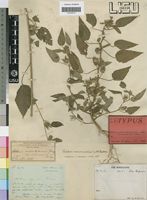
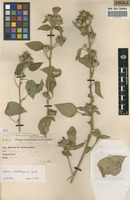
Hibiscus mossamedensis

2 Images see all

Isotype of Hibiscus rhabdotospermus var. mossamedensis Hiern [family MALVACEAE]
Filed as Hibiscus rhabdotospermus Garcke [family MALVACEAE]
Previous
Next

Name

Identification
Hibiscus mossamedensis Exell & Mendonça [family MALVACEAE ] (stored under name); Verified by Mendonça, 1936 Isotype of Hibiscus rhabdotospermus [family MALVACEAE ] Verified by Mendonça, 1936
Related name
  • Hibiscus rhabdotospermus
  • Hibiscus mossamedensis

Flora

Entry for Hibiscus rhabdotospermus Garcke [family MALVACEAE]
Herbarium
Royal Botanic Gardens, Kew (K)
Collection
Flora Zambesiaca
Resource Type
Reference Sources
Entry From
FZ, Vol 1, Part 2, page 420, (1961) Author: A. W. Exell
Names
Hibiscus rhabdotospermus Garcke [family MALVACEAE], in Bot. Zeit. 7: 839 (1849). — Mast. in Oliv., F.T.A. 1: 200 (1868). Type from “Africa orientalis”.
Hibiscus mossamedensis Hiern Exell & Mendonça [family MALVACEAE], in Journ. of Bot. 74: 138 (1936); C.F.A. 1, 1: 170(1937). Type as above.
Hibiscus cordatus Hochst. ex Webb [family MALVACEAE], Fragm. Fl. Aethiop.-Aegypt.: 45 (1854) non H. cordatus D. Dietr. (1847). — Hochr. in Ann. Conserv. Jard. Bot. Genève, 4: 164 (1900). — Burtt Davy, F.P.F.T. 2: 281 (1932). Type from Ethiopia.
Hibiscus rhabdotospermus var. mossamedensis Hiern [family MALVACEAE], Cat. Afr. Pl. Welw. 1: 70 (1896). Type from Angola (Mossâamedes).
Information
Herb 1–2 m. tall; stems crisped-pubescent or tomentose and with sparse to dense stellate or simple bristles. Leaf-lamina 3·5–12 × 2·5–10 cm., ovate, broadly ovate or suborbicular, pubescent to densely pubescent with few to numerous branched or simple bristles mainly on the lower surface, apex acute, margin serrate, base cordate, truncate or broadly cuneate; petiole up to 8·5 cm. long, hairy like the stems; stipules up to 5 mm. long, filiform. Flowers up to 5 cm. in diam., yellow with reddish or purple centre, solitary, axillary; peduncle up to 4 cm. long, articulated above the middle. Epicalyx of c. 10 bracts; bracts up to 12 mm. long, filiform, usually extending beyond the sinuses formed by the calyx-lobes. Calyx up to 25 mm. long; lobes elongate-acuminate, joined at the base for up to 8 mm. Petals up to 3 × 2 cm., obovate-elliptic, stellate-pubescent outside where not overlapping. Staminal tube c. 18 mm. long; free parts of filaments 0·5–1·5 mm. long. Style-branches 2 mm. long. Capsule 12 × 10 mm., subglobose, densely pubescent; awns of the carpels up to 5 mm. long. Seeds 2·3 × 1·8 mm., angular-subreniform, sparsely white-lepidote.
Distribution
Mozambique MS Lupata, fr. 20.iv.1860, Kirk (K).Zimbabwe E Melsetter Distr., Hot Springs, 610 m., fl. & fr. 24.ii.1952, Chase 4380 (BM; SRGH).Mozambique T Tete, fl. & fr. 1859, Kirk (K).Zimbabwe N Urungwe Distr., Zambezi valley, 520 m., fl. 24.ii.1953, Wild 4103 (BM; PRE; SRGH).Botswana N Kwebe Hills, 1000 m., fl. & fr. 8.iii.1898, Lugard 215 (K).
Distribution (external)
Angola
SW. Africa
Sudan
Kenya
Notes
Recent material has linked H. rhabdotospermus and H. mossamedensis by a series of intermediates. Specimens from the south and west of our area tend to be more setose until, in SW. Africa, separation from H. engleri becomes difficult. Wild 4103, cited above, is a very luxuriant specimen with much larger leaves and longer stipules than usual.

Related Materials

  • Terms and Conditions
  • Privacy Policy
  • Cookie Policy
  • Cookie Settings
  • Accessibility
  • Help
  • Contact Us
  • Facebook
  • Twitter
ITHAKA

JSTOR is part of ITHAKA, a not-for-profit organization helping the academic community use digital technologies to preserve the scholarly record and to advance research and teaching in sustainable ways.

©2000-2026 ITHAKA. All Rights Reserved. JSTOR®, the JSTOR logo, JPASS®, Aluka®, and ITHAKA® are registered trademarks of ITHAKA.

╳