

Compilation
Hibiscus heterochlamys
1 Images see all
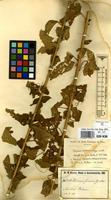
Name
Identification
Isotype of Hibiscus heterochlamys Ulbr. [family MALVACEAE ] Verified by Not on sheet, Hibiscus shirensis Sprague & Hutch. [family MALVACEAE ] (stored under name); Verified by Not on sheet,
Related name
- Hibiscus shirensis
- Hibiscus heterochlamys
Flora
Entry for Hibiscus shirensis Sprague & Hutch. [family MALVACEAE]
Herbarium
Royal Botanic Gardens, Kew (K)
Collection
Flora Zambesiaca
Resource Type
Reference Sources
Entry From
FZ, Vol 1, Part 2, page 420, (1961) Author: A. W. Exell
Names
Hibiscus shirensis Sprague & Hutch. [family MALVACEAE], in Kew Bull. 1907: 47 (1907). — Bak. f. in Journ. Linn. Soc., Bot. 40: 28 (1911). — Eyles in Trans. Roy. Soc. S. Afr. 5: 416 (1916). — Garcia in Bol. Soc. Brot., Ser. 2, 20: 39 (1946). — Cufod. in Ann. Naturh. Mus. Wien, 56: 57 (1948). — Brenan in Mem. N.Y. Bot. Gard. 8, 3: 224(1953). TAB. 90 fig. B. Type: Nyasaland, banks of Likangola R., Buchanan 385 (K).
Hibiscus heterochlamys Ulbr. [family MALVACEAE], in Notizbl. Bot. Gart. Berl. 7: [367] (1920). Syn-types from Uganda, Tanganyika and Nyasaland, Shire Highlands, Buchanan (B†).
Information
Shrub or perennial herb, up to 2–4(5) m. tall; stems with fuscous stellate hairs and an underlying pubescence of finer, pale green, stellate hairs. Leaf-lamina up to 10 × 7 cm., ovate to ovate-lanceolate with a tendency to become 3-lobed, stellate-pubescent to stellate-tomentose on both surfaces with occasional larger fuscous stellate hairs, apex acute, margin irregularly serrate, base obtuse to cordate 5–7-nerved. Flowers 2–3 cm. in diam., red, solitary, axillary and forming terminal racemes (sometimes corymbose) at the apices of the stems by reduction of the upper leaves; peduncles up to 6 cm. long but usually much shorter. Epicalyx of 6–8 bracts; bracts 2–7 mm. long, filiform to linear, silvery-green when dried and contrasting strongly with the fuscous calyx. Calyx 8–14 mm. long, fuscous-pilose; lobes 5–13 × 2–5 mm., narrowly lanceolate, acute. Petals 7–20 mm. long, obovate, with a few scattered setulose stellate hairs. Staminal tube 4–5 mm. long; free parts of filaments 2–3(5) mm. long. Style-branches 3–5 mm. long. Capsule 10 mm. in diam., subglobose, puberulous. Seeds with long white silky hairs and a short white pubescence.
Habitat
In Brachystegia woodland, wooded grassland, secondary thickets and cultivated ground
Altitude range
up to about 1250 m.
1250
0
inferred only top
Distribution
Mozambique MS Manica, Serra de Vumba, 1000 m., fl. & fr. 25.iii.1948, Garcia in Mendonça 716 (BM; LISC).Mozambique Z 16 km. SW. of Guruè, fl. & fr. 6.vii.1942, Hornby 4565 (PRE).Malawi S Zomba, Mulunguzi R., fl. & fr. 17.vi.1954, Banda 14 (BM).Malawi C Dedza, Golomoti Escarpment, fl. & fr. 13.vi.1950, Wiehe N. 586 (SRGH).Zambia W Kitwe, fl. & fr. lO.v.1958, Fanshawe 2272 (K).Mozambique N Vila Cabral, Lichinga, fl. & fr. 8.i.1955, Torre 432 (BM; COI; K; LISC).Malawi N Rumpi Distr., near Nchena-Chena, fl. & fr. 12.v.1952, White 2841 (FHO).Zimbabwe E Chirinda, 1160m., fl. & fr. iv.1906, Swynnerton 298 (BM; K).Zambia N Fort Rosebery, Lake Bangweulu, fl. & fr. 23.vni.1952, White 3143 (FHO).
Distribution (external)
Tanganyika
Belgian Congo (Katanga)
Notes
Barbosa 1110 (LISC) from Mozambique, Serra do Garuso (MS), has exceptionally large flowers but appears to be this species.