JSTOR Global Plants Home
  • Home
  • Browse
  • About
  • Access
  • Account
    • Saved Items
    • Profile
  • Log in

Global Plants

Skip to Main Content
  • JSTOR Global Plants Home
  • Global Plants

    • Browse
    • About
    • Access
    • Account
      • Saved Items
      • Profile
Log in
  • Browse
  • About
  • Access
  • Account
    • Saved Items
    • Profile
Advanced Search

Compilation
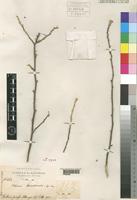
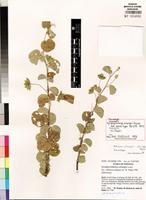
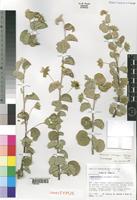
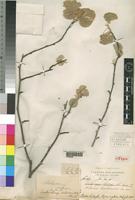
Hibiscus erlangeri

4 Images see all

Hibiscus benadirensis Mattei [family MALVACEAE]
Isoneotype of Hibiscus erlangeri (Gürke) Thulin [family MALVACEAE]
Symphyochlamys erlangeri Gürke [family MALVACEAE]
Hibiscus benadirensis Mattei [family MALVACEAE]
Previous
Next

Name

Identification
Hibiscus erlangeri (Gürke) Thulin [family MALVACEAE ] (stored under name); Verified by Data not digitized, Symphyochlamys erlangeri Gürke [family MALVACEAE ] Verified by Data not digitized,
Related name
  • Symphyochlamys erlangeri
  • Hibiscus benadirensis
  • Hibiscus erlangeri

Flora

Entry for HIBISCUS erlangeri (Gürke) Thulin [family MALVACEAE]
Herbarium
Royal Botanic Gardens, Kew (K)
Collection
Flora Somalia
Resource Type
Reference Sources
Entry From
Flora Somalia, Vol 2, (1999) Author: by M. Thulin [updated by M. Thulin 2008]
Names
HIBISCUS erlangeri (Gürke) Thulin [family MALVACEAE], (1998);. type: S1, “Korkora”, Ellenbeck 2227 (B holo., destr.); S1, Ceel Cilaan, 2°26’N, 42°33’E, Thulin, Hedrén & Abdi Dahir 7750 (UPS neo., FT K isoneo.). Fig. 31 A–F. Plate 1 D.
Symphyochlamys erlangeri Gürke [family MALVACEAE], (1903);. type: S1, “Korkora”, Ellenbeck 2227 (B holo., destr.); S1, Ceel Cilaan, 2°26’N, 42°33’E, Thulin, Hedrén & Abdi Dahir 7750 (UPS neo., FT K isoneo.). Fig. 31 A–F. Plate 1 D.
HIBISCUS benadirensis Mattei [family MALVACEAE], (1916);. types: S3, near “Salagle”, Paoli 560 (FT syn.), near “Allengo”, Paoli 862 (FT syn.).
Information
Slender shrub, up to c. 4 m tall; young branchlets floccose-tomentose with small whitish stellate hairs. Leaves with 2–30 mm long petiole; stipules subulate; blade suborbicular to reniform, not lobed, 1–5 x 1–7 cm, cordate at the base, rounded to subacute or emarginate and ± mucronate at the apex, with entire or indistinctly denticulate margins, pubescent above, floccose-tomentose beneath. Flowers solitary in leaf axils; pedicels 10–50 mm long, articulated in upper part. Epicalyx campanulate, 9–11-lobed with the segments united for at least half their length, 10–18 mm long, ± sparsely tomentose, glabrescent, with distinct venation; lobes triangular, apiculate. Calyx 10–13 mm long, splitting almost to the base into 2(–3) ovate lobes, floccose-tomentose, indistinctly veined; lobes often 2-toothed at the tip. Petals 25–35 mm long, yellow with purple base; staminal tube 10–15 mm long. Capsule c. 10 mm long, subglobose, glabrous; valves reticulately veined. Seeds c. 3 mm long, with long, white hairs.
Range
S1, 3 not known elsewhere.
Altitude range
100–320 m.
Distribution
SOMALIA Gillett & Hemming 24742; Hemming 83/164; Thulin & Bashir Mohamed 6887.
Notes
Chirir, gasaajo, gesaji (Som.). H. erlangeri has previously been placed in the monotypic genus Symphyochlamys, and Vollesen in Fl. Eth. 2(2): 212–214 (1995) argued that its “epicalyx and calyx structures are unique in African Malvaceae ”. An epicalyx of united bracts is also found in H. tiliaceus L., but this is in other respects very different from H. erlangeri. More similar is H. socotranus Lucas from limestone rocks on Socotra, which also has an epicalyx of more or less united bracts, rounded leaves with subentire margins, large yellow flowers with a purple centre, and a subglobose capsule. A close relationship between H. erlangeri and H. socotranus is possible, but the two differ clearly in, e. g., the calyx which is 5-lobed in H. socotranus, but splitting into 2(–3) lobes in H. erlangeri . However, the lobes are often more or less toothed at the apex, which indicates that the calyx in H. erlangeri is derived from a normal 5-lobed type. Other characteristics of H. erlangeri are the comose seeds (glabrous in H. socotranus), the glabrous capsule (hairy in H. socotranus), and the 9–11-lobed epicalyx (7-lobed in H. socotranus). Vollesen (1995) also stated that the style of H. erlangeri is more or less hairy near the apex and divided into short broad branches. This could not be confirmed in the material studied by me, where the style was found to be glabrous with slender branches and capitate stigmas, just as in Hibiscus in general.

Related Materials

  • Terms and Conditions
  • Privacy Policy
  • Cookie Policy
  • Cookie Settings
  • Accessibility
  • Help
  • Contact Us
  • Facebook
  • Twitter
ITHAKA

JSTOR is part of ITHAKA, a not-for-profit organization helping the academic community use digital technologies to preserve the scholarly record and to advance research and teaching in sustainable ways.

©2000-2026 ITHAKA. All Rights Reserved. JSTOR®, the JSTOR logo, JPASS®, Aluka®, and ITHAKA® are registered trademarks of ITHAKA.

╳