JSTOR Global Plants Home
  • Home
  • Browse
  • About
  • Access
  • Account
    • Saved Items
    • Profile
  • Log in

Global Plants

Skip to Main Content
  • JSTOR Global Plants Home
  • Global Plants

    • Browse
    • About
    • Access
    • Account
      • Saved Items
      • Profile
Log in
  • Browse
  • About
  • Access
  • Account
    • Saved Items
    • Profile
Advanced Search

Compilation
Heuchera flabellifolia

5 Images see all

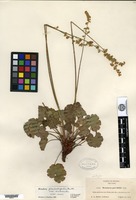
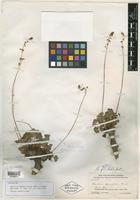
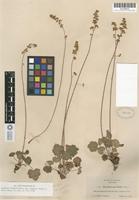
Isotype of Heuchera flabellifolia Rydberg var. subsecta Rosendahl, Butters & Lakela [family SAXIFRAGACEAE]
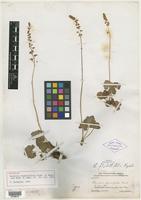
Isotype of Heuchera flabellifolia Rydb. [family SAXIFRAGACEAE]
Holotype of Heuchera flabellifolia Rydb. [family SAXIFRAGACEAE]
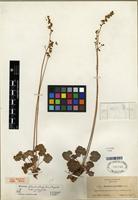
Type of Heuchera flabellifolia var. subsecta Rosend., Butters & Lakela [family SAXIFRAGACEAE]
Isotype of Heuchera flabellifolia Rydb. var. subsecta Rosendahl, Butters & Lakela [family SAXIFRAGACEAE]
Previous
Next

Name

Identification
Isotype of Heuchera flabellifolia Rydb. [family SAXIFRAGACEAE ] (stored under name); Verified by Not on sheet,
Related name
  • Heuchera parvifolia
  • Heuchera flabellifolia
Common name
  • Littleleaf or common alum-root, Flora of North America Vol. 8

Flora

Entry for Heuchera parvifolia Nuttall ex Torrey & A. Gray [family SAXIFRAGACEAE]
Herbarium
Flora of North America (FNA)
Collection
Flora of North America
Resource Type
Reference Sources
Entry From
Flora of North America, Vol 8,
Names
Heuchera parvifolia Nuttall ex Torrey & A. Gray [family SAXIFRAGACEAE], Fl. N. Amer., 1: 581. 1840 ,
Heuchera duranii Bacigalupi [family SAXIFRAGACEAE]
Heuchera flabellifolia Rydberg [family SAXIFRAGACEAE]
Heuchera flabellifolia var. subsecta Rosendahl, Butters & Lakela [family SAXIFRAGACEAE]
Heuchera flavescens Rydberg [family SAXIFRAGACEAE]
Heuchera nivalis Rosendahl, Butters & Lakela [family SAXIFRAGACEAE]
Heuchera parvifolia var. arizonica Rosendahl, Butters & Lakela [family SAXIFRAGACEAE]
Heuchera parvifolia var. flavescens (Rydberg) Rosendahl, Butters & Lakela [family SAXIFRAGACEAE]
Heuchera parvifolia var. nivalis (Rosendahl, Butters & Lakela) Á. Löve, D. Löve & B. M. Kapoor [family SAXIFRAGACEAE]
Heuchera parvifolia var. utahensis (Rydberg) Garrett [family SAXIFRAGACEAE]
Heuchera utahensis Rydberg [family SAXIFRAGACEAE]
Treatment Author(s)
Elizabeth Fortson Wells
Barbara Greene Shipes
Information
Herbs acaulescent; caudex branched or unbranched. Flowering stems 4–71 cm, short stipitate-glandular. Leaves: petiole glabrate or short stipitate-glandular; blade orbiculate or reniform to broadly cordate, shallowly to deeply 5–7-lobed, 1–8 cm, base cordate, lobes rounded, margins dentate, apex obtuse, surfaces (glaucous), glabrate or short stipitate-glandular, sometimes long stipitate-glandular along veins abaxially, glabrate or short stipitate-glandular adaxially. Inflorescences dense at anthesis, diffuse in fruit. Flowers: hypanthium radially symmetric, free 0.4–1 mm, greenish or cream to yellow, flat, saucer-shaped, 2.5–5 mm, short stipitate-glandular and sometimes sparsely long stipitate-glandular; sepals reflexed, green- or red-tipped, equal, 0.5–1.5 mm, apex acute; petals reflexed, white, elliptic or rhombic, (clawed), unlobed, 0.7–3 mm, margins entire; nectary tissue or disc encircling base of styles at junction of ovary and free hypanthium yellow or orange, exposed; stamens included 0.5 mm, (incurved over stigmas); styles included 1–1.5 mm, 0.3–0.5 mm, 0.1+ mm diam. Capsules ovoid or subglobose, 3–6 mm, beaks divergent, not papillose. Seeds dark brown, ovoid-ellipsoid, 0.6–1 mm. 2n = 14, 28.
Phenology
Flowering May–Sep
Altitude range
1200–3900 m
Distribution
USA Ariz.USA Calif.USA Colo.USA IdahoUSA Mont.USA Nev.USA N.Mex.USA UtahUSA Wyo.Canada Alta.Canada Sask.
Discussion
The specific epithet, parvifolia, is similar to that of another species, Heuchera parviflora, but these two species are distinct and have legitimate names. C. O. Rosendahl et al. (1936) recognized five species and eight varieties in the H. parvifolia complex, based on differences in development of the nectary disc, shapes of the hypanthium, disc, and petals, width of the leaves, lengths of the peduncle and flowers, type of indument of the petiole and peduncle, height of the inflorescence, and degree of lobing of the leaves. Some of their varieties intergrade completely. As P. K. Holmgren and N. H. Holmgren (1997) observed, expressions of some of these characters vary with the stage of development of the plant, and there seems to be no correlation of morphology with geographical distribution. Accordingly, we do not recognize infraspecific taxa in this polymorphic species.
The Blackfoot Indians used pounded, wet roots of Heuchera parvifolia for rheumatism and sores, and an infusion of the roots as an eyewash. They applied a poultice of chewed roots to wounds and sores, as a styptic, and to cold sores and children’s mouth cankers. The Navajo used the plant as a panacea or “life medicine” and for rat bites. They took a decoction of the roots for stomachaches and to ease the delivery of the placenta, and an infusion of the roots as a lotion for venereal disease (D. E. Moerman 1998).

Related Materials

  • Terms and Conditions
  • Privacy Policy
  • Cookie Policy
  • Cookie Settings
  • Accessibility
  • Help
  • Contact Us
  • Facebook
  • Twitter
ITHAKA

JSTOR is part of ITHAKA, a not-for-profit organization helping the academic community use digital technologies to preserve the scholarly record and to advance research and teaching in sustainable ways.

©2000-2026 ITHAKA. All Rights Reserved. JSTOR®, the JSTOR logo, JPASS®, Aluka®, and ITHAKA® are registered trademarks of ITHAKA.

╳