

Compilation
Hermbstaedtia rogersii
1 Images see all
Name
Identification
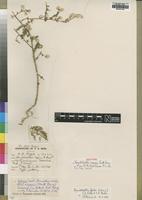
Isotype of Hermbstaedtia rogersii Burtt Davy [family AMARANTHACEAE ] Hermbstaedtia fleckii (Schinz) Baker&C.B.Clarke [family AMARANTHACEAE ] (stored under name); Verified by Townsend,C.C.,
Related name
- Hermbstaedtia fleckii
- Hermbstaedtia rogersii
Flora
Entry for Hermbstaedtia fleckii Schinz Baker & Clarke [family AMARANTHACEAE]
Herbarium
Royal Botanic Gardens, Kew (K)
Collection
Flora Zambesiaca
Resource Type
Reference Sources
Entry From
FZ, Vol 9, Part 1, page 28, (1988) Author: C. C. Townsend
Names
Hermbstaedtia fleckii Schinz Baker & Clarke [family AMARANTHACEAE], in F.T.A. 6, 1: 28 (1909). TAB. 9 fig. B. Type from Namibia.
Celosia namoensis Schinz [family AMARANTHACEAE], in Viert. Nat. Ges. Zurich 76: 134 (1931). Type from Namibia.
Hermbstaedtia rogersii Burtt Davy [family AMARANTHACEAE], in F.P.F.T. 1: 43 (1926). Type from Transvaal.
Celosia fleckii Schinz [family AMARANTHACEAE], in Bull. Herb. Boiss. Sér. 2, 3: 8 (1903).—Podlech & Meeuse in Merxm. Prodr. Fl. SW. Afr. 33: 12 (1966).
Information
Annual herb, erect, simple or branched from the base upwards, or occasionally branched from the base and decumbent, c. 15–60 cm. tall. Stem and branches terete and sulcate to more or less quadrangular, striate, thinly to moderately furnished with pale to yellowish multicellular hairs. Leaves linear to linear-oblanceolate, 15–60 (80) × 1–6 (8) mm., acute or subacute, attenuate to the base, subglabrous or the midrib and primary venation of the inferior surface together with the margins more or less furnished with divergent scabrid hairs, surfaces with softer multicellular hairs; superior and branch leaves smaller and narrower, small-leaved axillary shoots commonly present. Inflorescences terminal on the stem and branches, 1.5–15 (25) × (0.75) 1–1.5 cm., spicate, pinkish-white to bright magenta, the axis densely furnished with multicellular hairs. Bracts narrowly lanceolate, 2–4 mm. long, hyaline with a whitish central band, very acute with a shortly excurrent midrib, glabrous or ciliate, sometimes erose-denticulate; bracteoles similar but somewhat shorter and broader. Tepals elliptic-oblong, 3.5–6 mm. long, glabrous, the outer with a shortly excurrent midrib and 1–2 progressively shorter pairs of laterals (one or more of which is occasionally branched), narrowly hyaline-bordered; inner tepals similar but slightly narrower, more narrowed below and often only 3-nerved. Stamens fused into a tube for usually two thirds to three quarters of their length, 1–1.5 mm. shorter than the tepals; free apical portion more or less rounded, truncate or incised on each side of the antheriferous apex. Ovary c. 3–7-ovulate, rounded or slightly tapering above; stigmas (2) 3, spreading or recurved and much shorter than the 1.5–3 mm. long, finally more or less exserted style. Capsule c. (2) 3–4 mm. long, oblong-ovoid, circumcissile, the lid campanulate and rather shortly narrowed into the style, almost smooth or mammilose with low to prominently rounded colourless verrucae. Seeds c. 1 mm. in diam.
Habitat
Usually recorded from sand (red or grey-brown Kalahari) on basalt or paragneiss, in \"pans\", valley bottom, alluvium or river banks, along irrigation canals or in open woodland
Altitude range
452–1000 m.
1000
452
Distribution
Botswana SE Shashi Siding, 28.ii.1967, McClintock K34 (K).Botswana SW Mahulitlhaki Pan, c. 340 km. W. of Kanye, 22–27.v.1967 Cox 313 (K). Bohelabatho Pan, 15.i.1976, Skarpe S-6 (PRE; SRGH).Zimbabwe S Beitbridge Distr., Limpop Ranches Rd., between turn off from Bulawayo Rd. and Umzingwane R. 25.iii.1959, Drummond 6022 (K; LISC; SRGH).Botswana N S. of Mandunyane, Bokalaka area, 15.ii.1967, McClintock K62 (K).
Distribution (external)
S. Africa
Namibia (Transvaal and Cape Prov.)
Notes
Close to H. scabra but the ovary and capsule lid campanulate, not long-conical, and either smooth or rounded-verruculose and without the blunt, elongate unicellular papillose hairs of that species.The types of H. fleckii and H. rogersii apparently differ in no respect save the strongly verrucose ovary of the latter. Not surprisingly, the Zimbabwean material of the affinity resembles H. rogersii, since most of it is from Beitbridge Distr. - only just across the border from the type locality (Messina) of H. rogersii. Namibian material of H. fleckii has almost smooth ovaries, as has material from N. and W. Botswana, while gatherings from SE. Botswana have feebly (Coleman 102) to quite obviously (Cox 313) verruculose ovaries on boiling out. The variation, as far as one can judge without field studies, appears to be clinal and thus scarcely recognisable by formal taxonomic rank.I have examined the holotype of H. longistyla C.B. Clarke (Damara-land, T.G. Een s.n. (1879), BM) and find it conspecific with H. argenteiformis Schinz, not the present species as opined by some authorities.