JSTOR Global Plants Home
  • Home
  • Browse
  • About
  • Access
  • Account
    • Saved Items
    • Profile
  • Log in

Global Plants

Skip to Main Content
  • JSTOR Global Plants Home
  • Global Plants

    • Browse
    • About
    • Access
    • Account
      • Saved Items
      • Profile
Log in
  • Browse
  • About
  • Access
  • Account
    • Saved Items
    • Profile
Advanced Search

Compilation
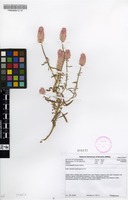
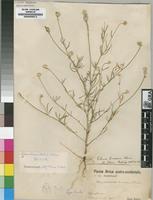
Hermbstaedtia linearis

2 Images see all

Filed as Hermbstaedtia linearis Schinz [family AMARANTHACEAE]
Isotype of Hermbstaedtia linearis Schinz [family AMARANTHACEAE]
Previous
Next

Name

Identification
Isotype of Hermbstaedtia linearis Schinz [family AMARANTHACEAE ] (stored under name); Verified by Not on sheet,
Related name
  • Hermbstaedtia linearis

Flora

Entry for Hermbstaedtia linearis Schinz [family AMARANTHACEAE]
Herbarium
Royal Botanic Gardens, Kew (K)
Collection
Flora Zambesiaca
Resource Type
Reference Sources
Entry From
FZ, Vol 9, Part 1, page 28, (1988) Author: C. C. Townsend
Names
Hermbstaedtia linearis Schinz [family AMARANTHACEAE], in Verh. Bot. Ver. Prov. Brand. 31: 210 (1890)—Baker & Clarke in F.T.A. 6, 1: 27 (1909). TAB. 9 fig. D. Type from Namibia.
Celosia linearis Schinz Schinz [family AMARANTHACEAE], in Engl. & Prantl Pflanzenfam. ed. 2, 16 C: 30 (1934).—Meeuse in Kirkia 2: 159 (1961).–Podlech & Meeuse in Merxm. Prodr. Fl. SW. Afr. 33: 13 (1966).
Hermbstaedtia schinzii C.B. Clarke [family AMARANTHACEAE], in F.T.A. 6, 1: 27 (1909). Type from Namibia.
Celosia schinzii C.B. Clarke Suesseng. [family AMARANTHACEAE], in Mitt. Bot. Staatss. München 1: 42 (1952). Type as above.
Information
Erect annual herb, 8–35 cm. tall, with several branches from the base and frequently branched above. Stem and branches terete to bluntly quadrangular, striate, glabrous or sparingly furnished in the upper parts with fine multicellular hairs. Leaves narrowly linear, those of the main stem 16–45 × 1–2 (3) mm., obtuse to acute, glabrous or very finely and sparingly pilose; superior and branch leaves diminishing, sterile axillary fascicles sometimes present. Inflorescence terminal on the stem and branches, rounded-capitate to spicate, c. 0.7–15 × 0.75–1 cm., pink-tinged to deep rose-pink, the axis more or less densely furnished with white multicellular hairs. Bracts lanceolate-ovate, 2–3 mm. long, hyaline, acuminate with an aristate long-excurrent midrib, glabrous or sparingly ciliate; bracteoles more or less similar. Tepals narrowly oblong-elliptic, (3) 4–5 mm. long, glabrous, narrowly hyaline-bordered, with a very shortly excurrent midrib and a single pair of (sometimes sparingly branched) lateral nerves about attaining the middle of the tepal or longer. Stamens fused into a tube for c. three quarters or more of their length, c. 1 mm. shorter than the tepals; usually with the free apices short, with a tooth shorter than or slightly exceeding it on each side of the anther, rarely the staminal tube fused even higher so that there appears to be a short free pseudostaminode on each side of each fertile tooth. Ovary (2) 4–8 (10)-ovulate, rounded or shortly narrowed above, somewhat verruculose; stigmas (2) 3, spreading or recurved, usually shorter than the (1) 1.25–2 mm. slender style, more or less equalling the tepals or frequently exserted in fruit. Capsule c. 1.75–3 mm. long, circumcissile with the apex narrowed into the style, oblong-ovoid, often constricted centrally, glabrous. Seeds c. 1 mm. in diam.
Habitat
Apparently one of the rarer species, but others often misidentified as it. In short grassland, cracks in limestone pavement, open Mopane woodland and Acacia scrub - frequently in sandy ground in the vicinity of lakes or pans.
Distribution
Botswana SW 9 km. W. of Ghanzi along Rd. to Mamuno, 15.ii.1978, Skarpe S258 (PRE).Botswana SE Boteli delta area N.E. of Mopipi, 900 m., 16.iv.1973, Galloway 2 (K; SRGH).Zimbabwe W Hwange Game Reserve, 22.ii,1956, Wild 4785 (K; SRGH).Botswana N Ngamiland, Makarikari Pan, 930 m., 10.iii.1961, Richards 14653 (K).
Distribution (external)
Namibia
S. Africa (Transvaal)

Related Materials

  • Terms and Conditions
  • Privacy Policy
  • Cookie Policy
  • Cookie Settings
  • Accessibility
  • Help
  • Contact Us
  • Facebook
  • Twitter
ITHAKA

JSTOR is part of ITHAKA, a not-for-profit organization helping the academic community use digital technologies to preserve the scholarly record and to advance research and teaching in sustainable ways.

©2000-2026 ITHAKA. All Rights Reserved. JSTOR®, the JSTOR logo, JPASS®, Aluka®, and ITHAKA® are registered trademarks of ITHAKA.

╳