

Compilation
Hermannia cyclophylla
1 Images see all
Name
Identification
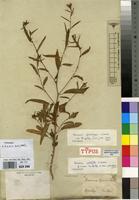
Isotype of Hermannia cyclophylla K.Schum. [family STERCULIACEAE ] Verified by Not on sheet, Hermannia glanduligera K.Schum. [family STERCULIACEAE ] (stored under name); Verified by Not on sheet,
Related name
- Hermannia glanduligera
- Hermannia cyclophylla
Flora
Entry for Hermannia glanduligera K. Schum. [family STERCULIACEAE]
Herbarium
Royal Botanic Gardens, Kew (K)
Collection
Flora Zambesiaca
Resource Type
Reference Sources
Entry From
FZ, Vol 1, Part 2, page 517, (1961) Author: H. Wild
Names
Hermannia boraginiflora [family STERCULIACEAE], sensu Eyles, tom. cit.: 418 (1916) pro parte quoad specim. Chubb.
Hermannia kirkii [family STERCULIACEAE], sensu Bak. f. in Journ. Linn. Soc., Bot. 40: 29 (1911).
Hermannia viscosa var. randii Bak. f. [family STERCULIACEAE], in Journ. of Bot. 39: 128 (1901). — Eyles in Trans. Roy. Soc. S. Afr. 5: 419 (1916) (\"viscida\"). Type: S. Rhodesia, Bulawayo, Rand 295 (BM, holotype).
Hermannia cyclophylla K. Schum. [family STERCULIACEAE], in Notizbl. Bot. Gart. Berl. 2: 303 (1899); in Engl., tom. cit.: 82 (1900) e descript. Type: Mozambique, Quelimane, Peters (B, holotype, †).
Hermannia nyasica Bak. [family STERCULIACEAE], in Kew Bull. 1897: 245 (1897). — K. Schum. in Engl., tom. cit.: 82 (1900). — N.E.Br. in Kew Bull. 1909: 94 (1909). Type: Nyasaland, Monkey Bay, Whyte (B†; K, holotype).
Hermannia glanduligera K. Schum. [family STERCULIACEAE], in Verh. Bot. Verein. Brand. 30: 232 (1888); in Engl., Mon. Afr. Pflanz. B: 57 (1900). TAB. 102 fig. D. Type from SW. Africa.
Hermannia inamoena K. Schum. [family STERCULIACEAE], in Engl., Pflanzenw. Ost-Afr. C: 270 (1895); in Engl., Mon. Afr. Pflanz. 5: 56 (1900). Type: Nyasaland, without precise locality, Buchanan 1251 (B, holotype †).
Hermannia viscosa [family STERCULIACEAE], sensu Bak. f. in Journ. of Bot. 37: 426 (1899). — Eyles, loc. cit. — Burtt Davy, F.P.F.T. 1: 267 (1926). — Martineau, Rhod. Wild Fl.: 54 (1954).
Information
Perennial herb or shrublet, up to c. 1 m. tall, viscid-pubescent with glandular hairs on all parts except the corolla but also with long simple hairs and stellate hairs. Leaf-lamina up to 5·5 × 2·3 cm. but usually less, lanceolate to narrowly oblong-lanceolate, apex acute or subacute, margin serrate, base cuneate or rounded, pilose on both surfaces with appressed stellate hairs and some glandular hairs; petiole up to 1·4 cm. long; stipules 1–2 mm. long, lanceolate-subulate. Flowers solitary in the upper axils; peduncle slender, up to 1·3 cm. long; pedicel c. 3 mm. long; bracts c. 0·5 mm. long, deltoid-subulate. Calyx 5–6 × 5–6 mm., campanulate,-lobed 2/3 of the way; lobes narrowly triangular with long simple hairs and shorter glandular hairs. Petals c. 4–5 × 3 mm., pink, red or rarely whitish, obovate, apex denticulate, retuse or truncate, margin subauriculate and inrolled in the lower half, pilose across the opening created by this inrolling. Stamens with obovate filaments c. 2·5 mm. long, pilose on the shoulders; anthers 5–6 mm. long, pubescent. Ovary shortly stipitate, narrowly obovoid, densely glandular with a few hispidulous hairs at the apex and on the ribs; styles c. 5 mm. long, pubescent and glandular except near the apex. Capsule c. 8 × 7 mm., oblong-obovoid, densely glandular but hispidulous on the ribs, with short spreading horns c. 1·5 mm. long at the apex. Seeds c. 1·5 × 1 mm., subreniform, wrinkled and granulated.
Habitat
River banks and open woodland in the drier parts of our area, and also as a weed of cultivation.
Distribution
Mozambique M Goba, fl. 22.iv.1944, Torre 6510 (LISC; SRGH).Mozambique GI Massengena, fl. & fr. 22.vii.1932, Smuts 351 (K; PRE).Mozambique MS Espungabera, fl. 22.vii.1949, Pedro & Pedrógão 7623 (LMJ; SRGH).Mozambique T Boroma, fl. & fr. 9.vii.1950, Chase 2657 (K; SRGH).Malawi S W. of Fort Johnston, fl. & fr. 14.iii.1955, E.M. & W. 862 (BM; LISC; SRGH).Malawi C Salima Bay, fl. & fr. 23.ix.1935, Galpin 15043 (K; PRE).Zimbabwe S Sabi-Lundi Junction, Chitsa’s Kraal, fl. & fr. 4.vi.1950, Chase 2292 (SRGH).Zimbabwe E Umtali, fl. iv.1947, Chase 345 (BM; K; SRGH).Zimbabwe C Gwelo, fl. & fr. iv., Eyles 6963 (K; SRGH).Zambia S Makoli, fl. vi.1909, Rogers 8282 (K; SRGH).Zimbabwe W Bulawayo, Khami, fl. & fr. 25.iv.1946, Wild 1064 (K; SRGH).Zambia C Rufunsa, fl. & fr. 19.ix.1953, Fanshawe 289 (K; SRGH).Mozambique Z Massingire, Megaza, fl. 2.x.1944, Mendonça 2324 (K; LISC; SRGH).Malawi N Nyika Plateau, Mwanemba, fl. ii.1903, McClounie 73 (K).Zimbabwe N Sebungwe, Zambezi R., fl. & fr. .ix.1955, Davies 1471 (K; SRGH).Zambia B Sioma Mission, Zambezi R., fl. 29.iv.1925, Pocock 1736 (PRE).Botswana N Okovango valley, fl. vi.1898, Lugard 236 (K).Caprivi Strip Kwando R., fl. & fr. x.1945, Curson 1239 (PRE).
Distribution (external)
Angola
SW. Africa
Transvaal
Notes
This common species has been identified in various publications and herbaria with H. viscosa Hiern. The latter is, however, a rather rare plant confined to the Mossâmedes desert of Angola with differently shaped, glabrous petals. Pedrógão 326 (K; LMJ; PRE) and Pedrógão 376 (LMJ; PRE) from Sul do Save, belong to H. glanduligera but are peculiar in that they have short blunt sterile anthers. This may be due to disease or perhaps to a mutation.Although the type of H. inamoena is destroyed and no duplicate can be traced at Kew, the British Museum or Edinburgh, there is no doubt that it belongs here.