JSTOR Global Plants Home
  • Home
  • Browse
  • About
  • Access
  • Account
    • Saved Items
    • Profile
  • Log in

Global Plants

Skip to Main Content
  • JSTOR Global Plants Home
  • Global Plants

    • Browse
    • About
    • Access
    • Account
      • Saved Items
      • Profile
Log in
  • Browse
  • About
  • Access
  • Account
    • Saved Items
    • Profile
Advanced Search

Compilation
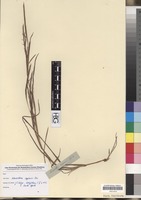
Hemarthria capensis

2 Images see all

Filed as Hemarthria compressa (L.f.) R.Br. [family POACEAE]
Filed as Hemarthria altissima (Poir.) Stapf & C. E. Hubb [family GRAMINEAE/POACEAE]
Previous
Next

Name

Identification
Hemarthria capensis Trin. [family GRAMINEAE/POACEAE ] (stored under name); Verified by Not on sheet,
Related name
  • Hemarthria capensis

Flora

Entry for ROTTBŒLLIA compressa Hack. var. fasciculata [family ]
Herbarium
Royal Botanic Gardens, Kew (K)
Collection
Flora Capensis
Resource Type
Reference Sources
Entry From
Flora Capensis, Vol 7, page 310, (1900) Author: (By O. STAPF.)
Names
ROTTBŒLLIA compressa Hack. var. fasciculata [family ], Androp. in DC. Monogr. Phan. vi. 286;—Durand & Schinz, Consp. Fl. Afr. v. 699; Hook. f. Fl. Brit. Ind. vii. 153.
ROTTBŒLLIA fasciculata Lam. [family ], Illustr. i. 204; Desf. Fl. Atl. i. 110, t. 36.
Lodicularia fasciculata Link [family POACEAE], Hort. Berol. i. 6.
Lodicularia capensis Nees [family POACEAE], Fl. Afr. Austr. 128.
Lepturus fasciculatus Trin. [family POACEAE], Fund. Agrost. 123.
Hemarthria fasciculata Kunth [family POACEAE], Rév. Gram. i. 153; Enum. i. 465, Suppl. 375; Steud. Syn. Pl. Glum. i. 359; Hack. in Mart. Fl. Bras. II. iii. 314, t. 72, fig. 2.
Hemarthria capensis Trin. [family POACEAE], Androp. in Mém. Acad. Pétersb. sér. vi. ii. 248.
Information
perennial; culms erect from a decumbent rooting base, branched, 1–5 ft. long, compressed, glabrous; sheaths shorter than the internodes, compressed, keeled, often ciliate at the mouth, otherwise glabrous; ligules membranous, very short, ciliate; blades linear, gradually tapering, acute, very variable in length and width, uppermost almost suppressed, somewhat rigid, glabrous; racemes often fascicled, rather stout, straight or curved, with the appearance of true spikes owing to the pedicels of the upper spikelets being adnate to the contiguous joint, more or less fragile; spikelets linear-oblong to oblong, 3–3 1/2 lin. long, glabrous; glumes equal, lower coriaceous, constricted below the obtuse tips or in the pedicelled spikelets more acuminate, finely 7–9-nerved, upper broadly lanceolate, acuminate, membranous and 3-nerved in the sessile, subchartaceous and 5–7-nerved in the pedicelled spikelets; valves subequal, nerveless, 2–2 1/2 lin. long; pale linear, 1–1 1/4 lin. long; anthers 1–1 1/2 lin. long. null
Range
Throughout the warm countries of both hemispheres, in many localities evidently introduced. The type through India to South-west China.
Distribution
CENTRAL REGION Graaff Reinet Div.; banks of Sunday River, near Graaff Reinet, 2500 ft., Bolus, 536!COAST REGION Clanwilliam Div.; Ebenezar, on sandy hills, Drège. Cape Div.; between Constantia and Wynberg, Burchell, 815! by the Salt River and at the Ponds near Cape Town, Burchell, 686! Cape Peninsula, near Claremont and in Muizenberg Vlei, Dodd, 2350! 2380! Paarl Div.; Klein Drakenstein Mountains, by the Berg River, Drège! Tulbagh Div.; near Tulbagh Waterfall, Verreaux! Worcester Div.; by the Hex River, Mund and Maire! Stellenbosch Div.; Hottentotts Holland, Ecklon. Caledon Div.; between Genadendal, and Zonder Einde River, Drège. Swellendam Div.; by the Zonder Einde River, Burchell, 7510! Uitenhage Div.; by the Zwartkops River, Drège! Albany Div.; Glenfilling, Drège.EASTERN REGION Tembuland; banks of Qumancu River, 2000 ft., Baur, 723! Natal; by the Umlazi River, Krauss, 14! between St. Johns River and the Great Waterfall, Drège! by streamlets near Umpumulo, Buchanan, 198! and without precise locality, Buchanan, 74! Gerrard, 677!

Related Materials

  • Terms and Conditions
  • Privacy Policy
  • Cookie Policy
  • Cookie Settings
  • Accessibility
  • Help
  • Contact Us
  • Facebook
  • Twitter
ITHAKA

JSTOR is part of ITHAKA, a not-for-profit organization helping the academic community use digital technologies to preserve the scholarly record and to advance research and teaching in sustainable ways.

©2000-2026 ITHAKA. All Rights Reserved. JSTOR®, the JSTOR logo, JPASS®, Aluka®, and ITHAKA® are registered trademarks of ITHAKA.

╳