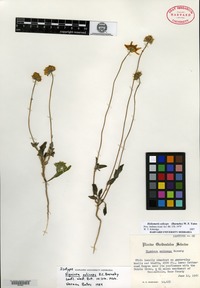
Tropical false goldeneye, Flora of North America Vol. 21
Flora
Entry for Heliomeris soliceps (Barneby) W. F. Yates [family COMPOSITAE]
Herbarium
Flora of North America (FNA)
Collection
Flora of North America
Resource Type
Reference Sources
Entry From
Flora of North America, Vol 21,
Names
Heliomeris soliceps(Barneby) W. F. Yates [family COMPOSITAE], Proc. Indiana Acad. Sci., 88: 370. 1979
Viguiera solicepsBarneby [family COMPOSITAE], Leafl. W. Bot., 10: 316. 1966
Treatment Author(s)
Edward E. Schilling
Information
Annuals, (2–)10–30(–40+) cm (tap-rooted). Stems strigillose. Leaves opposite (proximal) or alternate (distal); blades ovate to rhombic-ovate, 15–38 × 6–20+ mm, margins ciliate to 1/4 their lengths, hairs mostly less than 0.5 mm, faces hispid or strigose (abaxial not gland-dotted). Heads 3–15+. Peduncles 7–28 cm, lengths 2–5 times leafy portions of stems. Involucres 7–10 mm diam. Phyllaries lanceolate, 5–6 mm. Paleae oblong, ca. 5 mm, cuspidate. Ray florets 10–12; laminae ovate, 10–15 mm (glabrous). Disc florets 25+; corollas 4 mm. Cypselae black or gray-striate, 2.8–3.3 mm.
Conservation Status
of conservation concern;
Phenology
may (spring), jun (summer)
Altitude range
1400–1500 m;
Distribution
USA Utah.
Discussion
Heliomeris soliceps is characterized by the relatively long, scapiform peduncles rising beyond relatively short, leafy stems, and ovate to rhombic-ovate leaf blades that are relatively broader than those of most other members of the genus. Its blooming period is also significantly earlier than those of other members of Heliomeris. It is known from southern Utah, where it forms large populations.