

Compilation
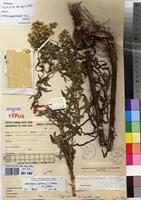
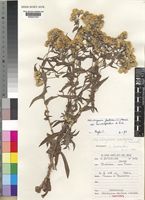
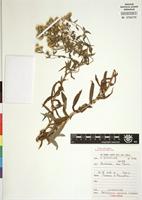
Helichrysum zairense
3 Images see all
Name
Identification
Helichrysum zairense Lisowski [family ASTERACEAE ] Verified by Not on sheet, Helichrysum foetidum (L.) Moench [family ASTERACEAE ] (stored under name); Verified by Beentje H., 1996
Related name
- Helichrysum foetidum
- Helichrysum zairense
Flora
Entry for HELICHRYSUM foetidum (L.) Moench [family COMPOSITAE]
Herbarium
Royal Botanic Gardens, Kew (K)
Collection
Flora of Tropical East Africa
Resource Type
Reference Sources
Entry From
Flora of Tropical East Africa, page 315, (2002) Author: H.J. BEENTJE
Names
HELICHRYSUM foetidum (L.) Moench [family COMPOSITAE], Meth. Pl.: 575 (1794); Cass. in Dict. Sci. Nat. 25: 469 (1822); DC., Prodr. 6: 187 (1838); Richard, Tent. Fl. Abyss. 1: 426 (1848); Oliv. & Hiern in F.T.A. 3: 352 (1877); Moeser in E.J. 44: 336 (1910); F.P.S. 3: 35 (1956); C.D. Adams in F.W.T.A. ed. 2, 2: 264 (1963); Hilliard, F.S.A. 33, 7 (2): 304 (1983); Blundell, Wild Flow. E. Africa: 170, fig. 368 (1987); A.J. Scott in Fl. Mascar. 109: 63 (1993); U.K.W.F. ed. 2: 212, t. 87 (1994); Mesfin & T. Reilly in D.J.N. Hind et al. (eds), Adv. Comp. Syst.: 436 (1995). Type: Africa, Gnaphalium no. 13 in Herb. Hort. Cliff. (BM-HC sheet “8”!, designated by Hilliard & Burtt in Taxon 47: 361 (1998))
Gnaphalium foetidum L. [family COMPOSITAE], Sp. Pl.: 851 (1753)
Helichrysum glutinosum A. Braun [family COMPOSITAE], in Flora 24: 277 (1841), non (Hook.) Benth. (1866), nom. illegit .; Lisowski in F.A.C. Compositae, Inuleae: 182, t. 40/f-j (1989). Type: plant cult. in Hort. Karlsruhe in 1840 from Ethiopian seeds sent by Schimper (B, holo., K!, iso.)
Gnaphalium foetidum (A. Braun) Sch. Bip. var. glutinosum [family COMPOSITAE], in Bot. Zeit. 3: 173 (1845)
Helichrysum foetidum A. Rich. var. microcephalum [family COMPOSITAE], Tent. Fl. Abyss. 1: 426 (1848); Moeser in E.J. 44: 336 (1910); Maquet in Troupin, Fl. Rwanda 3: 606, fig. 186/3 (1985); Mesfin & T. Reilly in D.J.N. Hind et al. (eds), Adv. Comp. Syst.: 439 (1995), nov. Type: Ethiopia, Mt Soloda near Adwa, Schimper 927 (P!, holo., K!, iso.)
Helichrysum foetidum A. Rich. var. macrocephalum [family COMPOSITAE], Tent. Fl. Abyss. 1: 426 (1848). Syntypes: Ethiopia, Ambaetcha, Quartin-Dillon s.n. (P!, syn.) & Mt Seleuda near Adwa [Adoua], Quartin Dillon s.n. (P, syn., not found)
Helichrysum gregorii S. Moore [family COMPOSITAE], in J.L.S. 35: 335 (1902). Type: Kenya, Laikipia District, Rangata Ndaro, Gregory s.n. (BM, holo.)
Helichrysum foetidum Moeser var. molle [family COMPOSITAE], (possibly, see note)in E.J. 44: 337 (1910). Type: Rwanda, Rukarara, Mildbraed 987 (B†, holo.)
Helichrysum zairense Lisowski [family COMPOSITAE], in B.J.B.B. 56: 366, fig. 6 (1986) & in F.C.A. Compositae, Inuleae: 186, t. 42 (1989), nov. Type: Congo (Kinshasa), Gutzwiller 3476 (BR!, holo., K!, iso.)
Information
Annual or short-lived perennial herb, 0.3–1.5 m high; stem erect, simple but for the inflorescence (rarely branched near base), hollow?, thinly pubescent or tomentose and glandular. Leaves sticky and aromatic, sessile, lanceolate to slightly panduriform, 2–10(–12) cm long, 0.5–2.5(–3.5) cm wide, base semi-amplexicaul and slightly auriculate, margins entire, apex acute and mucronate, glandular-scabridulous with traces of pubescence above, similar or white-tomentellous beneath. Capitula 6–10 mm long, heterogamous, several to many (–100) in dense or lax leafy corymbs; stalks of individual capitula 1–12 mm long; phyllaries pale lemon to golden yellow, (rarely whitish on drying), shiny, multiseriate, 2.5–9 mm long, acute, the outermost woolly at base; receptacle honeycombed, 3.5–8 mm in diameter. Florets yellow to orange, many; outer florets many, in several rows, tube filiform from a wider base, 1.5–3.6 mm long, lobes 0.1–0.2 mm long, style 2–4 mm long; inner florets few to many, but generally (much) fewer than the outer, tube cylindric, 1.9–3 mm long, lobes 0.3–0.5 mm long, anthers 1.2–1.5 mm long, style 2.1–3.5 mm long. Achenes ellipsoid, 0.5–0.8 mm long, glabrous; pappus yellow or white, 2.5–4 mm long, falling separately.
Range
DISTR. U 1–3; K 3–7; T 2–4, 6, 7
Altitude range
1350–2700 m
Distribution
UGANDA Karamoja District Mt Moroto, Oct. 1958, J. Wilson 567!;KENYA Elgeyo District Embobut Forest, Jan. 1971, Mabberley 583!;TANZANIA Mbulu District Ngorongoro, Empakaai, Apr. 1973, Frame 112!;UGANDA Kigezi District Kachwekano Farm, Apr. 1949, Purseglove 2740!;UGANDA Mbale District Elgon, Nov. 1933, Tothill 2286!KENYA Kiambu District Muguga, Sep. 1965, Kokwaro & Kabuye 352!;KENYA Masai District Olenguerone, May 1961, Glover, Gwynne & Samuel 1159!TANZANIA Lushoto District 6 km NE of Lushoto, Apr. 1953, Drummond & Hemsley 2112!;TANZANIA Ufipa District Chala Mts, May 1997, Bidgood et al. 3800!
Distribution (external)
; Nigeria
Cameroon
Bioko
Congo (Kinshasa)
Rwanda
Burundi
Sudan
Ethiopia
South Africa
Arabia
Spain
Notes
Hilliard and Wild believed that foetidum and microcephalum were different taxa; Mesfin united them, and made them into varieties, both of which he says occur in Ethiopia and East Africa. I believe they are a single taxon. I have not been able to find the differences enumerated by Mesfin; the white pubescence of the abaxial leaf surface seems randomly distributed, and is not correlated with number or size of heads, or leaf size, or locality, or habitat. The diameter of the capitula shows a continuous range from 8–18 mm, that of the receptacle from 3.5–8 mm, and the phyllaries range from 2.5–9 mm. Therefore, I have to conclude that our material forms the end of a cline, with slightly smaller receptacles and phyllaries than in most (but not all) plants from South Africa. This large variation does not seem exceptional for a pioneer species.There is a form with smaller florets (≤ 2(–2.5) mm long, as opposed to the usual ≥ 2.5 mm long) and golden yellow rather than pale yellow or cream pappus. It is more or less sympatric with the other form and probably does not deserve even varietal status. Moeser states for his var. molle 'has much darker yellow heads than the other forms'. This was probably the above taxon, but he gives no measurements, and the colour variation is not absolute: darker yellow heads have been found in H. foetidum s.s.(e.g. Purseglove 521, 1610 from Uganda). Since the type has been destroyed, it seems foolhardy to assign this varietal name, while doubt remains.