JSTOR Global Plants Home
  • Home
  • Browse
  • About
  • Access
  • Account
    • Saved Items
    • Profile
  • Log in

Global Plants

Skip to Main Content
  • JSTOR Global Plants Home
  • Global Plants

    • Browse
    • About
    • Access
    • Account
      • Saved Items
      • Profile
Log in
  • Browse
  • About
  • Access
  • Account
    • Saved Items
    • Profile
Advanced Search

Compilation
Helichrysum sphaeroideum

8 Images see all

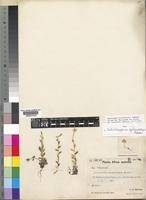
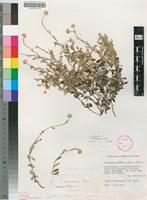
Type of Helichrysum sphaeroideum Moeser [family COMPOSITAE]
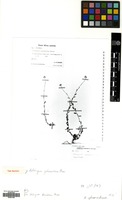
Isotype of Helichrysum sphaeroideum Moeser [family ASTERACEAE]
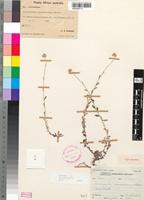
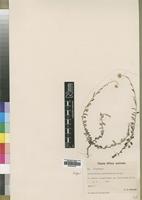
Type of Helichrysum sphaeroideum Moeser [family ASTERACEAE]
Filed as Helichrysum sphaeroideum Moeser [family ASTERACEAE]
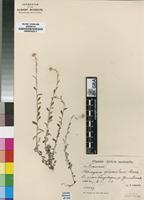
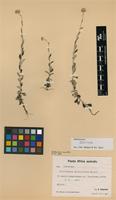
Type of Helichrysum sphaeroideum Moeser [family COMPOSITAE]
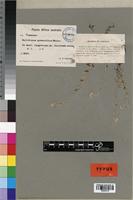
Isotype of Helichrysum sphaeroideum Moeser [family ASTERACEAE]
Previous
Next

Name

Identification
Isotype of Helichrysum sphaeroideum Moeser [family ASTERACEAE ] (stored under name);
Related name
  • Helichrysum sphaeroideum

Flora

Entry for Helichrysum sphaeroideum [family ASTERACEAE]
Herbarium
South African National Biodiversity Institute, Compton Herbarium, Cape Town (SAM)
Collection
Flora of Southern Africa
Resource Type
Reference Sources
Entry From
Flora of South Africa, (2003) Author: Dr J.P. Roux
Names
Helichrysum sphaeroideum [family ASTERACEAE]
Information
Straggling subshrub perhaps up to 600 mm tall, branching from the base, branches often tangled, long, slender, thinly white-woolly, leafy, becoming distantly so and pedunculoid below the compound in­florescence. Leaves 7—40 x 4—15 mm, lower with an elliptic to subrotund, acute to obtuse, mucronate blade, narrowed below and petiole-like, base expanded, ear-clasping, petiole becoming less pronounced upwards, uppermost leaves oblong, sessile, passing into distant, lanceolate-acuminate bracts, margins of all minutely crisped, upper surface coarsely hairy, lightly cob­webby as well, at least initially, lower surface thinly white-woolly-felted. Heads homogamous, cylindric-campanulate, 3—4 x 2—4 mm, few to many in terminal congested clusters 10—20 mm across, becom­ing somewhat lax with age. Involucral bracts in 4—5 series, more or less graded, outermost pellucid, tinged palest brown, glabrous or thinly cobwebby, inner with tips opaque milk-white, sometimes reddish above the stereome, or rarely the whole tip suffused pink, obtuse, or subacute, some­what crisped, minutely radiating. Recept­acle shortly honeycombed. Flowers 8—31. Achenes 0,75 mm long, ± cylindric, with peculiar thickened hairs, not myxogenic. Pappus bristles many, equalling corolla, scabrid, bases cohering strongly by patent cilia. Fig. 38: 1.
Habitat
Both Burchell and Drege collected H. sphaeroideum, but De Candolle confused the Burchell specimen he saw (7296, G-DC, K, from a mountain near Swellendam) with H. serpyllifolium var. polifoli-um (that is, Plecostachys polifolia). The Drege specimen (at K), distributed as H. serypyllifolium var. polifolium a (from Du Toit's Kloof) is partly H. sphaeroideum, partly Plecostachys polifolia.
Use
116. Helichrysum sphaeroideum Moeser in Bot. Jb. 44: 306 (1910). Type: SW. Cape, Langeberg near Zuurbrak, Schlechter 2047 (Z, nolo.!; BM; G; PRE; S, iso.!).
Range
On the Cape mountains from about Tulbagh, Paarl and Worcester to the Langeberg between Swellendam and Riversdale, between 900 and 1 600 m above sea level. Favours damp sheltered rocky places, often on steep slopes in gullies or ravines; flowering between September and February, but mainly in December and January. Map 125.

Related Materials

  • Terms and Conditions
  • Privacy Policy
  • Cookie Policy
  • Cookie Settings
  • Accessibility
  • Help
  • Contact Us
  • Facebook
  • Twitter
ITHAKA

JSTOR is part of ITHAKA, a not-for-profit organization helping the academic community use digital technologies to preserve the scholarly record and to advance research and teaching in sustainable ways.

©2000-2026 ITHAKA. All Rights Reserved. JSTOR®, the JSTOR logo, JPASS®, Aluka®, and ITHAKA® are registered trademarks of ITHAKA.

╳