

Compilation
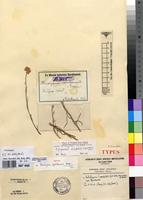
Helichrysum leptothamnus
1 Images see all
Name
Identification
Isotype of Helichrysum leptothamnus Moeser [family ASTERACEAE ] Verified by Not on sheet, Helichrysum forskahlii (J.F.Gmel.) Hilliard & B.L.Burtt [family ASTERACEAE ] (stored under name); Verified by Beentje H., 1997
Related name
- Helichrysum forskahlii
- Helichrysum leptothamnus
Flora
Entry for HELICHRYSUM forskahlii var. forskahlii [family COMPOSITAE]
Herbarium
Royal Botanic Gardens, Kew (K)
Collection
Flora of Tropical East Africa
Resource Type
Reference Sources
Entry From
Flora of Tropical East Africa, page 315, (2002) Author: H.J. BEENTJE
Names
HELICHRYSUM forskahlii var. forskahlii [family COMPOSITAE]
Gnaphalium fruticosum Forssk. [family COMPOSITAE], Fl. Aegypt.-Arab.: 218 (1775), nom. illegit ., non Mill. (1768)
Gnaphalium forskahlii J.F. Gmel. [family COMPOSITAE], Syst. Nat. ed. 13 (2): 1214 (1792) Syst. Nat. ed. 13 (2): 1214 (1792)
Gnaphalium chrysocephalum Sch. Bip. [family COMPOSITAE], in Bot. Zeit. 3: 174 (1845). Type: Ethiopia, Schweinfurth 1765 (P, holo., not found, BM, K!, iso.)
Helichrysum chrysocoma A. Rich. [family COMPOSITAE], Tent. Fl. Abyss. 1: 424 (1848), nom. invalid. Based on: Ethiopia, Schimper 979
Helichrysum fruticosum Vatke [family COMPOSITAE], in Linnaea 39: 491 (1875); O. Hoffm. in P.O.A. C: 411 (1895); Moeser in E.J. 44: 257 (1910); T.T.C.L.: 153 (1949); F.P.S. 3: 36 (1956)
Helichrysum cymosum [family COMPOSITAE], [sensu Oliv. & Hiern in F.T.A. 3: 353 (1877); C.D. Adams in F.W.T.A. ed. 2, 2: 264 (1963), non (L.) D. Don]
Helichrysum fruticosum Moeser var. majus [family COMPOSITAE], in E.J. 44: 258 (1910) & in Z.A.E.: 410 (1911). Type: Congo (Kinshasa), Mildbraed 1592 (B†, holo.)
Helichrysum cymosum (Vatke) Hedb. subsp. fruticosum [family COMPOSITAE], A.V.P. 15: 203, 339 (1957); F.P.U.: 177, t. 116 (1962)
Helichrysum helothamnus (Moeser) Lisowski var. majus [family COMPOSITAE], in F.A.C. Compositae, Inuleae: 92, t. 16/f-j (1989), syn. nov.
Helichrysum leptothamnus Moeser [family COMPOSITAE], in E.J. 44: 258 (1910); Lisowski in F.A.C. Compositae, Inuleae: 94, t. 17 (1989). Type: Rwanda, Rugege, Rukarara, Mildbraed 963 (B†, syn., BR!, fragment, lecto., chosen here), syn. nov.
Information
Erect or sometimes scandent herb or shrub 30–100cm high. Leaves spreading, somewhat distant, (0.5–)1–2.5(–4.5) cm long, 0.2–0.5(–0.8) cm wide, sparsely tomentose to glabrous above, grey-tomentose beneath. Achenes papillose.
Range
DISTR. U 1–4; K 1–6; T 1–4, 6–8 from Nigeria to Sudan and Ethiopia in the north, throughout central Africa to Angola and Zimbabwe in the south; also in Yemen
Altitude range
1050–4000(–4700) m
Distribution
UGANDA Karamoja District Morongole, Nov. 1939, A. S. Thomas 3288!;KENYA S Nyeri District Mt Kenya, Castle Forest Station, Dec. 1966, D. Wood 793!;TANZANIA Kigoma District Mahali Mts, Sisaga, Aug. 1958, Newbould & Jefford 1795!;UGANDA Toro District Ruwenzori, Nyamileju Hut, Dec. 1968, Lye 1274!;UGANDA Mbale District Elgon, Sasa Hut, Oct. 1970, Rwaburindore 443!KENYA Machakos District Kilungu, 5 km N of Nunguni, June 1967, Mwangangi 56!;KENYA Masai District Nasampolai Valley, Dec. 1972, Greenway & Kanuri 15068!TANZANIA Morogoro District Lukungulu Plateau, S Uluguru Forest Reserve, Mar. 1955, Mgaza 33!;TANZANIA Songea District Matengo Hills, Feb. 1956, Milne-Redhead & Taylor 8773!
Notes
Some specimens verge towards the other variety, var. compactum, e.g. Eggeling 2880 from Mt Moroto, and Linder 3887 from Iringa District.The differences between Moeser's variety majus and the typical variety, i.e. the colour of the capitula (brownish and not yellow), and the distal part of the achene being enlarged or narrowed, do not warrant distinction, in my opinion. H. forskahlii var. forskahlii is a very variable taxon, but further splitting is not feasible because of the large range of intermediates which can be found for any grouping of character differences.Maquet (in the Flora of Rwanda) states that H. helothamnus Moeser and H. longiramum Moeser are only subspecifically distinct. The types (Mildbraed 1750 and 1688, respectively) are from Rwanda. Lisowski states that the latter taxon occurs in Uganda; I have seen no authenticated specimens.