JSTOR Global Plants Home
  • Home
  • Browse
  • About
  • Access
  • Account
    • Saved Items
    • Profile
  • Log in

Global Plants

Skip to Main Content
  • JSTOR Global Plants Home
  • Global Plants

    • Browse
    • About
    • Access
    • Account
      • Saved Items
      • Profile
Log in
  • Browse
  • About
  • Access
  • Account
    • Saved Items
    • Profile
Advanced Search

Compilation
Helichrysum delhayei

2 Images see all

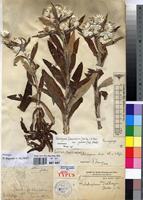
Lectotype of Helichrysum delhayei De Wild. [family ASTERACEAE]
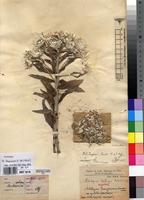
Syntype of Helichrysum delhayei De Wild. [family ASTERACEAE]
Previous
Next

Name

Identification
Helichrysum delhayei De Wild. [family ASTERACEAE ] Verified by Not on sheet, Helichrysum formosissimum (Sch.Bip.) A.Rich. [family ASTERACEAE ] (stored under name); Verified by Beentje H., 1996
Related name
  • Helichrysum formosissimum
  • Helichrysum delhayei

Flora

Entry for HELICHRYSUM formosissimum (Engl.) Mesfin var. guilelmi [family COMPOSITAE]
Herbarium
Royal Botanic Gardens, Kew (K)
Collection
Flora of Tropical East Africa
Resource Type
Reference Sources
Entry From
Flora of Tropical East Africa, page 315, (2002) Author: H.J. BEENTJE
Names
HELICHRYSUM formosissimum (Engl.) Mesfin var. guilelmi [family COMPOSITAE], in Comp. Newsl. 22: 14 (1992), as ' guilelmii '; Mesfin & T. Reilly in D.J.N. Hind et al. (eds), Adv. Comp. Syst.: 413 (1995). Type: Tanzania, Kilimanjaro, above Kiboscho, Volkens 1556 (B†, holo., K!, iso.)
HELICHRYSUM guilelmi Engl. [family COMPOSITAE], in Hochgebirgsfl. Trop. Afr.: 426 (1892); Hook. in Bot. Mag. 127: t. 7789 (1901); Moeser in E.J. 44: 329 (1910); A.V.P.: 215, 347 (1957); Maquet in Troupin, Fl. Rwanda 3: 604 (1985); Lisowski in F.A.C. Compositae, Inuleae: 159, t. 35/a-e (1989); U.K.W.F. ed. 2: 212 (1994); K.T.S.L.: 558 (1994). Syntypes: Tanzania, Kilimanjaro, Marangu–Machame [Madschame], Kersten 131 (B†, syn.) and Meyer 320 (B†, syn.); Kilimanjaro, above Kiboscho, Volkens 1556 (B†, K!, syn.)
HELICHRYSUM lentii Volkens & O. Hoffm. [family COMPOSITAE], in P.O.A. C: 410 (1895); Moeser in E.J. 44: 329 (1910). Type: Tanzania, Kilimanjaro, Volkens 1147 (B†, holo., BM!, BR!, K!, iso.)
HELICHRYSUM wollastonii S. Moore [family COMPOSITAE], in J.L.S. 38: 260 (1908). Type: Uganda, Ruwenzori, Wollaston s.n. (BM!, holo.)
HELICHRYSUM delhayei De Wild. [family COMPOSITAE], Pl. Bequaert. 5: 48 (1929). Type: Congo (Kinshasa), Nyiragongo, Delhaye s.n. (BR!, lecto.)
HELICHRYSUM glabrimucronatum De Wild. [family COMPOSITAE], Pl. Bequaert. 5: 55 (1929). Type: Tanzania, Kilimanjaro, Janssens s.n. (BR!, holo.)
Information
Leaves arachnoid-pubescent above, glabrescent, but always smooth, 2–15 cm long, 0.5–4 cm wide. 
Range
DISTR. U 2; K 3, 4; T 2, 3
Altitude range
(1800–)2500–4200 m
Distribution
UGANDA Toro District Ruwenzori, Kabamba, July 1951, Osmaston 3881!;KENYA Elgeyo District Cherangani, Embobut Forest, Jan. 1971, Mabberley 571!TANZANIA Masai District Longido, Oct. 1966, Carmichael 1280!;UGANDA Kigezi District Mt Mgahinga, June 1949, Purseglove 2949! & Muhavura, Oct. 1948, Hedberg 2149!KENYA ?Naivasha District Nyandarua/Aberdare Mts, Dec. 1989, Freidberg & Kaplan 89!KENYA N Nyeri District Mt Kenya, Jan. 1922, Fries & Fries 1306!TANZANIA Arusha District Mt Meru, Sep. 1960, Kanywa 24!;TANZANIA Moshi District Kilimanjaro, between Umbwe and Weru Weru Rs, Aug. 1932, Greenway 3163!
Distribution (external)
; Congo (Kinshasa)
Rwanda
Ethiopia
Notes
I consider Mesfin's reduction of this taxon to a variety fully justified. A few intermediates exist between var. guilelmi and var. formosissimum, but most specimens can be assigned to their variety instantly. The phyllary colour, sometimes used as a character, is not consistently white; it may vary from white to pink, and the type has a pink tinge. Strangely enough (see under var. formosissimum) in the Ruwenzori many specimens of this taxon have pink phyllaries.The material from Longido (Carmichael 1280, cited above, and Knox 3320) has leaves that are very densely tomentose on both surfaces. The plants occur in dry sites on fully exposed rock surfaces, and form clumps several meters across (Knox, pers. comm.); they may be worthy of taxonomic recognition. Knox also believes the Ruwenzori and Virunga plants are different from the more eastern populations, and will be studying the DNA involved.

Related Materials

  • Terms and Conditions
  • Privacy Policy
  • Cookie Policy
  • Cookie Settings
  • Accessibility
  • Help
  • Contact Us
  • Facebook
  • Twitter
ITHAKA

JSTOR is part of ITHAKA, a not-for-profit organization helping the academic community use digital technologies to preserve the scholarly record and to advance research and teaching in sustainable ways.

©2000-2026 ITHAKA. All Rights Reserved. JSTOR®, the JSTOR logo, JPASS®, Aluka®, and ITHAKA® are registered trademarks of ITHAKA.

╳