JSTOR Global Plants Home
  • Home
  • Browse
  • About
  • Access
  • Account
    • Saved Items
    • Profile
  • Log in

Global Plants

Skip to Main Content
  • JSTOR Global Plants Home
  • Global Plants

    • Browse
    • About
    • Access
    • Account
      • Saved Items
      • Profile
Log in
  • Browse
  • About
  • Access
  • Account
    • Saved Items
    • Profile
Advanced Search

Compilation
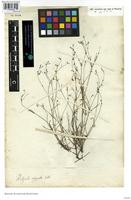
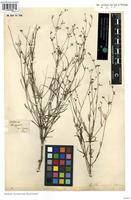
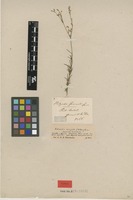
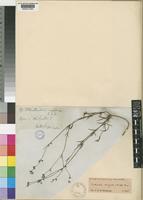
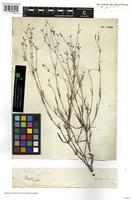
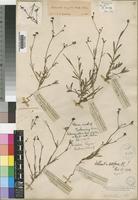
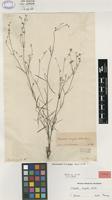
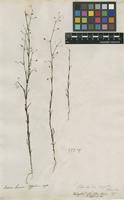
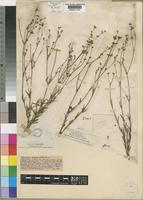
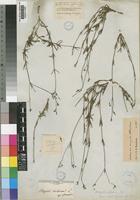
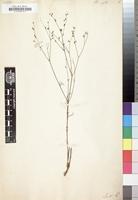
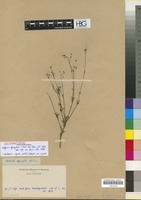
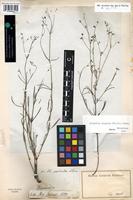
Hedyotis virgata

14 Images see all

Filed as Kohautia virgata (Willd.) Bremek. [family RUBIACEAE]
Type of Hedyotis gerrardii Sond. [family RUBIACEAE]
Kohautia virgata (Willd.) Bremek. [family RUBIACEAE]
Type? of Hedyotis virgata [family RUBIACEAE]
Filed as Kohautia virgata (Willd.) Bremek. [family RUBIACEAE]
Type of Kohautia setifera DC. [family RUBIACEAE]
Type of Hedyotis virgata Willd. [family RUBIACEAE]
Filed as Hedyotis stricta Sm. in Rees [family RUBIACEAE]
Kohautia virgata (Willd.) Bremek. [family RUBIACEAE]
Type? of Hedyotis virgata [family RUBIACEAE]
Isosyntype of Hedyotis thymifolia C. Presl [family RUBIACEAE]
Syntype of Hedyotis virgata Willd. [family RUBIACEAE]
Previous
Next

Name

Identification
Hedyotis virgata Not on sheet. [family RUBIACEAE ] (stored under name); Verified by Not on sheet.,
Related name
  • Kohautia virgata
  • Hedyotis virgata

Flora

Entry for KOHAUTIA virgata (Willd.) Bremek. [family RUBIACEAE]
Herbarium
Royal Botanic Gardens, Kew (K)
Collection
Flora of Tropical East Africa
Resource Type
Reference Sources
Entry From
Flora of Tropical East Africa, page 1, (1976) Author: B. VERDCOURT
Names
KOHAUTIA virgata (Willd.) Bremek. [family RUBIACEAE], in Verh. K. Nederl. Akad. Wet., Afd. Natuurk., ser. 2, 48 (2): 77 (1952); Hepper in F.W.T.A., ed. 2, 2: 209 (1963); U.K.W.F.: 398 (1974). Type: probably Ghana [Guinea], Thonning (B, holo., S, iso.)
Hedyotis virgata Willd. [family RUBIACEAE], Sp. Pl. 1: 567 (1797)
Oldenlandia virgata (Willd.) DC. [family RUBIACEAE], Prodr. 4: 426 (1830); Hiern in F.T.A. 3: 59 (1877); F.W.T.A. 2: 132 (1931)
Oldenlandia caffra Eckl. & Zeyh. [family RUBIACEAE], Enum. Pl. Afr. Austr.: 360 (1837). Type: South Africa, Uitenhage, Zwartkops R., Zeyher 2705 (K,? iso.!)—see Bremek., loc. cit.: 79 (1952)
Kohautia parviflora Benth. [family RUBIACEAE], in Hook., Niger Fl.: 403 (1849). Type: Ghana, Accra, Vogel (K, holo.!)
Oldenlandia parviflora (Benth.) Oliv. [family RUBIACEAE], in Trans. Linn. Soc. 29: 84 (1873); Hiern in F.T.A. 3: 60 (1877), quoad typum solum
Kohautia virgata Bremek. var. oblanceolata [family RUBIACEAE], in Verh. K. Nederl. Akad. Wet., Afd. Natuurk., ser. 2, 48(2): 80 (1952). Type: South Africa, Transvaal, Kruger National Park, Ikukusa, Cholmondeley (PRE, holo.)
Information
Perennial (? rarely annual) erect herb, 9–60 cm. tall, with few to many rather slender strict or spreading branches from a woody base; stems glabrous, scabridulous or quite densely pubescent with short spreading hairs. Leaf-blades linear to narrowly elliptic, 1–4 cm. long, 0.5–5 mm. wide, acute and often, particularly in wider leaves, ending in a seta up to 1 mm. long, gradually narrowed at the base, glabrous to quite densely covered with spreading hairs at least above and on margins and midvein beneath; stipule-sheath 1–2 mm. long, divided into 2–6 filiform fimbriae (1–)2–6 mm. long. Inflorescences lax, with 2–several flowers at each node, some with short pedicels others long, those in the lower parts of the inflorescence actually axillary but the leaves reduced to stipules only which form hyaline bracts; peduncles 0.1–3(–6) cm. long, internodes of inflorescence 0.6–3.3 cm. long; pedicels 1–9(–18) mm. long, glabrous. Calyx-tube subglobose, ± 1 mm. long, 1.5 mm. wide, glabrous; lobes narrowly triangular, 1.2–2 mm. long, ending in a short seta, glabrous or somewhat scabridulous on the margins. Corolla white to purplish brown with lobes white, pale rose, red or lilac (sometimes only at the apex outside); tube 3.5–5.5 mm. long, the widened part 1–1.3 mm. long, 0.9–1.2 mm. wide, glabrous outside and throat not bearded within; lobes ovate-elliptic, 0.9–1.9 mm. long, 0.8–1.2 mm. wide, ± acute. Style 2.5–3.5 mm. long; stigma-lobes 1.2–1.4 mm. long. Capsule transversely oblong or subglobose, 1–2 mm. long, 1.5–3 mm. wide, glabrous; fruiting pedicel up to 1.3 cm. long. Seeds dark brown, subconic to irregularly ovoid, ± 0.3 mm. long.
Range
DISTR. U3; K4, 7; T2, 3, 6; Z widespread in tropical Africa from Guinée to South West Africa, Zaire and Sudan to South Africa
Altitude range
0–1080(–1620) m.
Distribution
KENYA Kiambu District Ruiru, 5 Aug. 1930, Napier 380!KENYA Kwale District 22.4 km. S. of Mombasa, Twiga, 14 Oct. 1962, Verdcourt 3286!KENYA Kilifi District Malindi area, May 1959, Rawlins 614! & 659!TANZANIA Pangani District 29 km. SW. of Pangani, 17 Mar. 1950, Verdcourt 116!TANZANIA Morogoro District Morogoro-Dakawa road, 14.4 km. N. of Morogoro, 25 Mar. 1953, Drummond & Hemsley 1784!TANZANIA Rufiji District S. bank of Rufiji R., Utete, 2 Dec. 1955, Milne-Redhead & Taylor 7467!TANZANIA Zanzibar I., Walezo Ridge, 9 Nov. 1930, Vaughan 1672! & Marahubi, 17 May 1935, Vaughan 2229!UGANDA Teso District Serere, Mar. 1933, Chandler 1129!
Distribution (external)
Comoro Is
Madagascar
Notes
Specimens with broader leaves ending in setae are to be found scattered throughout the distribution of this species and since intermediates occur I have not considered the variety worth retaining.A plant from Tanzania (Uzaramo District, Dar es Salaam, 8 May 1970, Harris 4155!) is a monstrous form of this species with many of the floral organs leaf-like; there are however a few normal flowers and fruits on some specimens. The Kew sheet showed no normal flowers and was at first thought to be an intergeneric hybrid. The pollen proved to be 95% infertile; there are a few large fat 5-furrowed grains but the rest are deformed, collapsed and tiny.

Related Materials

  • Terms and Conditions
  • Privacy Policy
  • Cookie Policy
  • Cookie Settings
  • Accessibility
  • Help
  • Contact Us
  • Facebook
  • Twitter
ITHAKA

JSTOR is part of ITHAKA, a not-for-profit organization helping the academic community use digital technologies to preserve the scholarly record and to advance research and teaching in sustainable ways.

©2000-2026 ITHAKA. All Rights Reserved. JSTOR®, the JSTOR logo, JPASS®, Aluka®, and ITHAKA® are registered trademarks of ITHAKA.

╳