JSTOR Global Plants Home
  • Home
  • Browse
  • About
  • Access
  • Account
    • Saved Items
    • Profile
  • Log in

Global Plants

Skip to Main Content
  • JSTOR Global Plants Home
  • Global Plants

    • Browse
    • About
    • Access
    • Account
      • Saved Items
      • Profile
Log in
  • Browse
  • About
  • Access
  • Account
    • Saved Items
    • Profile
Advanced Search

Compilation
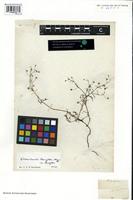
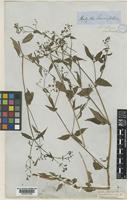
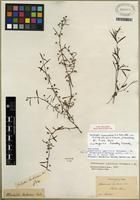
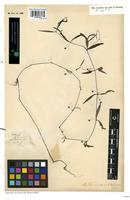
Hedyotis lancifolia

8 Images see all

Filed as Oldenlandia lancifolia (Schumach.) DC. [family RUBIACEAE]
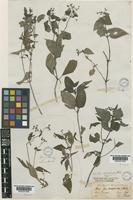
Type of Neanotis lancifolia Dalz. [family RUBIACEAE]
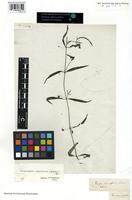
Isotype of Oldenlandia lancifolia (Schumach.) DC. [family RUBIACEAE]
Filed as Oldenlandia lancifolia (Schumach.) DC. [family RUBIACEAE]
Neanotis decipiens (Hook.f.) W.H.Lewis [family RUBIACEAE]
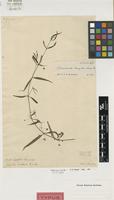
Lectotype of Hedyotis lancifolia Schumach. [family RUBIACEAE]
Type of Hedyotis lancifolia Schumach. [family RUBIACEAE]
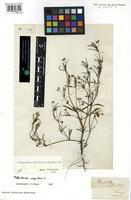
Syntype of Hedyotis longifolia Schumach. and Thonn. [family RUBIACEAE]
Previous
Next

Name

Identification
Oldenlandia lancifolia (Schumach.) DC. [family RUBIACEAE ] (stored under name); Verified by Bremenkamp, 1950 Hedyotis lancifolia Schumach. [family RUBIACEAE ] Verified by Not on Sheet,
Related name
  • Neanotis decipiens
  • Hedyotis herbacea
  • Anotis decipiens
  • Neanotis concanensis
  • Hedyotis lancifolia
  • Neanotis lancifolia
  • Oldenlandia lancifolia

Flora

Entry for OLDENLANDIA lancifolia (Schumach.) DC. [family RUBIACEAE]
Herbarium
Royal Botanic Gardens, Kew (K)
Collection
Flora of Tropical East Africa
Resource Type
Reference Sources
Entry From
Flora of Tropical East Africa, page 1, (1976) Author: B. VERDCOURT
Names
OLDENLANDIA lancifolia (Schumach.) DC. [family RUBIACEAE], Prodr. 4: 425 (1830); Hiern in F.T.A. 3: 61 (1877); K. Schum. in P.O.A. C: 375 (1895); Bremek. in Verh. K. Nederl. Akad. Wet., Afd. Natuurk., ser. 2, 48(2): 230 (1952); Hepper in F.W.T.A., ed. 2, 2: 212 (1963); U.K.W.F.: 400 (1974). Type: Ghana, Valley of Aquapim, Thonning 210 (C, lecto., S, isolecto.)
Hedyotis lancifolia Schumach. [family RUBIACEAE], in Schumach. & Thonn., Beskr. Guin. Pl.: 72 (1827)
Information
Perennial (rarely annual) straggling or prostrate herb, often much branched near the base into almost simple stems, (5–)20–60(–90) cm. long, which sometimes root at the nodes, glabrous or in some variants scabridulous when young; sometimes forming loose mats. Leaf-blades linear to linear-lanceolate, less often elliptic or lanceolate, 1–6 cm. long, 0.2–1.2 cm. wide, acute at the apex, cuneate at the base, scabridulous above near the margins, glabrous beneath or with midvein scabridulous; petioles not developed, very short and adnate to the stipule sheath which is 1 mm. long and bears 2–5 linear fimbriae 1.5 mm. long. Flowers not heterostylous, often solitary at the nodes (pseudo-axillary) or sometimes several at the nodes but then these actually borne on very reduced axillary shoots; pedicels slender, 0.5–3 cm. long, glabrous or scabridulous. Calyx-tube bowl-shaped, 0.8 mm. tall, 1.5 mm. wide, glabrous or with scattered very short hairs; lobes triangular, 1–1.8 mm. long, acuminate at the apex, glabrous or sparsely scabridulous. Corolla white, sometimes tinged pink or purple; tube 1 mm. long, glabrous inside; lobes triangular, 1–2 mm. long. Style slightly longer than the tube; stigma-lobes 0.7–1.4 mm. long. Capsule depressed subglobose, 2.2–3 mm. tall including the 1 mm. tall beak, 3.2–5 mm. wide, grooved at the middle. Seeds pale brown, angular, 0.3–0.4 mm. long, strongly reticulate.
Range
DISTR. (of species as a whole). Widespread in tropical Africa from Senegal to Ethiopia, thence to Transvaal and Angola; also introduced into S. America and West Indies
Notes
Bremekamp has divided this species into 7 varieties which are mostly very minor in character and have been ignored by most workers (e.g. Hepper in F.W.T.A. ed. 2). There are certainly two distinguishable entities in the Flora area and I have maintained Bremekamp’s names for these. His description of the pedicels of var. seseensis in the flowering stage as being only 0.5 mm. long is clearly an error but even if 5 mm. were meant certain sheets annotated by him have flowering pedicels 1 cm. long. There is scant morphological justification for separation this from var. lancifolia, but since it forms a rather isolated population it is not unreasonable to maintain the varietal name.

Related Materials

  • Terms and Conditions
  • Privacy Policy
  • Cookie Policy
  • Cookie Settings
  • Accessibility
  • Help
  • Contact Us
  • Facebook
  • Twitter
ITHAKA

JSTOR is part of ITHAKA, a not-for-profit organization helping the academic community use digital technologies to preserve the scholarly record and to advance research and teaching in sustainable ways.

©2000-2026 ITHAKA. All Rights Reserved. JSTOR®, the JSTOR logo, JPASS®, Aluka®, and ITHAKA® are registered trademarks of ITHAKA.

╳