JSTOR Global Plants Home
  • Home
  • Browse
  • About
  • Access
  • Account
    • Saved Items
    • Profile
  • Log in

Global Plants

Skip to Main Content
  • JSTOR Global Plants Home
  • Global Plants

    • Browse
    • About
    • Access
    • Account
      • Saved Items
      • Profile
Log in
  • Browse
  • About
  • Access
  • Account
    • Saved Items
    • Profile
Advanced Search

Compilation
Haworthia asperiuscula

1 Images see all

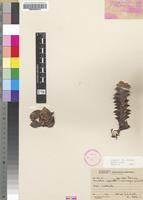
Isotype of Haworthia asperiuscula Haw. var. subintegra G.G.Sm. [family ASPHODELACEAE]
Previous
Next

Name

Identification
Isotype of Haworthia asperiuscula Haw. [family ASPHODELACEAE ] Verified by Not on sheet, Haworthia viscosa (L.) Haw. [family ASPHODELACEAE ] (stored under name); Verified by Not on sheet,
Related name
  • Haworthia viscosa
  • Haworthia asperiuscula

Flora

Entry for HAWORTHIA asperiuscula Haw. [family ALOACEAE]
Herbarium
Royal Botanic Gardens, Kew (K)
Collection
Flora Capensis
Resource Type
Reference Sources
Entry From
Flora Capensis, page 253, (1897) Author: (By J. G. BAKER).
Names
HAWORTHIA asperiuscula Haw. [family ALOACEAE], Suppl. 60;—Baker in Journ. Linn. Soc. xviii. 200.
Aloe asperiuscula Roem. et Schultes [family ALOACEAE], Syst. Veg. vii. 653; Salm-Dyck, Aloe, sect. iii. fig. 2; Kunth, Enum. iv. 496.
Information
leafy stem 4–6 in. long, 1–1 1/4 in. diam. including leaves; leaves ovate, all ascending, regularly trifarious, ovate, under an inch long, 1/2– 5/8 in. broad, 1/3 in. thick, dark green, without any spots or tubercles, the young ones rather concave, the old nearly flat on the face, scabrous on both sides, semicircular on the back with an obscure keel towards the tip; peduncle slender, simple, 1/2 ft. long; raceme very lax, few-flowered; pedicels erecto-patent, 1/3– 1/2 in. long; bracts ovate, minute; perianth 3/4 in. long; limb half as long as the tube. null
Distribution
SOUTH AFRICA without locality.
Notes
Like the last, first described in 1819 from living plants in the Kew collection sent from the Cape by Dr. Mackrell in 1818.

Related Materials

  • Terms and Conditions
  • Privacy Policy
  • Cookie Policy
  • Cookie Settings
  • Accessibility
  • Help
  • Contact Us
  • Facebook
  • Twitter
ITHAKA

JSTOR is part of ITHAKA, a not-for-profit organization helping the academic community use digital technologies to preserve the scholarly record and to advance research and teaching in sustainable ways.

©2000-2026 ITHAKA. All Rights Reserved. JSTOR®, the JSTOR logo, JPASS®, Aluka®, and ITHAKA® are registered trademarks of ITHAKA.

╳