JSTOR Global Plants Home
  • Home
  • Browse
  • About
  • Access
  • Account
    • Saved Items
    • Profile
  • Log in

Global Plants

Skip to Main Content
  • JSTOR Global Plants Home
  • Global Plants

    • Browse
    • About
    • Access
    • Account
      • Saved Items
      • Profile
Log in
  • Browse
  • About
  • Access
  • Account
    • Saved Items
    • Profile
Advanced Search

Compilation
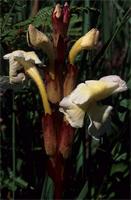
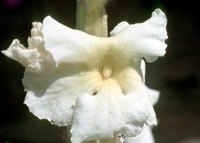
Harveya speciosa

21 Images see all

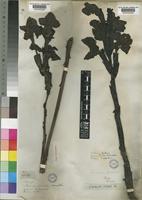
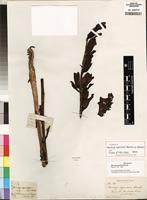
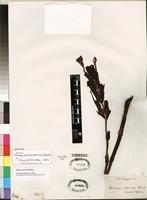
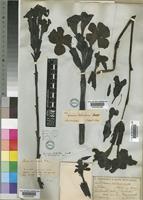
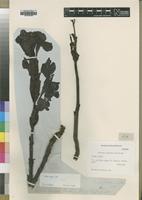
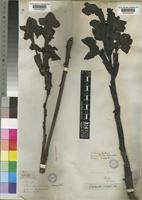
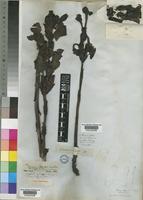
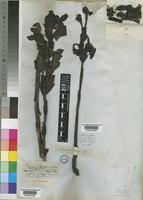
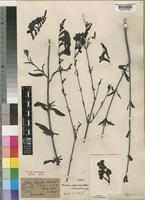
Isotype of Harveya speciosa Bernh. [family SCROPHULARIACEAE]
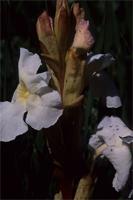
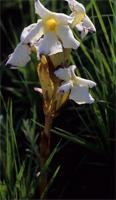
Harveya speciosa
Isotype of Harveya speciosa Bernh. [family SCROPHULARIACEAE]
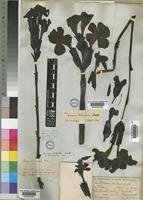
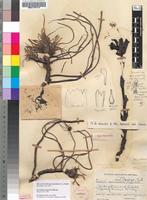
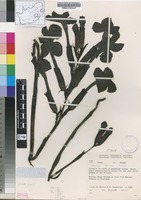
Harveya speciosa Bernh. [family SCROPHULARIACEAE]
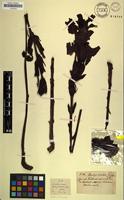
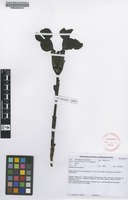
Isotype of Harveya speciosa Bernh. ex Krauss [family SCROPHULARIACEAE]
Harveya speciosa Bernh. [family SCROPHULARIACEAE]
Isotype of Harveya speciosa Bernh. [family SCROPHULARIACEAE]
Harveya speciosa Bernh. [family SCROPHULARIACEAE]
Type of Buchnera speciosa Skan [family SCROPHULARIACEAE]
Harveya speciosa Bernh.
Harveya speciosa Bernh. [family SCROPHULARIACEAE]
Harveya speciosa
Filed as Harveya speciosa Bernh. [family OROBANCHACEAE]
Holotype of Harveya anisodonta C.A.Sm. [family OROBANCHACEAE]
Harveya speciosa
Harveya speciosa Bernh.
Isotype of Harveya speciosa Bernh. [family SCROPHULARIACEAE]
Filed as Harveya speciosa Bernh. [family OROBANCHACEAE]
Harveya speciosa Bernh.
Harveya speciosa Bernh. [family SCROPHULARIACEAE]
Previous
Next

Name

Identification
Harveya speciosa Bernh. [family OROBANCHACEAE ]
Related name
  • Harveya speciosa

Flora

Entry for HARVEYA speciosa Bernh. ex Krauss [family SCROPHULARIACEAE]
Herbarium
Royal Botanic Gardens, Kew (K)
Collection
Flora Capensis
Resource Type
Reference Sources
Entry From
Flora Capensis, Vol 4, page 121, (1904) Author: By W. P. HIERN, F.R.S.
Names
HARVEYA speciosa Bernh. ex Krauss [family SCROPHULARIACEAE], in Flora, 1844, 831
Orobanche tubata E. Meyer ex Drège [family SCROPHULARIACEAE], in Cat. Pl. Exsicc. Afr. Austr. 4, and Zwei Pflanzengeogr. Documente, 145, 205.
Harwaya tubata Hook. ex Steud. [family ], Nomencl. Bot. ed. 2, i. 723.
Harveya speciosa Bernh. [family SCROPHULARIACEAE], in Flora, 1844, 831.
Cycnium tubatum Benth. [family SCROPHULARIACEAE], in DC. Prodr. x. 505; Harv. Thes. Cap. i. 32, t. 50.
Harveya tubata Reuter [family SCROPHULARIACEAE], in DC. Prodr. xi. 38.
Information
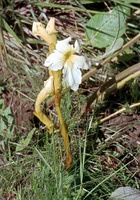
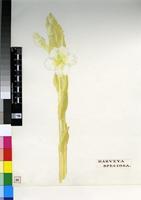
an erect herb, sometimes decumbent at the base, glabrous or nearly so, 2/3–3 1/2 ft. high, parasitical, dusky when dried; stem simple, obtusely angular when fresh, furrowed when dry, usually erect or sinuous-erect; leaves all scale-like, opposite or alternate, not numerous, ovate or oblong, obtuse or scarcely acute, somewhat narrowed at the sessile base, concave and adpressed, entire, 1/2–1 1/4 in. long, 1/6– 2/5 in. broad; flowers racemose, subspicate, on short pedicels in the axils of the bracts, 2–3 1/2 in. long; pedicels up to 5/8 in. long or less, bibracteolate above the middle; bracteoles opposite, free from the calyx, linear or nearly so, 2/3–1 1/4 in. long; calyx campanulate-oblong, loose, veined, 10-nerved, not ribbed, 1–1 1/2 in. long, shortly 5-lobed; tube subcylindrical above the campanulate base, 1/3– 1/2 in. in diam.; lobes deltoid or ovate, 1/8– 1/4 in. long; corolla-tube subcylindrical, narrowly funnel-shaped and gently curved towards the top, shaggy outside with turgid somewhat viscid hairs, glabrous within below, bearded within about the insertion of the filaments, usually 2–3 in. long, 1/8– 1/4 in. in diam. about the middle, white with yellow throat or cream-coloured; mouth oval, about 3/8 in. long; limb spreading, subvertical, about 2 in. deep and 1 3/4 in. broad; lobes broadly obovate, wavy, 2/3– 7/8 in. long, 2 upper connate rather higher than the rest; stamens glabrous or nearly so, subequal; filaments about 1/6 in. long, inserted about the middle of the corolla-tube; anthers ovate, acute at the base, about 1/6 in. long at the apex with a very short blunt appendage; ovary finely pilose-puberulous, narrowing at the apex into the glabrous flattened style; stigma club-shaped, glandular-puberulous in part, exceeding the stamens, included, turned almost horizontally; capsule ovoid-conical, subcompressed, obsoletely puberulous, about 5/8 in. long, enclosed within the floral envelopes, somewhat fleshy. null
Distribution
CENTRAL REGION Aliwal North Div.; at the foot of the Witte Bergen (distributed as Albert Div.), Cooper, 624!COAST REGION Stockenstrom Div.; mountain slopes, Benholm, Scully, 374! Bedford Div.; summit of Kaga Berg, 3200 ft., MacOwan, 519! Kaffraria, Brownlee! Eastern Frontier, Hutton!EASTERN REGION , ascending from 50 to 5000 ft.: Transkei; between Gekau (Geua) River and Bashee River, Drège! Tembuland; near Cala, in the Xalanga district, Bolus, 8754! Griqualand East, near Clydesdale, Tyson, 2014! Natal; near the Umlaas River, Krauss, 54! Weenen County, Wood! Inanda, Wood, 387! near Durban, Wood, 4649! Plant, 24! Rehmann, 8819! and without precise locality, Gerrard, 775! Sanderson, Cooper, 1131!KALAHARI REGION Orange River Colony; near Caledon River, Burke, 416! Zeyher, 1279! and without precise locality, Cooper, 984! Transvaal; Umlomati Valley, near Barberton, 4000 ft., Galpin, 1234! Spitz Kop Goldmine, Wilms, 1095!
Notes
In Hooker's Kew Journal, iv. 262, Mr. R. W. Plant in a “Notice of an excursion in the Zulu Country,” referred as follows to a parasite found between the Umsatense and Umgoa Rivers:—“A plant, which I imagine to be an Orobanche (Harveya capensis, Hook. Ic. Plant. t. 118): its habits agree exactly with that parasite; it produces a flower-stem of about a foot in length, bearing five or six very large pure white flowers, averaging about 3 in. in diam.; it is usually found adhering to a thistle.” Possibly it belonged to Harveya speciosa.

Related Materials

  • Terms and Conditions
  • Privacy Policy
  • Cookie Policy
  • Cookie Settings
  • Accessibility
  • Help
  • Contact Us
  • Facebook
  • Twitter
ITHAKA

JSTOR is part of ITHAKA, a not-for-profit organization helping the academic community use digital technologies to preserve the scholarly record and to advance research and teaching in sustainable ways.

©2000-2026 ITHAKA. All Rights Reserved. JSTOR®, the JSTOR logo, JPASS®, Aluka®, and ITHAKA® are registered trademarks of ITHAKA.

╳