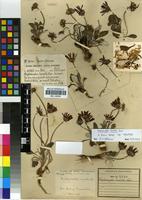
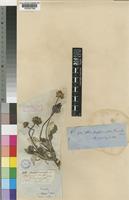
Haplocarpha lanata(Thunb.) Less. [family ASTERACEAE ] (stored under name); Verified by McKenzie, R.J., 2007
Related name
Haplocarpha lanata
Haplocarpha lessingii
Arctotis acaulis
Flora
Entry for HAPLOCARPHA lanata Less. [family COMPOSITAE]
Herbarium
Royal Botanic Gardens, Kew (K)
Collection
Flora Capensis
Resource Type
Reference Sources
Entry From
Flora Capensis, Vol 3, page 44, (1894) Author: (By W. H. HARVEY).
Names
HAPLOCARPHA lanataLess. [family COMPOSITAE], ! Linn. 6, 90;—Less. Syn. p. 36.
HAPLOCARPHA LessingiiDC. [family COMPOSITAE], l. c. 494.
Information
leaves scabrous above, white-woolly beneath, oblong or obovate, acute or obtuse, tapering to the base, subpetiolate, subentire or crenate; pedunc. 2–3 times longer than leaves, hirsute; outer inv. sc. lanceolate, hairy; achenes silky over the whole surface; pappus-scales lance-linear, obtuse or subacute, but not taper-pointed. Rootstock thick and woody. Leaves radical, 2–3 inches long, 3/4–1 1/2 in. wide, very white beneath, thickish. Pedunc. 2–6 inches high. Rays white above, dark purple beneath. E. & Z.'s specimens were confounded by DC. with Arctotis acaulis, var. β; besides the generic characters, they are easily known from that species by the invol.
Distribution
SOUTH AFRICA Platteklip, on Table Mt. Cape, Bergius, E. & Z.! Zey.! 966. (Hb. Sd., Hk.)