

Compilation
Hamamelis macrophylla
2 Images see all
Name
Identification
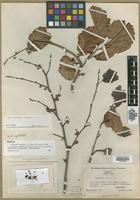
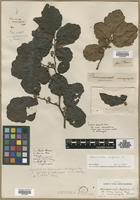
Hamamelis macrophylla Pursh [family HAMAMELIDACEAE ] (stored under name); Verified by Not on Sheet, Hamamelis virginiana L. [family HAMAMELIDACEAE ] Verified by Meyer, F.G., 1992 Hamamelis virginiana L. [family HAMAMELIDACEAE ] Verified by Jenne, G.E., 1965
Related name
- Hamamelis macrophylla
- Hamamelis virginiana
Common name
- Witch-hazel, Flora of North America Vol. 3
- hamémelis, Flora of North America Vol. 3
- café du diable, Flora of North America Vol. 3
Flora
Entry for Hamamelis virginiana Linnaeus [family HAMAMELIDACEAE]
Herbarium
Flora of North America (FNA)
Collection
Flora of North America
Resource Type
Reference Sources
Entry From
Flora of North America, Vol 3,
Names
Hamamelis virginiana Linnaeus [family HAMAMELIDACEAE], Sp. Pl., 1: 124. 1753
Hamamelis androgyna Walter [family HAMAMELIDACEAE]
Hamamelis corylifolia Moench [family HAMAMELIDACEAE]
Hamamelis dioica Walter [family HAMAMELIDACEAE]
Hamamelis macrophylla Pursh [family HAMAMELIDACEAE]
Hamamelis virginiana var. angustifolia Nieuwland [family HAMAMELIDACEAE]
Hamamelis virginiana var. orbiculata Nieuwland [family HAMAMELIDACEAE]
Hamamelis virginica Linnaeus var. macrophylla (Pursh) Nuttall [family HAMAMELIDACEAE]
Hamamelis virginica var. parvifolia Nuttall [family HAMAMELIDACEAE]
Trilopus dentata Rafinesque [family HAMAMELIDACEAE]
Trilopus estivalis Rafinesque [family HAMAMELIDACEAE]
Trilopus nigra Rafinesque [family HAMAMELIDACEAE]
Trilopus nigra var. catesbiana Rafinesque [family HAMAMELIDACEAE]
Trilopus parvifolia (Nuttall) Rafinesque [family HAMAMELIDACEAE]
Trilopus rotundifolia Rafinesque [family HAMAMELIDACEAE]
Trilopus virginica (Linnaeus) Rafinesque [family HAMAMELIDACEAE]
Information
Shrubs or small trees, to 6(-10.6) m, suckering, forming dense clumps, not aromatic and resinous. Leaves not persistent in winter; petioles 6-15(-20) mm. Leaf blade broad-elliptic to nearly rounded or obovate, 3.7-16.7 × 2.5-13 cm, base strongly oblique and rounded, sometimes somewhat cuneate and weakly oblique, apex acute to short-acuminate or broadly rounded; surfaces abaxially pale green, not glaucous. Flowers appearing in autumn, faintly fragrant; calyx adaxially yellow-green to yellow; petals pale to deep yellow, rarely reddish, 10-20 mm; staminodes conspicuously dilated. Capsules 10-14 mm. Seeds 5-9 mm. 2n = 24.
Phenology
Flowering fall (Oct-Nov [Dec])
Altitude range
0-1500 m
Distribution
USA Ala.USA Ark.USA Conn.USA Del.USA D.C.USA Fla.USA Ga.USA Ill.USA Ind.USA IowaUSA Ky.USA La.USA MaineUSA Md.USA Mass.USA Mich.USA Minn.USA Miss.USA Mo.USA N.H.USA N.J.USA N.Y.USA N.C.USA OhioUSA Okla.USA Pa.USA R.I.USA S.C.USA Tenn.USA Tex.USA Vt.USA Va.USA W.Va.USA Wis.Canada N.B.Canada N.S.Canada Ont.Canada Que.
Discussion
Hamamelis virginiana exhibits a complex range of variation, not easily reconciled taxonomically, especially in the leaves and flowers. In the northern part of the range, the leaves are larger, averaging 9 × 2.6 cm, the petals are bright yellow, and the plants are normally shrubby. In South Carolina, Georgia, and Florida, the leaves are usually smaller, averaging 6.2 × 4.1 cm, the petals are distinctly pale yellow, and the plants sometimes attain small tree proportions, to 30 cm in trunk diameter. Such plants have been referred to as H. virginiana var. macrophylla. On the Ozark Plateau, H. virginiana and H. vernalis are sympatric. There the petals of H. virginiana are often reddish at the base, indicating the role of hybridization in that part of the range. Infraspecific taxa are not recognized for H. virginiana because no consistently defined pattern of variation or geographic correlation can be identified with this plant.
Hamamelis virginiana was well known as a medicinal plant by Native Americans. Cherokee, Chippewa, Iroquois, Menominee, Mohegan, and Potowatomi tribes used it as a cold remedy, dermatological aid, febrifuge, gynecological aid, eye medicine, kidney aid, and in other ways (D. E. Moerman 1986).
Witch-hazel was subsequently used by the early European settlers in similar ways. A tea of the leaves was employed for a variety of medicinal purposes. The twigs were used as divining rods (water-witching), thus giving the vernacular name to the plant. Modern uses employ both the bark and leaves, and a good demand still exists for the pleasant-smelling water of witch-hazel, derived from the leaves and bark. The products are used in skin cosmetics, shaving lotions, mouth washes, eye lotion, ointments, and soaps.
Hamamelis virginiana is sometimes cultivated, largely for its autumn flowering.
The largest known tree of Hamamelis virginiana, 10.6 m in height with a trunk diameter of 0.4 m, is recorded from Bedford, Virginia (American Forestry Association 1994).