JSTOR Global Plants Home
  • Home
  • Browse
  • About
  • Access
  • Account
    • Saved Items
    • Profile
  • Log in

Global Plants

Skip to Main Content
  • JSTOR Global Plants Home
  • Global Plants

    • Browse
    • About
    • Access
    • Account
      • Saved Items
      • Profile
Log in
  • Browse
  • About
  • Access
  • Account
    • Saved Items
    • Profile
Advanced Search

Compilation
Halostachys occidentalis

3 Images see all

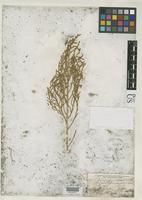
Holotype of Halostachys occidentalis Watson, S. 1871 [family CHENOPODIACEAE]
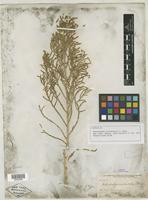
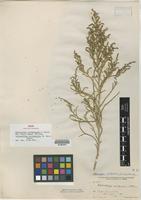
Isotype of Halostachys occidentalis S. Watson [family CHENOPODIACEAE]
Previous
Next

Name

Identification
Isotype of Halostachys occidentalis S. Watson [family CHENOPODIACEAE ] (stored under name); Verified by Not on sheet,
Related name
  • Allenrolfea occidentalis
  • Halostachys occidentalis

Flora

Entry for Allenrolfea occidentalis (S. Watson) Kuntze [family CHENOPODIACEAE]
Herbarium
Flora of North America (FNA)
Collection
Flora of North America
Resource Type
Reference Sources
Entry From
Flora of North America, Vol 4,
Names
Allenrolfea occidentalis (S. Watson) Kuntze [family CHENOPODIACEAE], Revis. Gen. Pl., 2: 546. 1891
Halostachys occidentalis S. Watson [family CHENOPODIACEAE], Botany (Fortieth Parallel), 293. 1871
Treatment Author(s)
Leila M. Shultz
Information
Plants 3–15 dm, ± glaucous. Stems woody proximally, fleshy distally; articulations (joints) (2–)3–5(–10) × 1–4.5 mm. Leaves deciduous; blade 2–4 × 2–3 mm. Inflorescences 6–25 × 2.5–4 mm. Utricles enclosed by perianth. Seeds ca. 0.6 mm.
Phenology
jun-aug (summer), sep-nov (fall)
Altitude range
1000–1700 m;
Distribution
Mexico.USA Ariz.USA Calif.USA IdahoUSA N.Mex.USA Nev.USA Oreg.USA Tex.USA Utah
Discussion
A dominant shrub of salt playas and mudflats in the American Southwest, iodine bush is easily distinguished from great distances by the dark hue of its stems. The blackish-colored shrubs stand in stark contrast to surrounding vegetation and on close examination can be easily distinguished from the opposite-branched, but vegetatively similar members of Sarcocornia.

Related Materials

  • Terms and Conditions
  • Privacy Policy
  • Cookie Policy
  • Cookie Settings
  • Accessibility
  • Help
  • Contact Us
  • Facebook
  • Twitter
ITHAKA

JSTOR is part of ITHAKA, a not-for-profit organization helping the academic community use digital technologies to preserve the scholarly record and to advance research and teaching in sustainable ways.

©2000-2026 ITHAKA. All Rights Reserved. JSTOR®, the JSTOR logo, JPASS®, Aluka®, and ITHAKA® are registered trademarks of ITHAKA.

╳